B Dorian mode backing track

Kerry Brown

Ambassador of the Great Northern Bar Jams
Country flag
Based on the comments from my last backing track post I'm trying to develop something a little more interesting. This is just the first part. There will be another part and a bridge. This part goes | Bm | Bm | D | A | E | E | Is this something people could play to? I struggled trying to play lead to it but lead is not my thing. Should I continue on with this one or scrap it and start over? Thanks for any comments. Be honest. If it's no good tell me.

 
Based on the comments from my last backing track post I'm trying to develop something a little more interesting. This is just the first part. There will be another part and a bridge. This part goes | Bm | Bm | D | A | E | E | Is this something people could play to? I struggled trying to play lead to it but lead is not my thing. Should I continue on with this one or scrap it and start over? Thanks for any comments. Be honest. If it's no good tell me.

B minor is the key of D.

1629590962042.png
 
B minor is the key of D.

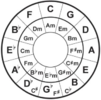
View attachment 72380
Yes Bm is the relative minor of D. In this case I believe I am playing in the B Dorian mode which uses the same scale as A major with a focus on Bm Maybe I should change the title to B Dorian. The chords in B Dorian are Bm C#m D E F#m G#* A

Edit: I changed the title of the thread to B Dorian mode.
 
Last edited:
Yes Bm is the relative minor of D. In this case I believe I am playing in the B Dorian mode which uses the same scale as A major with a focus on Dm. Maybe I should change the title to D Dorian. The chords in B Dorian are Bm C#m D E F#m G#* A

In one sense you could call it the key of F#m. You‘re starting on the iv chord, and never playing the i chord, but that’s okay. There’s no rule that says you have to start on the root chord of a key signature or even play the root chord of a key signature in any given composition.

If you were writing this in standard notation you would have to give it a key signature. If you used Bm, every instance of the E chord would have an accidental (the G#). If you used the key signature of F#m, there would be no accidentals.

Now, I realize there is a bit of disagreement among some opinions on the internet about how to treat this, but I believe an understanding of what a mode really is helps clear it up.

A mode is not something unique and separate from a scale. It is simply a different starting point on the scale; it is a mode of that scale. The key signature provides information about that scale, regardless of where you start playing it.

Keep in mind, every key signature has seven modes. We already express two of those modes with a common key signature. The major key is the Ionian mode and the minor key is the Aeolian mode, but it’s the same key signature.

I realize the dilemma you’re considering. The piece does not have its tonal center in either F#m or A major, so there is the temptation to call it something else. But, regardless, B Dorian is still just the second mode of the same scale that is expressed by the A or F#m key signature.

If you were going to change the title you should call it what it is: B Dorian. If you were going to write this in musical notation, you should use the same key signature as used for F#m or A major and make a note in the music that it is B Dorian.

Don‘t call it D Dorian because that isn‘t what it is. D Dorian includes the exact same notes as the C major scale (C Ionian).
 
In one sense you could call it the key of F#m. You‘re starting on the iv chord, and never playing the i chord, but that’s okay. There’s no rule that says you have to start on the root chord of a key signature or even play the root chord of a key signature in any given composition.

If you were writing this in standard notation you would have to give it a key signature. If you used Bm, every instance of the E chord would have an accidental (the G#). If you used the key signature of F#m, there would be no accidentals.

Now, I realize there is a bit of disagreement among some opinions on the internet about how to treat this, but I believe an understanding of what a mode really is helps clear it up.

A mode is not something unique and separate from a scale. It is simply a different starting point on the scale; it is a mode of that scale. The key signature provides information about that scale, regardless of where you start playing it.

Keep in mind, every key signature has seven modes. We already express two of those modes with a common key signature. The major key is the Ionian mode and the minor key is the Aeolian mode, but it’s the same key signature.

I realize the dilemma you’re considering. The piece does not have its tonal center in either F#m or A major, so there is the temptation to call it something else. But, regardless, B Dorian is still just the second mode of the same scale that is expressed by the A or F#m key signature.

If you were going to change the title you should call it what it is: B Dorian. If you were going to write this in musical notation, you should use the same key signature as used for F#m or A major and make a note in the music that it is B Dorian.

Don‘t call it D Dorian because that isn‘t what it is. D Dorian includes the exact same notes as the C major scale (C Ionian).
It was a typing mistake. I fixed it. My last backing track was in in D Dorian :) Yes, the key signature would be A. I understand modes but my fingers type too fast sometimes. The progression so far: ii ii IV I V V. The second part will change it up. The bridge will be IV V IV V
 
Interesting.

At this point, I’d say this is straight up in the key of A.
It is ambiguous. It starts on Bm but ends on A. It didn’t sound right to me ending on Bm. It doesn’t really matter though as B Dorian and A major use the same notes. I just realized I wrote the chords wrong. I played the G# diminished as G# diminished 7. Also just found out my iPad doesn’t have the symbol for diminished :(
 
In one sense you could call it the key of F#m. You‘re starting on the iv chord, and never playing the i chord, but that’s okay. There’s no rule that says you have to start on the root chord of a key signature or even play the root chord of a key signature in any given composition.

If you were writing this in standard notation you would have to give it a key signature. If you used Bm, every instance of the E chord would have an accidental (the G#). If you used the key signature of F#m, there would be no accidentals.

Now, I realize there is a bit of disagreement among some opinions on the internet about how to treat this, but I believe an understanding of what a mode really is helps clear it up.

A mode is not something unique and separate from a scale. It is simply a different starting point on the scale; it is a mode of that scale. The key signature provides information about that scale, regardless of where you start playing it.

Keep in mind, every key signature has seven modes. We already express two of those modes with a common key signature. The major key is the Ionian mode and the minor key is the Aeolian mode, but it’s the same key signature.

I realize the dilemma you’re considering. The piece does not have its tonal center in either F#m or A major, so there is the temptation to call it something else. But, regardless, B Dorian is still just the second mode of the same scale that is expressed by the A or F#m key signature.

If you were going to change the title you should call it what it is: B Dorian. If you were going to write this in musical notation, you should use the same key signature as used for F#m or A major and make a note in the music that it is B Dorian.

Don‘t call it D Dorian because that isn‘t what it is. D Dorian includes the exact same notes as the C major scale (C Ionian).

Smart guys...I don't understand any of this. I only know that I play the way I want the emotion of the song conveyed and engineers will generally tell me what they want in terms like "make it sound angry/sad/troubled/worried, etc.
 
Smart guys...I don't understand any of this. I only know that I play the way I want the emotion of the song conveyed and engineers will generally tell me what they want in terms like "make it sound angry/sad/troubled/worried, etc.
That’s how I think of modes, emotions. Each mode has an emotion or feel to it. Dorian is generally a melancholy mode. Not really sad but not happy either. That said there are some rocking Dorian mode songs, Oye Como Va, Evil Ways, Moondance, Eleanor Rigby, Last Dance With Mary Jane.
 
That’s how I think of modes, emotions. Each mode has an emotion or feel to it. Dorian is generally a melancholy mode. Not really sad but not happy either. That said there are some rocking Dorian mode songs, Oye Como Va, Evil Ways, Moondance, Eleanor Rigby, Last Dance With Mary Jane.

I don't know any scales by name. All I know how to do is connect notes that blend with the song's key and then convey an emotion.
 
I envy that ability. I don’t have the ear to do that. It is a gift. For me without knowing some theory I’d be lost.

You are indeed blessed to be able to grasp theory. It never made sense to me...and I couldn't stop playing long enough (earning a living) to devote enough time to learning it.

My Mom showed me some basic chords and gave me a Mel Bay Photo Chord Book,, but I never had any lessons. I just started out playing along to 45's and LP's.

When we started our first garage band in 1979, we would hear songs on the radio and learn them so we could set up in the quad at school and perform them the next day. Often we would play during assemblies or other school events whenever we could.

So, when I would learn a solo, for example, in the song Back In Black, I just memorize it, but I couldn't tell you what scale pattern it used or even what notes were in the solo...all I knew how to do was replicate what I heard, including vibrato, squeals, pinch harmonics, etc., so all the techniques I learned were from playing along to records.

I didn't start watching guitar lessons on You Toob until 2015.
 
Last edited:
Back
Top