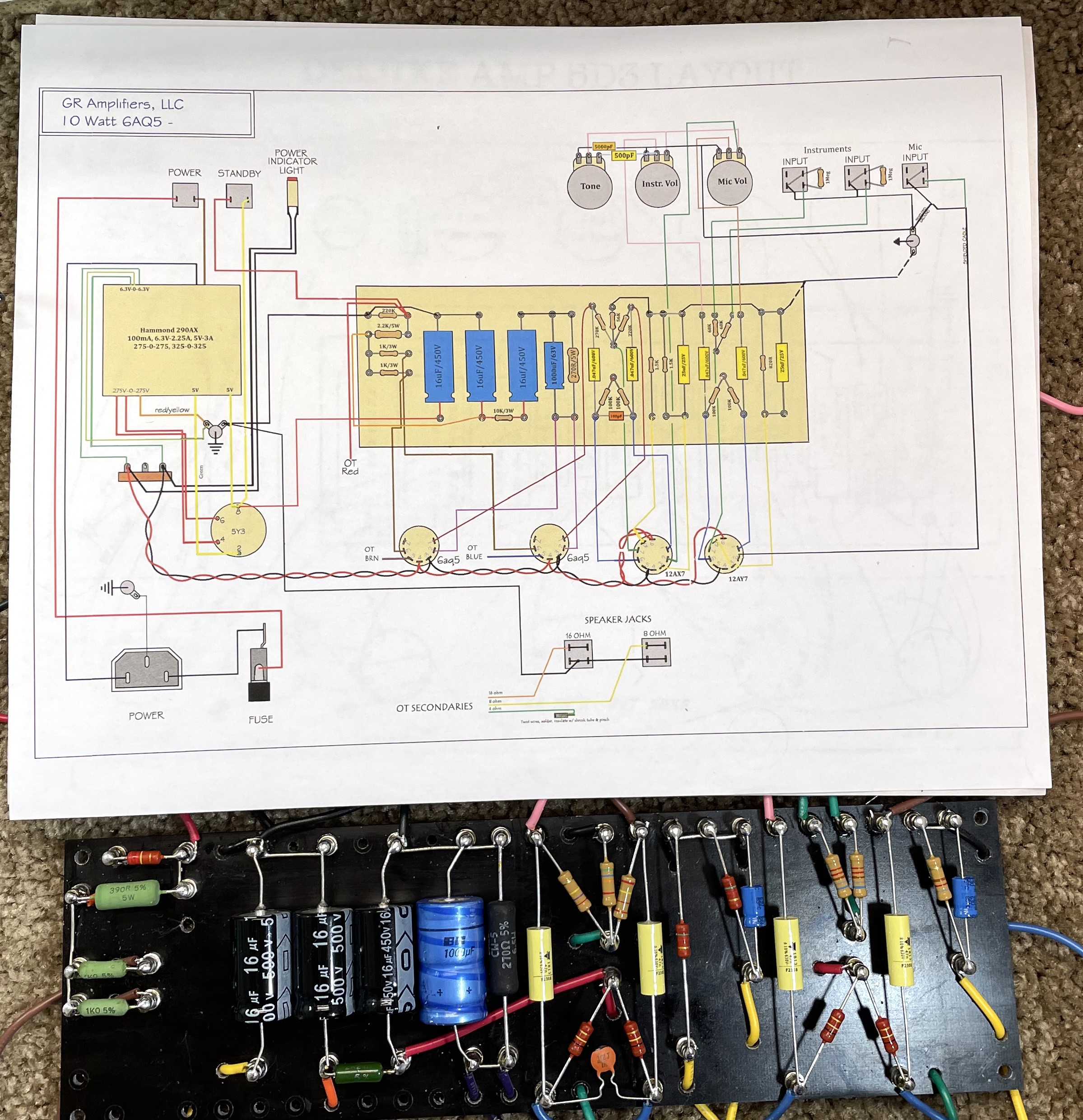
Certainly. Since the preamp up to the power tubes was built as a Tweed 5D3 Deluxe, when that model of Deluxe came out in 1954, it had on the far right as you are looking at the amp face on, a Mic input with no grid stopper and two other Instrument jacks to the left of that Mic input jack. Both of those Instrument jacks had their own " 1 each 1 meg to ground resistor at the jack and a their own each 68K grid stopper".
The idea back then in 1954 was the ability to plug in two different guitars and a microphone to the amp. The Mic input had a separate Volume pot and the two other jacks are combined to a single Instrument Volume pot. Both Volume pots are tied into a Tone pot.
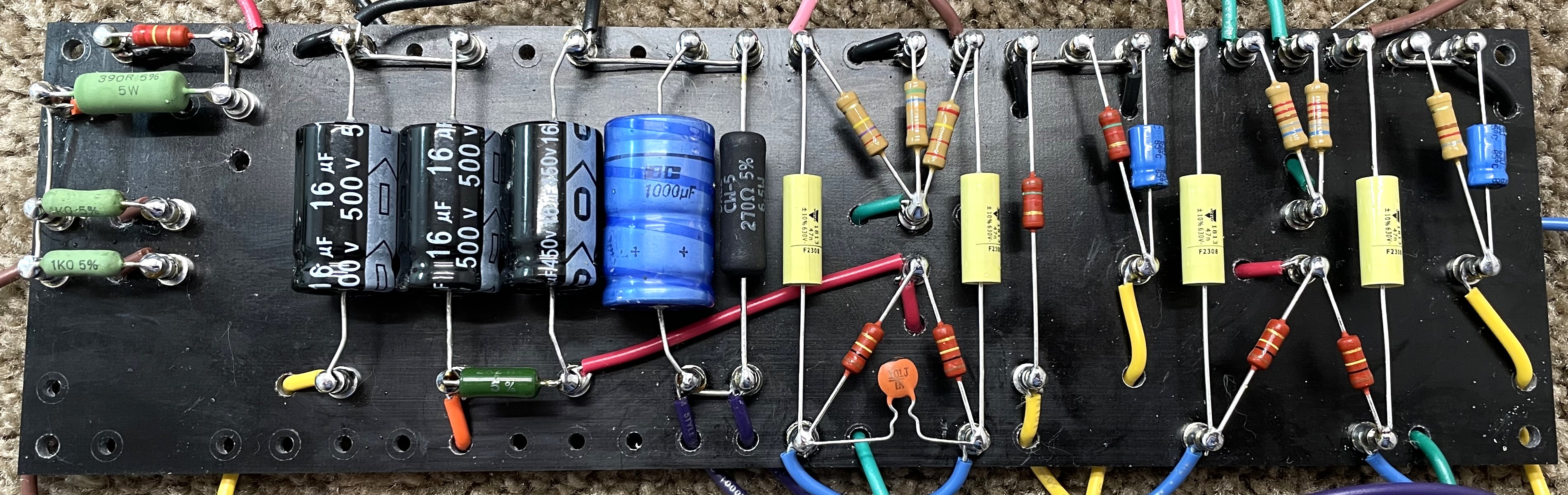
Since we have evolved from "knuckle dragging back in 1954" those input configurations were not of much service to me. I took the Mic input and pot and put a 47K grid stopper on it and left it as a "Normal Channel" (no 1meg to ground). The two other inputs became a Low and a High jack, each with the 68K grid stoppers as per 1954 spec with the High Jack also having the 1meg to ground at the input jack. I revoiced the "Bright channel" coupling cap to a .022uF from the stock .047uF cap. Bear in mind both triodes are shared bypass cathode as in a Marshall JTM45.
This allows me a nicer "Bright channel" with a Low/High option, and a good Fender "Normal channel". I can now even channel jump between the two jacks of the Normal and Bright low and blend the two channels together as on a tweed Deluxe 5E3, only with a Brighter option on the second Volume pot.
One may ask why didn't I just build a 5E3 Tweed Deluxe preamp then instead. My reason is the 5D3 Deluxe and the 5D5 Pro were the only two amps that Fender built with the 12ax7 as a floating paraphase phase invertor. To invert the signal for the other power tube required a gain stage, but you can't have one inverted signal higher that the other going to the power tubes. If looking at a schematic at first glance it looks like a long tailed pair PI, but it is not. Thus the designed floating paraphase PI. I think the tone has a unique quality.