
You are using an out of date browser. It may not display this or other websites correctly.
You should upgrade or use an alternative browser.
You should upgrade or use an alternative browser.
Another Marshall SLX issue - no heater voltage on one socket?
- Thread starter AndyK
- Start date


Great news!!!

ninjaking67
Ambassador of Good Will

Glad you got it sorted out. Now, play it LOUD!:dood:

Amp Mad Scientist
Ambassador of Heresy
I have seen people rip the circuit board to shreds...As I previously said, I'm unfamiliar with these amps, but this here makes perfect sense. As electrolytic capacitors age, the electrolyte dries out, ESR, leakage current etc goes up, so that bridge rectifier has to work harder. Spikes aren't the problem, it's a 1A rectifier so has been surge tested at about twice that. It can safely supply 1A, so supplying 900mA for the filaments isn't a problem. The extra current continuously drawn by an old, out of spec electrolytic capacitor would be a problem. Cheers
trying to modify BR3.
And most of the time BR3 is working fine doesn't need to be replaced.
I don't know who started this, but it was poor advice.
Amp Mad Scientist
Ambassador of Heresy
But you "should" replace the filter caps.Got the amp back from Fuchs! He did the following:
Re-solder heater wires to tube socket due to cracked solder joint(s)
Re-solder and clean impedance switch (it was cutting in and out)
Re-bias
The amp works perfectly now! I guess if I had better analytic/testing skills, I could have done all this for free, but it was worth it to have it gone over and fixed by a pro for peace of mind.
Glad to know it WASN'T one of my repairs that caused the issues!
In these units the filter caps die early / were not long life caps to start with.

syscokid
Ambassador of War & Peace
Pics are always welcomed here...Every filter cap was replaced. And the bias caps, C8, 9, and 10.
Interesting, Fuchs bridged pin 2 and 7 on V5 to 2 and 7 on V6? Wonder why?

I always end up emailing them to myself…choosing to send the “large” version…The pics from my iPhone are always too large for this site.
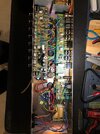
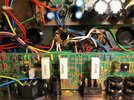
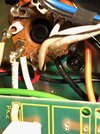
syscokid
Ambassador of War & Peace
Yes... like this:Also, the black wire on pin 1 and 8 - would I insert a 1-ohm resistor there to be able to measure bias?
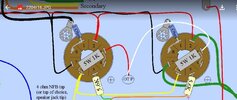
Notice that one end of the 1 ohm bias sensor resistor is going to ground. These bias sensor resistors need to be metal films with at least 1% tolerance.
But IMO, I think those poor power tube sockets have been through too much molestation already. Bias sensing tube socket adapters would be a simpler and safer approach. These adapters already have those 1 ohm sensor resistors inside them.
Or, learn to bias without those sensor resistors. Which will be a little more dangerous and involve more measurements and calculations.
Yes... like this:
View attachment 86610
Notice that one end of the 1 ohm bias sensor resistor is going to ground. These bias sensor resistors need to be metal films with at least 1% tolerance.
But IMO, I think those poor power tube sockets have been through too much molestation already. Bias sensing tube socket adapters would be a simpler and safer approach. These adapters already have those 1 ohm sensor resistors inside them.
Or, learn to bias without those sensor resistors. Which will be a little more dangerous and involve more measurements and calculations.
Interesting....
OP

AndyK
Active Member
I have a Eurotubes bias probe socket adapter that measures MA, and the amp doesn't like it. All I get is buzz and no readings. I'm thinking the 1-ohm resistor method may work better, measuring MV.
Also, the wire joining pins 1 and 8 goes to ground somewhere, but there is no actual ground lug like in most JCM800's. So I would attach the resistor to the socket, cut the black wire and splice it to the other end of the resistor, if that makes sense.
Also, the wire joining pins 1 and 8 goes to ground somewhere, but there is no actual ground lug like in most JCM800's. So I would attach the resistor to the socket, cut the black wire and splice it to the other end of the resistor, if that makes sense.
syscokid
Ambassador of War & Peace
When was the last time you tried your Eurotubes bias probe socket adapter? Before your amp was fixed? If the adapter is not faulty, then you should be able to get proper readings with no buzzing. Even with your meter set to read mA's, you will still get the same readings with the meter set to read mV's. Try it again with the adapter. If you're still having problems, either the adapter and meter were connected wrong or the adapter is faulty.I have a Eurotubes bias probe socket adapter that measures MA, and the amp doesn't like it. All I get is buzz and no readings. I'm thinking the 1-ohm resistor method may work better, measuring MV.
Maybe a pic of your meter?
Yes.Also, the wire joining pins 1 and 8 goes to ground somewhere, but there is no actual ground lug like in most JCM800's. So I would attach the resistor to the socket, cut the black wire and splice it to the other end of the resistor, if that makes sense.

67plexi
Ambassador of Amps
The 1 ohm resistor is not accurate for setting bias and to be honest I'm more concerned on cross over distortion on the PI
so on my 50 watt ODS amps 470 VDC on the plates and -34mA bias with a 5K trimmer on the PI to adjust or fine tune the cross over distortion
I tend to set bias on the colder side for longer tube life
This video may help.
so on my 50 watt ODS amps 470 VDC on the plates and -34mA bias with a 5K trimmer on the PI to adjust or fine tune the cross over distortion
I tend to set bias on the colder side for longer tube life
This video may help.
syscokid
Ambassador of War & Peace
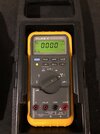
That's a very nice Fluke meter you got there.I tried the adapter yesterday. Could be a faulty one I guess. Here is my meter-
I just researched the Eurotubes bias probe socket adapter, and it does not use a 1 ohm resistor. As you have said, it measures current only. Therefore the adapter must be breaking the circuit. I'm assuming the adapter socket has to be fully connected to the amp's socket and to the power tube, and the adapter's leads have to be connected to the meter. The meter should be set to its mA socket and turned on before the amp is turned on. Is this the way you've been setting it up?
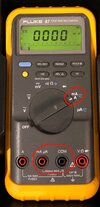
If I would have known that the Eurotubes bias socket adapter measures current only by breaking the circuit, I would have invested in a pair of those a long time ago!
syscokid
Ambassador of War & Peace
Are you adjusting this with an O-scope, or your ears?I'm more concerned on cross over distortion on the PI
so on my 50 watt ODS amps 470 VDC on the plates and -34mA bias with a 5K trimmer on the PI to adjust or fine tune the cross over distortion
OP
AndyK
Active Member
Thanks.I got the meter on ebay about 10 years ago! And yes, that's the way I've been trying the probe.
The tube goes all the way into the adapter socket, and the socket fits the amp socket fine. I turn the meter on, turn the amp on, and when I turn the standby to on, it makes a noise, and the bias reading says 13, no matter how I turn the trimmer pot. So, something ain't right.
When I first got the amp this summer, it had old tubes, and when I used another Eurotubes bias probe (the deluxe version with LCD display) a similar thing happened, where the bias read 10, or so, and it made noise. Like an idiot, I tossed the probe and bought this simple one, thinking the first probe died.
The tube goes all the way into the adapter socket, and the socket fits the amp socket fine. I turn the meter on, turn the amp on, and when I turn the standby to on, it makes a noise, and the bias reading says 13, no matter how I turn the trimmer pot. So, something ain't right.
When I first got the amp this summer, it had old tubes, and when I used another Eurotubes bias probe (the deluxe version with LCD display) a similar thing happened, where the bias read 10, or so, and it made noise. Like an idiot, I tossed the probe and bought this simple one, thinking the first probe died.
Last edited: