Another Marshall SLX issue - no heater voltage on one socket?

AndyK

Active Member
Country flag
Hey-

I've been repairing, upgrading my new to me '93 SLX 2500. I replaced all the relevant filter caps, BR3 (hard wired due to burned traces), new FX jacks, new volume pots.
When I fired up the amp (on standby), only one power tube lights. Swap tubes, same V5 socket doesn't light. Turns out I measure 1 vac at that socket, 7 vac at the one that's working.

What to check/do next??
 
Hey-

I've been repairing, upgrading my new to me '93 SLX 2500. I replaced all the relevant filter caps, BR3 (hard wired due to burned traces), new FX jacks, new volume pots.
When I fired up the amp (on standby), only one power tube lights. Swap tubes, same V5 socket doesn't light. Turns out I measure 1 vac at that socket, 7 vac at the one that's working.

What to check/do next??
I have the same exact amp down to the model and year and have been PLAGUED with issues on it. When it works it's amazing but it's got more bugs than a Bangkok hostel.

Mine did the BR3 thing as well and C8 capacitor along with every pot going bad. Have changed every single capacitor that should be changed and yet I got issues from the heater circuit producing far too much resistance and thus choking voltage which incidentally increases the amperage and blows out fuses and tubes
 
I think I may have solved the problem. I put in fast blow fuses, instead of timed! Probably blew the new fuse as soon as it turned on! Ordered the right fuses today.
hopefully that works for you, just bear in mind that sometimes a slow blow fuse will allow unwanted inrush and could damage circuits.

But, I'm sure to the best of their abilities, a few of our resident amp gurus and tech savvy fellows can help you out! Between @Amp Mad Scientist , @syscokid , @ivan H , @T-Rex , @NewReligion , @jtcnj , @Inspector #20, @Jethro Rocker and @SG John all can offer some extremely valuable advice. Some of these guys roaming around here are among the best I've ever seen
 
I think I may have solved the problem. I put in fast blow fuses, instead of timed! Probably blew the new fuse as soon as it turned on! Ordered the right fuses today.
I took a quick look at this amp's power supply schematics and some internet pics of the rear faceplates. Nowhere does it say to use slo-blow fuses. I've been under the assumption that if the schematic and rear faceplate's description does not show the word: slo-blow, then use only regular timed fuses. I wish I could help more, but I don't know anything about these type of Marshalls. Hopefully others will reply with better help.
 
I took a quick look at this amp's power supply schematics and some internet pics of the rear faceplates. Nowhere does it say to use slo-blow fuses. I've been under the assumption that if the schematic and rear faceplate's description does not show the word: slo-blow, then use only regular timed fuses. I wish I could help more, but I don't know anything about these type of Marshalls. Hopefully others will reply with better help.
This particular amp has a bit of a history with heat issues burning up various key components, namely the BR3 bridge Rectifier and C8 capacitor damn near going out on any one I ever heard of, including mine lol

There were other reports of charring happening on the boards and rendering them brittle, as well as heater circuit issues going on in the power tubes, namely too much resistance that choked down the voltage and ramped up the amperage and would blow fuses and even tubes ( mine is a victim of this one as well).

I know @Amp Mad Scientist has a pretty good bit of experience in this particular model and helped me out over at the Marshall Forums years ago with some of the issues previously mentioned. So you might wanna hit him up @AndyK !

It's a fine amp with tons of gain and an incredible old school hotrodded JCM800 2204 sound straight from the factory. But it unfortunately came with some issues
 
Ok, bearing in mind that I'm not too familiar with the 900's (& later) amps, I'll still attempt suitable queries.
Firstly, being that the filament supply is linked "daisy chain" style from valve socket to valve socket, if you have the correct(-ish) filament supply voltage at one power tube socket & the tube filament is lit up, your power transformer's filament winding is ok, so that's something you don't have to worry about.
Have you checked for filament voltage at the V5 socket with no power tubes installed (or at least no tube in the V5 socket)?
While you haven't said that it has blown (either one or both of) the F5 & F6 filament supply fuses, I kinda get the gist that maybe it has (you mention fast blow vs slow blow types etc). Am I correct in assuming it has blown a fuse/fuses??
I'll wait for responses to these two questions before going on with. Cheers
 
Last edited:
Hey-

The fuses are listed as T type, which are "timed" vs. fast blow.

Originally, when I hard wired BR3, one of the wires touched the other, and blew the F5 fuse. I repared the wires, routing them apart from eachother, and installed fast blow fuses, which blew right away.

There was no voltage at the V5 socket, and 7 volts at V6. BUT, the fuse blew for V5. So, I think the no voltage is caused by the blown fuse. The amp wasn't blowing fuses before my lame attempt to hard wire BR3.
 
I think you should be able to use the fast acting fuse with no tubes in the sockets fed by that heater supply, as a trouble shooting baseline.
With no filaments drawing, the circuit should be stable, with no-load voltage across each of the socket filament pins.
If so, the correct slo-blo fuse may be the answer.
If not, the supply circuit has issues.
 
Ok, firstly I'll explain why you need to use "timed" (= Slo-Blo) fuses here;
When cold, the tube filaments have notably higher resistance than they do when hot. So at initial power-up the filament current draw surges briefly. Ever seen that nice bright flash the old production Mullard 12AX7's exhibit at power-up, this is what causes it.
So with that out of the way, I'd best go back & read through the thread properly so I can give correct advice.
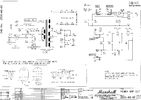
So, here i the JCM900 SLX2500 Power Supply Unit's schematic
16648359896075465629241987910643.gif
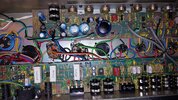
From this, it appears that the power amp tubes (PI included) are AC heater'd, while the pre-amp tubes are DC heater'd. Further, it shows the power amp filament supply is applied to the PI (V4) tube socket & from there connects to the power tube sockets (V5 then V6). Being that I'm not familiar with "post JCM800" amps, I checked a few 2500 SLX gutshots to confirm this, & here's a gutshot where this can be seen.
16648619996773399439546249085280.jpg
So we can see the red & black filament leads coming from the 'board to the PI (V4), from there on to the first power tube socket (V5) & then the next power tube socket (V6), in the normal "twisted leads" daisy chain fashion.
So V5 is the socket reading 1VAC, while the V4 PI socket & the V6 socket have 7VAC(?) & their tubes light up.
The thing is, for the filament current to get from V4 to V6, it has to come via the V5 socket, as their filament leads are linked there (at V5).
So there's a few possibilities as to what the problem may be, but, you say you previously created a short that blew the filament fuses,,, can you take a close look at the V5 socket (well lit & possibly using something like a jewelers loupe or similar magnifier). Look say, between pins 2 & 1, or pins 7 & 8, looking for "carbon tracking" between them. I'll wait to hear the results. Cheers
 
Last edited:
Ok, firstly I'll explain why you need to use "timed" (= Slo-Blo) fuses here;
When cold, the tube filaments have notably higher resistance than they do when hot. So at initial power-up the filament current draw surges briefly. Ever seen that nice bright flash the old production Mullard 12AX7's exhibit at power-up, this is what causes it.
So with that out of the way, I'd best go back & read through the thread properly so I can give correct advice.
So, here i the JCM900 SLX2500 Power Supply Unit's schematic
View attachment 86295
From this, it appears that the power amp tubes (PI included) are AC heater'd, while the pre-amp tubes are DC heater'd. Further, it shows the power amp filament supply is applied to the PI (V4) tube socket & from there connects to the power tube sockets (V5 then V6). Being that I'm not familiar with "post JCM800" amps, I checked a few 2500 SLX gutshots to confirm this, & here's a gutshot where this can be seen.
View attachment 86297
So we can see the red & black filament leads coming from the 'board to the PI (V4), from there on to the first power tube socket (V5) & then the next power tube socket (V6), in the normal "twisted leads" daisy chain fashion.
So V5 is the socket reading 1VAC, while the V4 PI socket & the V6 socket have 7VAC(?) & their tubes light up.
The thing is, for the filament current to get from V4 to V6, it has to come via the V5 socket, as their filament leads are linked there (at V5).
So there's a few possibilities as to what the problem may be, but, you say you previously created a short that blew the filament fuses,,, can you take a close look at the V5 socket (well lit & possibly using something like a jewelers loupe or similar magnifier). Look say, between pins 2 & 1, or pins 7 & 8, looking for "carbon tracking" between them. I'll wait to hear the results. Cheers
Top friggin notch!!
 
Back
Top