Amp Gain staging question

Ghostman

Ambassador of the SuperNatural
Country flag
Tech question I'm hoping our brain trust can point in a general direction to the answer:

An amp has two channels: Clean, and overdrive. If the Clean channel runs through two stages of gain (1-12AX7) and the overdrive runs through five stages (2 1/2 - 12AX7s) how can the Clean channel be way louder than the overdrive channel?

I've run the stage gains through the calculator I found online and each stage has relatively the same amount of gain, around 60-75. The calculator is unloaded which definitely effects the next stage, but how would someone calculate what each stage gain would ultimately be?

In the above scenario, the clean and overdrive channels both run into the same power amp.

I'm considering building a custom amp from a schematic that I'm deciphering at the moment, but this is a big issue with the "prototype" real production model.
 
Tech question I'm hoping our brain trust can point in a general direction to the answer:

An amp has two channels: Clean, and overdrive. If the Clean channel runs through two stages of gain (1-12AX7) and the overdrive runs through five stages (2 1/2 - 12AX7s) how can the Clean channel be way louder than the overdrive channel?

I've run the stage gains through the calculator I found online and each stage has relatively the same amount of gain, around 60-75. The calculator is unloaded which definitely effects the next stage, but how would someone calculate what each stage gain would ultimately be?

In the above scenario, the clean and overdrive channels both run into the same power amp.

I'm considering building a custom amp from a schematic that I'm deciphering at the moment, but this is a big issue with the "prototype" real production model.
Need the schematic.
Typically it's actually a one channel preamp that changes configuration, and they call it "two channel."

The "boost" is typically reduced since the distortion makes the amp much louder.
But the amount of reduction may be too much.
So what you need to do is look at the channel switching method and see what reduces the boost mode.
 
Need the schematic.
Typically it's actually a one channel preamp that changes configuration, and they call it "two channel."

The "boost" is typically reduced since the distortion makes the amp much louder.
But the amount of reduction may be too much.
So what you need to do is look at the channel switching method and see what reduces the boost mode.

Does it ever have anything to do with headroom? I've noticed this phenomenon on a few amps I have owned as well but I always thought it kind of sounded like the dirty channel was more compressed from the additional gain and therefore I was perceiving the volume to be different.
 
Does it ever have anything to do with headroom? I've noticed this phenomenon on a few amps I have owned as well but I always thought it kind of sounded like the dirty channel was more compressed from the additional gain and therefore I was perceiving the volume to be different.
In this amp, the Clean channel is WAY louder than the gain channel. Clean volume 2 is the same as gain volume 8.
 
Need the schematic.
Typically it's actually a one channel preamp that changes configuration, and they call it "two channel."

The "boost" is typically reduced since the distortion makes the amp much louder.
But the amount of reduction may be too much.
So what you need to do is look at the channel switching method and see what reduces the boost mode.
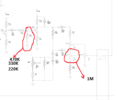
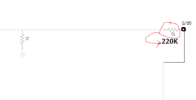
I'm working on the schematic, but you are correct. Input channel feeds the first stage of the V1, and then gets split via the channel switching. On the Clean channel, it goes to the second stage of V1 and then to the power section. The Gain channel, gets two more 12AX7's for four more stages, and then back into the Power section.

The channel switching is modern but straight forward with Opto-couplers doing the heavy lifting.
 
I drew up my Schematic in CAD to clean up the factory schematic I have. I've also added the gain channel mods I have already performed in this production amp.

It's my Crate BV120H that I really enjoy the sound of now. However, I'm considering building an amp and would like to spend this year planning out the build. I do not want to build a run-of-the-mill Marshall or Fender, so this is where I'm starting.

I'm going to take the BV120 Preamp, figure out if I like the Effects Loop designed in this, and then look into the power section last. I think building this in discreet circuitry, turret board style with proper components could be a bad ass amp.
 

Attachments

The Schematic has the switching but I am only going to build the Lead Channel, no clean.

Eww. clean.

tahLoKB.gif
 
I drew up my Schematic in CAD to clean up the factory schematic I have. I've also added the gain channel mods I have already performed in this production amp.

It's my Crate BV120H that I really enjoy the sound of now. However, I'm considering building an amp and would like to spend this year planning out the build. I do not want to build a run-of-the-mill Marshall or Fender, so this is where I'm starting.

I'm going to take the BV120 Preamp, figure out if I like the Effects Loop designed in this, and then look into the power section last. I think building this in discreet circuitry, turret board style with proper components could be a bad ass amp.

volume1.png

volume 2.png
 
Thanks AMS! I knew you guys would be able to point to some things. I ordered a book yesterday and received it today about tube amp designs, and the one thing I forgot from my old Electronic days was the stage coupling voltage dividers. Each stage gets attenuation from the voltage dividers.

I'm going to experiment some this coming week with tweaks. :)
 
Thanks AMS! I knew you guys would be able to point to some things. I ordered a book yesterday and received it today about tube amp designs, and the one thing I forgot from my old Electronic days was the stage coupling voltage dividers. Each stage gets attenuation from the voltage dividers.

I'm going to experiment some this coming week with tweaks. :)
So each stage actually is attenuated. Huh. Seems a bif too much in that case.
I know compeession can kill some snap that "clean" has. Not that I use that much.
 
My DST Solera is a two channel amp that is basically a 50 watt Hiwatt on one side and a 50 watt Soldano on the other side. The Hiwatt side has such massive headroom, and is really loud. When you switch to the Soldano side, it loses volume and is super compressed. I wrote it off as "Nature of the Beast" regarding the High Gain Soldano sound. If using either channel as a stand alone amp sound, they are both great, and fun to use. But for me, it is best when keeping it on the Hiwatt side. Since my two Hiwatts are both 100 watts, this amp feeds my slightly less loud Hiwatt fix.
 
So each stage actually is attenuated. Huh. Seems a bif too much in that case.
I know compeession can kill some snap that "clean" has. Not that I use that much.
According to some research it's very common for amps to have attenuation after every stage of high gain amps. It keeps the integrity of the signal and according to one book I have if there's no attenuation then, "...it produces a distortion that is unfocused and fizzy."
 
Back
Top