Alright, got a quandary and open to suggestions!

I just went, and reviewed some of my rig expenditures…
I spent through your budget entirely… for my Novo 18 board(there are much cheaper alternatives there though…that would do the job just fine), one (of two) power supply(a must, in my experience), a tiny loop box, and patch cabling…alone.
I used to make all of my own patch cables, and it is a little bit less expensive, but some of the new “flat” cables are pretty darned good space savers…I can’t build them nearly as “low profile”, and it does make a difference as far as available real estate goes.
I could have built the loop box, but I don’t think I would have done as nicely with the size of the one I bought…and it was the least expensive of the above listed stuff.
 
Second: if pedals are what I do end up with ( again not final!) , are there cases where name power is meaningless in certain pedals? What I'm trying to say I guess, is there a difference in EQs or Noise Gates? Obviously, yeah you have parametric vs 6-7-10 band graphic but I mean does one brand sound better than the other?
Sometimes…yes…one of the things I could toss your way would be the noise gate that I can’t stand(but some people really like)..an EHX Silencer. Further on noise gates: I have had, at least, one Boss NS-2 going on in my amp setup for over 30 years now. They work, and work reasonably well. I like being able to control the opening and closing of the gate it offers. It has the Typical Boss buffer though, and my recent fuzz odyssey showed me how that can affect tone. I tried a TC Sentry….problem solved, while retaining even better control over the gate characteristics. I have always read rave reviews about the Decimator line of gates, but never had the opportunity (or willingness to shell out the $$) to try one myself.
Others can chime in on the eq…I haven’t bothered with a dedicated eq pedal…yet.
 
buy yourself line 6 processor. Its great tool i had it but could not make it work for band settings as my bassist plays 3000 watt rig so i could not keep up…

I sold it then i got jcm2000.

I use minimal pedals possible.. still have 9 on board. :rolf: :victoire:
I actually have a line 6 lol but was looking to upgrade from it or change the system entirely
 
Damn!! I thought this was another concert issue.
Oh well!

Ok here is my take.
If $400 is your cap and you have minimal pedals.
By the time for factor the cost of your basic pedals.
For arguments sake. Let’s just go with
An OD of some kind. EQ, a modulation and possibly reverb or delay pedal. Plus a board, cables, power supply. I will guess you will blow past that $400 mark in a hurry.
If you go with something like an HX Stomp or equivalent you will spend more less around the same and have more options to sculpt your sound.

I had that exact same POD. I traded it in because it wouldn’t accept updates anymore (about 2 or 3 years ago) they gave me $100 credit. Plus GC was running a 15% off on new purchases with trade in.
I bought the HX Stomp. And now I have a closet full of pedals I don’t use anymore.

Just checked on a stomp and it’s about $650 new. Figure if you trade in the POD. You could get it for around $500-$550. And you can still hook up pedals you like with it if you wish. Although I don’t know why. But you could.
You are way ahead of me but exactly where I was going liveevile2 (we could be bias toward using it but...)

The Hx Stomp is the Trifecta . Amps, Pedals and it's a interface. All you need is a computer and you are done.
With the recent update it has vastly improved in tones.
All the amps, cabs and pedals have different names but are very much like pedal effects you can buy. But some pedals are way more than your max spending limit.
Of course you can run the stomp through the effects loop with the 4 cable method also.
 
Last edited:
You are way ahead of me but exactly where I was going.

The Hx Stomp is the Trifecta . Amps, Pedals and it's a interface. All you need is a computer and you are done.
With the recent update it has vastly improved in tones.
All the amps, cabs and pedals have different names but are very much like pedal effects you can buy. But some pedals are way more than your max spending limit.
Of course you can run the stomp through the effects loop with the 4 cable method also.
A lot of stuff gets packed into today’s processing units, and they do just fine. I have a Kemper, and it does a great job. I don’t use it as often as I should, but that’s just a convenience thing. If I were at the desk more often than the recliner, it might be a different story. However, I know that I like the whole aspect of building my chain, and tweaking each dedicated box…but that does get expensive….heck!…they both can. The multiprocessor route, today, has a far higher bang for the buck ratio though…for sure. I just don’t like tweaking through the menus as much as the pedal board.
 
I've never understood since the early '90s why someone would need an overdrive pedal. Amps since then have more gain that could ever even be used unless you are the great Ramo! Just go to the high gain channel and forgo the transistor pedal? :unsure:

In my opinion it's was always about a phaser, flanger, chorus, and delay, and non of which I used often. I really just never had any interest anything aside from analog spring reverb. I don't think you're going to want to mess with individual pedals if you never have had the interest up to this point in your life. You're probably more likely to throw one through the window at some point.

You should really think about what you want in the end and then consider what would achieve it best. If you just want some delay maybe a single pedal might be best, whereas if you want an assortment of effects maybe a digital multi effects processor might be best. I'd tread carefully though because if you never got into pedals you may get real bored with them after the honeymoon after-purchase period and after you've dicked with them for a little while.

This would be a cool setup ...

Use a 5 button MIDI controller pedal and assign each button to any effect in a single rack unit. You could arrange your own way. It's neat and compact as well ...

The pedal: https://xsonicaudio.com/products/airstep

The effects unit: https://www.amazon.com/Behringer-Virtualizer-FX2000-High-Performance-Multi-Engine/dp/B003EZXMS0/ref=asc_df_B003EZXMS0

Then you just need a 5 pin MIDI cable if one of the two doesn't come with it already.

Effects included:

Reverbs include:​

  • CATHEDRAL
  • GOLD PLATE
  • SMALL HALL
  • ROOM
  • STUDIO
  • CONCERT
  • STUDIO
  • STAGE
  • SPRING REVERB
  • AMBIENCE
  • EARLY REFLECTIONS

Specialty reverbs include:​

  • REVERB - reverb is synthetically turned off after a predetermined amount of time
  • REVERSE REVERB - reverb envelope is reversed - it slowly gets louder

Delays include:​

  • STEREO DELAY - delay is processed across the entire stereo image
  • TAPE ECHO - simulates classic tape echo devices, pre-dating the advent of digital delays
  • PING PONG - delay signal is "bounced" from left to right at an adjustable tempo

Much More than Just Reverb and Delay​

The FX2000 has some of the best-sounding reverb and delay programs, but that's not all. It also provides excellent modulation effects (such as chorus, flanger and phaser), including special variations like musical pitch shifter, tremolo and even a rotary speaker simulation.

Modulation and Pitch Shifter FX:​

  • STEREO FLANGER (originally generated by playing back two synchronized "reel to reel" tape recorders with a finger rubbing on the flange of one of the take-up reels)
  • VINTAGE FLANGER simulates a guitar fl anger stomp box
  • JET STREAM FLANGER sounds like a classic analog flanger
  • STEREO CHORUS (combines a slightly detuned signal with the original)
  • ANALOG CHORUS simulates a guitar chorus stomp box
  • VINTAGE CHORUS imitates a classic analog studio chorus
  • ULTRA CHORUS creates the sound of an eight person chorus
  • STEREO PHASER (combines a second, phaseshifted signal to the original)
  • VINTAGE PHASER represents a guitar phaser stomp box
  • DUAL PHASER processes the left and right channels separately
  • ROTARY (simulation of the rotating speakers typically used on an organ) - Slow or Fast
  • PITCH SHIFTER (changes the pitch of the original signal) - can be used to create harmonies with the original signal or replace it entirely with the altered pitch. Choices include stereo, two and three vocal pitch shifter
  • VIBRATO - the peak frequency of the tone is periodically and uniformly changed (quickly or slowly)
  • TREMOLO (common vintage guitar amplifier effect) - a fast or slow periodic variation in volume
  • AUTO PANNING - signal is automatically sent from one side of the stereo image to the other, either once or multiple times

Dynamic FX:​

  • COMPRESSOR - reduces the dynamic range of the signal, maintains consistent signal level and thus avoids distortion associated with excessive input levels
  • EXPANDER - effectively broadens the dynamic range of source signals while reducing background noise
  • GATED REVERB - helps reduce background clutter by turning reverb off below a predetermined threshold level. Particularly effective on drum mics and vocals
  • ANA. KOMPR/LIM. - similar to COMPRESSOR but with Limiting functionality
  • ULTRAMIZER - analyses incoming signal and automatically applies compression across two independent frequency bands
  • DENOISER - eliminates or reduces noise and other interference
  • DE-ESSER - reduces or removes sibilance (Ssss sound) from signal
  • WAVE DESIGNER - allows you to influence the envelope by adjusting Attack and Release of the signal

Psychoacoustic FX:​

  • EXCITER - adds artificially generated overtones to the original signal, increasing presence and perceived loudness without significant increase in signal level
  • ENHANCER - functions much like a dynamic pitch equalizer
  • ULTRA BASS - sub-harmonic processor combined with bass exciter and limiter
  • STEREO IMAGER - divides the signal into middle and side signals, allowing individual signals to be amplif ed when desired and placed on the stereo image
  • ULTRA WIDE - creates a broader stereo image
  • BINAURALIZER - also creates a broader stereo image and compensates for crosstalk between both speakers

Filter/EQ FX:​

  • AUTO FILTER - influences the frequency response of a signal. Two filters are included: low pass allows low frequencies to pass and suppresses high frequency content; high pass does the exact opposite
  • LFO FILTER - Controls the rate of oscillation effects
  • PARAMETRIC EQ - allows you to control the bandwidth, frequency and amplitude of a signal
  • GRAPHIC EQ - the sound spectrum is divided into eight (8) adjacent frequency bands, which can be cut or boosted, bandwidth is predetermined

Distortion FX and Amp Simulations​

The FX2000 is also equipped with distortion, amplifier and speaker simulation including VOCAL DISTORTION, TUBE DISTORTION, GUITAR AMP, TRI FUZZ, SPEAKER SIMULATION, RING MODULATOR and LO-FI.

Special FX:​

  • VINYLIZER - adds clicks and/or noise to the signal, reminiscent of old vinyl records and tape machines
  • SAMPLER - allows you to record and playback up to five (5) seconds of program material
  • VOCODER - allows the input signal to modulate another signal (usually a synthesizer sound), creating the familiar "talking synthesizer" effect
  • VOICE CANCELER - removes mono vocal parts from stereo recordings for "instant Karaoke"
  • RESONATOR - simulates and oscillating system that amplifies a specific frequency

Our FX Combinations Go to 11​

Sometimes you want to add a little (or a lot) of color to your reverb and delay patches. The FX2000 allows you to layer modulation effects like chorus, flanger, pitch or tremolo with your reverb or delay selections.

FX Combinations include:​

  • Chorus Reverb
  • Flanger Reverb
  • Leslie Reverb
  • Pitch Reverb
  • Delay Reverb
  • Tremolo Reverb
  • Phaser Reverb
  • Chorus Delay
  • Flanger Delay
  • Pitch Delay
  • Tremolo Delay
 
Last edited:
I've never understood since the early '90s why someone would need an overdrive pedal. Amps since then have more gain that could ever even be used unless you are the great Ramo! Just go to the high gain channel and forgo the transistor pedal? :unsure:

In my opinion it's was always about a phaser, flanger, chorus, and delay, and non of which I used often. I really just never had any interest anything aside from analog spring reverb. I don't think you're going to want to mess with individual pedals if you never have had the interest up to this point in your life. You're probably more likely to throw one through the window at some point.

You should really think about what you want in the end and then consider what would achieve it best. If you just want some delay maybe a single pedal might be best, whereas if you want an assortment of effects maybe a digital multi effects processor might be best. I'd tread carefully though because if you never got into pedals you may get real bored with them after the honeymoon after-purchase period and after you've dicked with them for a little while.

This would be a cool setup ...

Use a 5 button MIDI controller pedal and assign each button to any effect in a single rack unit. You could arrange your own way. It's neat and compact as well ...

The pedal: https://xsonicaudio.com/products/airstep

The effects unit: https://www.amazon.com/Behringer-Virtualizer-FX2000-High-Performance-Multi-Engine/dp/B003EZXMS0/ref=asc_df_B003EZXMS0

Then you just need a 5 pin MIDI cable if one of the two doesn't come with it already.

Effects included:

Reverbs include:​

  • CATHEDRAL
  • GOLD PLATE
  • SMALL HALL
  • ROOM
  • STUDIO
  • CONCERT
  • STUDIO
  • STAGE
  • SPRING REVERB
  • AMBIENCE
  • EARLY REFLECTIONS

Specialty reverbs include:​

  • REVERB - reverb is synthetically turned off after a predetermined amount of time
  • REVERSE REVERB - reverb envelope is reversed - it slowly gets louder

Delays include:​

  • STEREO DELAY - delay is processed across the entire stereo image
  • TAPE ECHO - simulates classic tape echo devices, pre-dating the advent of digital delays
  • PING PONG - delay signal is "bounced" from left to right at an adjustable tempo

Much More than Just Reverb and Delay​

The FX2000 has some of the best-sounding reverb and delay programs, but that's not all. It also provides excellent modulation effects (such as chorus, flanger and phaser), including special variations like musical pitch shifter, tremolo and even a rotary speaker simulation.

Modulation and Pitch Shifter FX:​

  • STEREO FLANGER (originally generated by playing back two synchronized "reel to reel" tape recorders with a finger rubbing on the flange of one of the take-up reels)
  • VINTAGE FLANGER simulates a guitar fl anger stomp box
  • JET STREAM FLANGER sounds like a classic analog flanger
  • STEREO CHORUS (combines a slightly detuned signal with the original)
  • ANALOG CHORUS simulates a guitar chorus stomp box
  • VINTAGE CHORUS imitates a classic analog studio chorus
  • ULTRA CHORUS creates the sound of an eight person chorus
  • STEREO PHASER (combines a second, phaseshifted signal to the original)
  • VINTAGE PHASER represents a guitar phaser stomp box
  • DUAL PHASER processes the left and right channels separately
  • ROTARY (simulation of the rotating speakers typically used on an organ) - Slow or Fast
  • PITCH SHIFTER (changes the pitch of the original signal) - can be used to create harmonies with the original signal or replace it entirely with the altered pitch. Choices include stereo, two and three vocal pitch shifter
  • VIBRATO - the peak frequency of the tone is periodically and uniformly changed (quickly or slowly)
  • TREMOLO (common vintage guitar amplifier effect) - a fast or slow periodic variation in volume
  • AUTO PANNING - signal is automatically sent from one side of the stereo image to the other, either once or multiple times

Dynamic FX:​

  • COMPRESSOR - reduces the dynamic range of the signal, maintains consistent signal level and thus avoids distortion associated with excessive input levels
  • EXPANDER - effectively broadens the dynamic range of source signals while reducing background noise
  • GATED REVERB - helps reduce background clutter by turning reverb off below a predetermined threshold level. Particularly effective on drum mics and vocals
  • ANA. KOMPR/LIM. - similar to COMPRESSOR but with Limiting functionality
  • ULTRAMIZER - analyses incoming signal and automatically applies compression across two independent frequency bands
  • DENOISER - eliminates or reduces noise and other interference
  • DE-ESSER - reduces or removes sibilance (Ssss sound) from signal
  • WAVE DESIGNER - allows you to influence the envelope by adjusting Attack and Release of the signal

Psychoacoustic FX:​

  • EXCITER - adds artificially generated overtones to the original signal, increasing presence and perceived loudness without significant increase in signal level
  • ENHANCER - functions much like a dynamic pitch equalizer
  • ULTRA BASS - sub-harmonic processor combined with bass exciter and limiter
  • STEREO IMAGER - divides the signal into middle and side signals, allowing individual signals to be amplif ed when desired and placed on the stereo image
  • ULTRA WIDE - creates a broader stereo image
  • BINAURALIZER - also creates a broader stereo image and compensates for crosstalk between both speakers

Filter/EQ FX:​

  • AUTO FILTER - influences the frequency response of a signal. Two filters are included: low pass allows low frequencies to pass and suppresses high frequency content; high pass does the exact opposite
  • LFO FILTER - Controls the rate of oscillation effects
  • PARAMETRIC EQ - allows you to control the bandwidth, frequency and amplitude of a signal
  • GRAPHIC EQ - the sound spectrum is divided into eight (8) adjacent frequency bands, which can be cut or boosted, bandwidth is predetermined

Distortion FX and Amp Simulations​

The FX2000 is also equipped with distortion, amplifier and speaker simulation including VOCAL DISTORTION, TUBE DISTORTION, GUITAR AMP, TRI FUZZ, SPEAKER SIMULATION, RING MODULATOR and LO-FI.

Special FX:​

  • VINYLIZER - adds clicks and/or noise to the signal, reminiscent of old vinyl records and tape machines
  • SAMPLER - allows you to record and playback up to five (5) seconds of program material
  • VOCODER - allows the input signal to modulate another signal (usually a synthesizer sound), creating the familiar "talking synthesizer" effect
  • VOICE CANCELER - removes mono vocal parts from stereo recordings for "instant Karaoke"
  • RESONATOR - simulates and oscillating system that amplifies a specific frequency

Our FX Combinations Go to 11​

Sometimes you want to add a little (or a lot) of color to your reverb and delay patches. The FX2000 allows you to layer modulation effects like chorus, flanger, pitch or tremolo with your reverb or delay selections.

FX Combinations include:​

  • Chorus Reverb
  • Flanger Reverb
  • Leslie Reverb
  • Pitch Reverb
  • Delay Reverb
  • Tremolo Reverb
  • Phaser Reverb
  • Chorus Delay
  • Flanger Delay
  • Pitch Delay
  • Tremolo Delay
LoL

At one point I was using 2x Od pedals into Friedman Be-od sounded like a good fat burger when all that juice is slashing around your mouth….

Mxr gt-od and Boss ss 1 all at once. Noice

@Iron1 he used to hate it and gave up on me. He said there is no hope for this guy lmfao
 
I’ve got a pretty simple board. Couple overdrives, chorus, delay, tuner and compressor. I get not feeling the need for an OD, just crank the amps gain. One issue I have on a 50 year old Traynor YGM3 is… no gain. Master volume only. By the time I get to amp break up, even 20W’s is getting really loud. Especially at home. So an OD is a must. Lets me achieve breakup without blowing windows out and neighbors calling the noise patrol on me.

That said. Since I got the Boss GT1 multi effect box, I’ve been plugging into it and using headphones. Don’t disturb anyone but my own ears.
 
Further thoughts for consideration...
I have pedals that sound fantastic with certain amps, and the same pedals sound just meh with other amps.
Kinda like tubes and speakers, matching a pedal with an amp and getting tone YOU like may consist of a bit of random chance, some trial and error, and dumb luck.
I'd advise shopping used so you can experiment a little, and be able roll anything that doesn't work for a minimal net cost.
 
I've kinda flip-flopped over the years from sometimes just using an overdrive as a boost into the front end to tighten the sound with a chorus, straight into the amps to sometimes switching over to the Line 6 X3, but when I do use it, it's still relatively simple: I might use a completely different sounding amp model, EQ, noise gate and maybe a lil delay but running it into the FX return only as a preamp bypass, making the amp a power amp at that point.

So really, I don't use a whole lot effects I guess when you think about it, but I do use them. The issue with the current Line 6 I have, is while it's done really well for being about 14 years old or better, it has always been a bit limited and now worse since they quit giving update support to it. It was always pretty awful using it as an interface when recording because while it boasted cab simulation, it's so incredibly thin sounding and @Ramo ridiculed me endlessly for this once lol ( that's why I bought a real interface and began using a mic).

The other issue with it,is you could only really assign 3 pedals at any time: Stomp ( overdrive, distortion, fuzz or compressor), Mod ( Choruses, Flangers, Phasers and Modulators) and Delay. Reverb, EQ, Noise Gate and Amp sim could be added into that and you could also assign an FX loop order where if one were to use the 4 cable method, certain effects would go in the loop and others in the front of the amp. But the variety of stuff is limited in my opinion and truthfully? Never really use much of them.

So, either direction I would go, I'd really only be using namely the noise gate, overdrive/boost, EQ , Chorus and occasionally a Delay. So what, 4 maybe 5 effects? That's why I began thinking MAYBE of switching to a small pedal board and just sticking to a basic sound?
 
I'd really only be using namely the noise gate, overdrive/boost, EQ , Chorus and occasionally a Delay. So what, 4 maybe 5 effects? That's why I began thinking MAYBE of switching to a small pedal board and just sticking to a basic sound?
I've got a lot of pedals, but I follow a basic layout on each amp.
My standard loop trinity is EQ, chorus & reverb (unless the amps has that already).
Usually a dirt pedal (or a few) out front to complement the amp's native overdrive and/or add another flavor entirely.

Start with the basics - hard to go wrong with a SD-1 or TS9 out front, but I've also had favorable results with the Bad Monkey & a BE-OD clone on just about any amp.
GE-7 or MXR10 for EQ also a fairly safe bet.
TBE can be finicky depending on the amp, so best of luck... :yesway:

Edit: this kind of basic stuff is available, with other options, on those Zoom thingamabobs I mentioned earlier.
Also has amp & cab sims - and I think they do some of that interface stuff, but I've never used any of that.
Relatively inexpensive to pick up used, and easy to roll if you find something you want later.
 
Last edited:
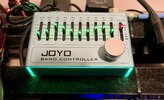
Here is an EQ I’ve been using for a while.
Joyo R12 EQ.
Some people have compared it with the MXR 10 band.
I don’t own the MXR so I can’t say much about it, but I can speak for the R12. It’s silent and it does everything asked of it well. The red level slider to the right can give you a signal boost.
Even has cool LED lights (because lights make you play better!! lol)
Some have complained about the chassis LED lights adding noise. I haven’t encountered that issue. Even if they do add noise. They can be turned off. But as you can see, I have them on! Purdy lights!!!
I know it’s priced considerably less than the MXR version. I believe the MXR is around $150. The Joyo is $90.
IMG_2091.jpeg
I also have the Behringer EQ on my budget board. I’m mostly happy with it. It does its job, has a small footprint (like a BOSS EQ). The only thing I don’t like is,the sliders don’t have that unity bump (the point at which it kinda stops when the sliders are at 0)
It doesn’t have as much incremental control as the Joyo and the sliders feel like they are cheap. But for about $30 you can’t beat it. But my favorite is the Joyo here.
IMG_2092.jpeg
 
For distortion/fuzz I have the following.
ProCo RAT2 - it really is as good as they say. It can go from boost to fuzzy. This will run around $90

BOSS Metal Zone -nothing says 80s like this black box. This thing is so debated over. So many people hate it for its “bees in a can” tone. But set it right (the secret is in the mids controls) and it’s a beast! You will need to really fiddle with the EQ controls to get it to sound right and the gain knob will never go past 10 o’clock. This will go for around $100.

Now for the mid range budget option. Gracing my budget board is the JOYO Tauren. It’s pretty good. It sounds a little thin compared to the RAT. It basically does what the RAT does. It goes from boost to distortion. The LED lights on the chassis on mine do add noise, so best to keep them off. This pedal will run you about $55. But for a little more money, the RAT2 is the better option. But if you want to keep to a budget. This is an option.

Now for the super budget fuzz option. Nothing, and I do mean nothing beats the Behringer Super Fuzz with a $30 price tag it can’t be beat. It is a BOSS FZ-2 clone at a third of the price. Is it as good as some of the more popular muff and fuzz faces? I don’t know. I never did a head to head comparison. It’s the best pedal Behringer makes IMO. It’s the only dedicated fuzz pedal I have. I don’t do fuzz much, but it does sound pretty darn good.

As for the other pedals on your list. Delay pedals, phasers and such. I tried some budget pedals. But none of them sounded as good as some of the higher priced pedals out there. I have the TC Flashback2 and the Hall of Fame reverb. Love them!! But they are gonna cost you a good bit of change.

As for a compressor. I have a Keeley compressor which works very well. Like OD pedals. There are a ton out there.

I think this post and my previous posts round out my experience with the pedals you are looking for.

Mike, by now I’m sure you are aware of the pedal rabbit hole you just dove into. It’s deep, dark, and twisting.
 
Last edited:
And one more thing. If you go the pedal route. Don’t be afraid of picking up used. I have saved tons of cash on reverb this way.

Also, for a pedal board. Amazon has some great deals on pedal boards. Just figure out what pedals you are going to buy and how much room you need.

This will all eventually lead to the power supply discussion …
So,what’s it going to be Alice. pedals or FX box?
IMG_2093.jpeg
 
Back
Top