ABR-1 vs. Nashville Bridge

DirtySteve

Ambassador of Hold My Beer
Country flag
Just curious. I'm not asking what the differences are, I know what the differences are. I'm asking which style YOU prefer (if you have a preference) and especially would like to know why you prefer one over the other?
 
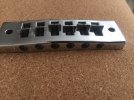
Nashville style only ill go one better. I like the Metric style bridge posts there way stronger than the Gibson stuff.Just toss the Nashville style metric bridge on your metric guitar and buy Tone Pros bridge or amother comparable quality hardware. ABR-1 looks good but flimsy.I remember original SGs and such the little agjustment wheel went up and down the stud. I mean if your restoring a vintage guitar use original but guitars im just playing i use the big stud metric.
 
ABR-1
because that's what came on the archtop I bought.

I tried it with some nylon saddles but it turned to mud (i play flats...it might be less mud with rounds but I don't want to go to the effort of finding out.) That said, and consistent as I am...I've a rosewood bridge that I'm eventually going to shape and install...maybe but all things considered...
ABR-1
 
On guitars with a stop bar, I like to deck that bar. With the ABR-1 not being as wide as the Nashville, there's less of a chance that the strings will make contact with the bridge behind the saddles.

That's why. :)
 
I vote for the ABR-1 have 9 guitars that are stock and only 3 with Nashville
My 1965 SG Standard has the nylon saddles sounds good I try to keep guitars stock
 
Nashville. Main reason, really, is that ABRs look too dainty/small on there. Nashville's have some beef to them and look more serious, and because they are bigger they feel a lot nicer under the edge of my palm when muting.

And I don't buy the crap about one or the other sounding different, not to mention screwing an ABR directly into the top is dumb idea IMO.
 
Nashville, I don't like the wire on the ABR-1

Also, the metric ones have a lot more metal into the wood which in my mind equates to more shared resonance. I prefer those from a simple scientific perspective.
 
Just curious. I'm not asking what the differences are, I know what the differences are. I'm asking which style YOU prefer (if you have a preference) and especially would like to know why you prefer one over the other?
The ABR with nylon saddles keeps the feedback squealing under control, when the amp is boosted way up.
The metal saddles will ring a lot more.
The weight mass of the bridge isn't a really big factor in the sound of it.
The sustain will be dependent on the type of wood more than anything else. The bridge isn't what makes the guitar sustain.
I think the nylon nut is the best way overall.
 
I was mainly curious if anyone thought the tone was affected by which type is used. I don't believe it's all in my head, I've gone back and forth between ABR-1 and Nashville on both by Standard and now my Traditional. In both cases the Nashville seems to take away some brightness that I get with the ABR-1 and seems to thicken the tone a little over all. It's not a lot, not as subtle as say removing a pickup cover, but nothing big enough to say it's a drastic change.

I play with a lot of palm muting. I seem to prefer the Nashville for tone, ABR-1 for feel.

As for the extra bulk of the Nashville, I like to deck the stopbar and it makes no difference to me if the strings touch the back of the bridge or not, I don't believe it matters.
 
I've said this before, but I regard the ABR-1 as an obsolete design from the 1950s
when guitar strings came in only one gauge: heavy. I regard the ABR-1 as something
that Gibson replaced with the Harmonica bridge in order to give guitarists more
travel in the saddles, so that they could intonate lighter strings. The Harmonica bridge
worked fine in the '70s, but guitarists are a closed minded group and complained
unceasingly until Gibson brought forth the Nashville bridge. Then guitarists complained
about that, until Gibson made the ABR-1 available again. So you pays yer money
and you takes yer choice... But the Nashville bridge will do everything the guitarist
needs, IMHO.

I don't believe there's any tonal advantage to screwing the studs into the wood.
And I don't believe there's MUCH of any tonal advantage to one bridge or another.
The exception to this might be the TonePros bridge, and maybe the Pigtail, because
I do believe they pay more attention to "coupling" which means the precise fit of the
screw threads on the studs into the body inserts. Better hardware I might give better
coupling which might give better tone. I don't really know. But maybe Tone Pros knows.
Maybe Gibson knows too. I have a feeling that they have good engineers working for them.

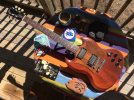
I bought a Tone Pros (Nashville) bridge for my beloved '07 SG faded special, and she rewards me
with the best sound of any guitar I've ever played. Sure and this is for a lot of reasons...
I love this guitar so well, I've modded her with the best of everything I could buy or make.
I use the top wrap method of installing strings, I've "Feitenized" her with a bone "Shelf nut"
and given her Gibson '57 Classic and Classic plus pickups, along with a high quality wiring
harness. '57s and SGs are made for each other IMHO...
IMG_1097@100.jpg
Q: So where's all this great tone come from, eh?
A: The combination of it all, including the guitar itself PLUS the amp, which might be
the most important feature of your signal chain.,

That's my humble opinion anyway.
I don't think an ABR-1 bridge would add anything to my guitars
except difficulty intonating tens. I fell in love with this
guitar because it sounded and felt the best (unamplified) of any of the SGs at GC
the day I wandered in... including some that were priced more than twice
what I paid for her. That was with her issue Nashville bridge.

So my humble SG faded special has a lot of magic for an inexpensive Gibbie.
So does my Epiphone ES-339, which I have also customized with lots of upgraded parts
including a Gotoh Bridge, a Tusq nut, P-90 pickups from Ken Rose and a high quality
wiring harness. My Epi can take her place onstage next to guitars costing eight to ten times more
than I paid, and not give up a thing. Replacing the Epiphone parts with higher quality may
have something to do with that.
April 2017@100.jpg
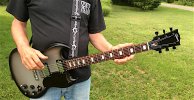
In spite of being a guitar mod guy, I've left my other SG pretty much stock. She's a 2012
SG special '70s tribute, with mini humbuckers, a Nashville bridge, a Corian nut
and Gibson branded 500k pots... no PCB... just an old fashioned soldering job
As soon as I saw this instrument advertised I wanted one. And I got an excellent one.
I played her for a long time, becoming more and more certain that she needed no mods
and played and sounded great as issued. That was in 2013, and she's given great service
ever since. Nothing wrong with the Nashville bridge. There are tens of thousands of them
out there rocking and rolling in all kinds of bands, with no problems. *shrugs

Gibson puts Nashville bridges on Vees and Explorers, ES series guitars, Firebirds, SGs and
Les Pauls. It's a good design, solid and dependable IMHO anyway. That's been my experience
with them. I don't think they suck tone. I use my controls to shape my tone. ...AND my strings
and my amp and my pick as well. All those things affect tone much more than hardware or
"tone wood" IMHO... (or pickup covers)
 
I've said this before, but I regard the ABR-1 as an obsolete design from the 1950s
when guitar strings came in only one gauge: heavy. I regard the ABR-1 as something
that Gibson replaced with the Harmonica bridge in order to give guitarists more
travel in the saddles, so that they could intonate lighter strings. The Harmonica bridge
worked fine in the '70s, but guitarists are a closed minded group and complained
unceasingly until Gibson brought forth the Nashville bridge. Then guitarists complained
about that, until Gibson made the ABR-1 available again. So you pays yer money
and you takes yer choice... But the Nashville bridge will do everything the guitarist
needs, IMHO.

I don't believe there's any tonal advantage to screwing the studs into the wood.
And I don't believe there's MUCH of any tonal advantage to one bridge or another.
The exception to this might be the TonePros bridge, and maybe the Pigtail, because
I do believe they pay more attention to "coupling" which means the precise fit of the
screw threads on the studs into the body inserts. Better hardware I might give better
coupling which might give better tone. I don't really know. But maybe Tone Pros knows.
Maybe Gibson knows too. I have a feeling that they have good engineers working for them.

I bought a Tone Pros (Nashville) bridge for my beloved '07 SG faded special, and she rewards me
with the best sound of any guitar I've ever played. Sure and this is for a lot of reasons...
I love this guitar so well, I've modded her with the best of everything I could buy or make.
I use the top wrap method of installing strings, I've "Feitenized" her with a bone "Shelf nut"
and given her Gibson '57 Classic and Classic plus pickups, along with a high quality wiring
harness. '57s and SGs are made for each other IMHO...
View attachment 101211
Q: So where's all this great tone come from, eh?
A: The combination of it all, including the guitar itself PLUS the amp, which might be
the most important feature of your signal chain.,

That's my humble opinion anyway.
I don't think an ABR-1 bridge would add anything to my guitars
except difficulty intonating tens. I fell in love with this
guitar because it sounded and felt the best (unamplified) of any of the SGs at GC
the day I wandered in... including some that were priced more than twice
what I paid for her. That was with her issue Nashville bridge.

So my humble SG faded special has a lot of magic for an inexpensive Gibbie.
So does my Epiphone ES-339, which I have also customized with lots of upgraded parts
including a Gotoh Bridge, a Tusq nut, P-90 pickups from Ken Rose and a high quality
wiring harness. My Epi can take her place onstage next to guitars costing eight to ten times more
than I paid, and not give up a thing. Replacing the Epiphone parts with higher quality may
have something to do with that.
View attachment 101217
In spite of being a guitar mod guy, I've left my other SG pretty much stock. She's a 2012
SG special '70s tribute, with mini humbuckers, a Nashville bridge, a Corian nut
and Gibson branded 500k pots... no PCB... just an old fashioned soldering job
As soon as I saw this instrument advertised I wanted one. And I got an excellent one.
I played her for a long time, becoming more and more certain that she needed no mods
and played and sounded great as issued. That was in 2013, and she's given great service
ever since. Nothing wrong with the Nashville bridge. There are tens of thousands of them
out there rocking and rolling in all kinds of bands, with no problems. *shrugs

Gibson puts Nashville bridges on Vees and Explorers, ES series guitars, Firebirds, SGs and
Les Pauls. It's a good design, solid and dependable IMHO anyway. That's been my experience
with them. I don't think they suck tone. I use my controls to shape my tone. ...AND my strings
and my amp and my pick as well. All those things affect tone much more than hardware or
"tone wood" IMHO... (or pickup covers)
Great post, thank you, Col.
 
I do like the vintage look of an ABR. But in a practical sense I prefer the feel of the Nashville.
Nashville might give a little more fullness and/or sustain.
ABR might give a little more brightness and air.
It's impossible to compare them back & forth on the same instrument since they use different posts.

IMO tone differences between the two likely are negligible compared to other factors that are actual contributors.
So I prefer Nashville for pragmatic reasons - I like the way it feels.
Plus, in the long run a Nashville won't ever deform; ABRs have been known to do that.

Still, I wouldn't modify an axe with a stock ABR to put a Nashville bridge on it.
Not ruling out a higher quality ABR replacement, though.
I have a couple of TonePros, and a Faber that I really like.
 
I do like the vintage look of an ABR. But in a practical sense I prefer the feel of the Nashville.
Nashville might give a little more fullness and/or sustain.
ABR might give a little more brightness and air.
It's impossible to compare them back & forth on the same instrument since they use different posts.

IMO tone differences between the two likely are negligible compared to other factors that are actual contributors.
So I prefer Nashville for pragmatic reasons - I like the way it feels.
Plus, in the long run a Nashville won't ever deform; ABRs have been known to do that.

Still, I wouldn't modify an axe with a stock ABR to put a Nashville bridge on it.
Not ruling out a higher quality ABR replacement, though.
I have a couple of TonePros, and a Faber that I really like.

With these new sorta fake ABRs that use the Nashville style inserts its easy to go back and forth and see if the bridge itself makes any difference in tone, since that variable is set. I've done it on couple of my Les Pauls, and no, it doesn't make any difference at all in the tone, and I really don't believe screwing the posts directly into the wood makes a bit of tonal difference and besides that's a recipe for eventual failure. There is a reason they changed the design after all.

What I do hear a difference in is bridge material - if you go back and forth between aluminum, zamak, bell brass, etc with the same style bridge you will hear some tonal differences. But IME if you have an aluminum ABR and an aluminum Nashville they are going to sound the same.
 
Back
Top