'82 Marshall JCM 800 4010 combo blowing fuses

  • Thread starter Thread starter BluesManRocker
  • Start date Start date
Bluesman, I have a number of fine Youtube videos I return to for Safety.

This is my number one and one I wish was a BIG STICKY in our FORUM


Glad you are here with us and asking very knowledgeable folks and those of us with less knowledge but actual walking our way through failures to fix scenarios too.
Good tip. I saw something like this before, about a decade ago, but forgot the detail, like the 100 ohm resistor at the end. Very good, will do! I have the clipping leads already, just need to find a resistor and follow proper procedure. You guys are the best. I really appreciate all this.
 
And the procedure for accomplishing this task, is done by,,, I don't know yet,,, please explain the steps, like does the mainboard require lifting and if so, how far? What all needs to be done underneath? I wish to know what I'm getting into before proceeding. I hope to be ordering parts soon so I can get this project going.
To do the job properly, the board needs to lifted enough to access the old parts that need to be unsoldered and then replaced and soldered with the new parts. It can be done from the top, but it'll look half-aass. Where are you located?
 

This is the 1st time I have ever seen this clip. I found it fascinating his demo of making a capacitor, checking capacitance, then cutting it in half, and in half again and watching the value decrease by 50% each time.
 
Last edited:
To do the job properly, the board needs to lifted enough to access the old parts that need to be unsoldered and then replaced and soldered with the new parts. It can be done from the top, but it'll look half-aass. Where are you located?
Lansing, Michigan. Wait, I have unusual tech, I am quite clever, please explain this lifting to get to the bottom, to work on resistors on the top. I have exceptional soldering and welding heat containment. Like crazy good. So please don't assume typical, just let me know exactly what the job entails, and I'll have a better idea what I can do.
 
Lansing, Michigan. Wait, I have unusual tech, I am quite clever, please explain this lifting to get to the bottom, to work on resistors on the top. I have exceptional soldering and welding heat containment. Like crazy good. So please don't assume typical, just let me know exactly what the job entails, and I'll have a better idea what I can do.
Trying to find a decent video that might help you is a bit tough, but this one should give you a pretty good idea. Right about the 15 minute mark, the PCB is loosened and lifted. Watch the whole video, but don't get caught up with all the fancy testing equipment.
 
Trying to find a decent video that might help you is a bit tough, but this one should give you a pretty good idea. Right about the 15 minute mark, the PCB is loosened and lifted. Watch the whole video, but don't get caught up with all the fancy testing equipment.
Dig it, I watched the whole thing. I feel pretty confident about lifting the board. I would like to have a variac, as I am an inventor and have uses for it for testing stuff. But I don't have that right now. Nor do I have an oscilloscope. I figure like you hinted, some tools are not necessarily required.

I used to work with PC's a lot, so I would never want to bend the main board as much as he did. Don't want to break any traces or contacts. I hate to be picky, but I winced when he lifted the amp out of the cab, by a cap and a preamp tube!

That was two different amps and two different starting bias readings. The first amp looked more like mine with a bunch of red blocks on the mainboard, but he later amp had very different components.

I would like to see how to replace the resistors that need to be replaced. I do not yet understand why we need to get to the underside to work on the resistors on the topside. I am guessing it's to apply the heat from below the board, but since I've never seen it done and no one has explained it to me yet, I have nothing to go by.
 
Those grid leak resistors highlighted in green really need to be changed to 220K's to keep the EL34's happy.
View attachment 44390

It will work just fine with either 150K or 220K bias split resistors.
The tubes don't care.
The tubes will be more sensitive with 220K, and slightly less with 150K.
In other words they get louder a little easier with 220K.
But they get just as loud, but when pushed harder, with 150K.

The grid leak resistors are 5.6K different purpose.
 
Good tip. I saw something like this before, about a decade ago, but forgot the detail, like the 100 ohm resistor at the end. Very good, will do! I have the clipping leads already, just need to find a resistor and follow proper procedure. You guys are the best. I really appreciate all this.

The caps will drain themselves, you don't need this.
The caps have bleeder resistors.
When the amp is turned off, the caps drain down because of the bleeder resistors.
 
Dig it, I watched the whole thing. I feel pretty confident about lifting the board. I would like to have a variac, as I am an inventor and have uses for it for testing stuff. But I don't have that right now. Nor do I have an oscilloscope. I figure like you hinted, some tools are not necessarily required.

I used to work with PC's a lot, so I would never want to bend the main board as much as he did. Don't want to break any traces or contacts. I hate to be picky, but I winced when he lifted the amp out of the cab, by a cap and a preamp tube!

That was two different amps and two different starting bias readings. The first amp looked more like mine with a bunch of red blocks on the mainboard, but he later amp had very different components.

I would like to see how to replace the resistors that need to be replaced. I do not yet understand why we need to get to the underside to work on the resistors on the topside. I am guessing it's to apply the heat from below the board, but since I've never seen it done and no one has explained it to me yet, I have nothing to go by.

It's really easy to damage the PC board with a soldering iron.
And I do not recommend you work on it without the tools and experience.

The amp is already set up for 6550.
But to run EL34s, you only need to change 1 resistor.
For EL34,
with the bias pot set half way, you should get -42 volts DC on pin 5 of the output socket.

You can change all 4 resistors, but the board can also be destroyed. Which is why an inexperienced person should not try to do this.

No I do not recommend that any inexperienced person should work on the PC board.
I tried to warn you.

I have seen these amps turned in paper weights because inexperienced people tried to work on the pc board. Bad Idea.
 
Bias pin 5 steady at -35.5 max, that's a problem as I want full range adjustment.
Bias pin5 adjustment is not ok, needs to gain higher values.
High voltage insulation tested ok, yes.

And the red bias resistor is assumed correct value at 220. My readings were 218 and 221 when I reversed the leads. So I assume that's correct reading, but I don't know if it's 220, or 220 k. I was waiting on you to explain something JohnH came over and said, why don't you just measure it with the amp off and the standby on, so both switches are in the same position, and the amp is unplugged. So I did, and I have been waiting every since. Sorry for not already un-soldering the resistor, but after taking the reading, people were accepting that was the correct value.

And it was pointed out that the white looked more yellow in another photograph, so it was generally accepted that this was the proper resistor. Or is this wrong? Sorry but I was left with the advice from those left over at MF's. Good to have you back.

View attachment 44373
And the red bias resistor is assumed correct value at 220. My readings were 218 and 221 when I reversed the leads.

220 What? 220 K ohms?
You can't assume anything. You have to know definitely.

You must change that 1 resistor to get into the ballpark.

He put the wrong caps in the bias circuit. The filter caps are supposed to be 10uF.
Not 47uF.
This will cause low frequency resonance.

A. Take it back to the tech and tell him to make it right.
B. Don't try to solder the PC board.
 
This started out recently when I accidentally unplugged one of the two speakers for my amp, and so when I turned it on, that blew a fuse and unfortunately, I've been blowing fuses every since. I found a bad power tube, but also, AmpMadScientist is helping me diagnose that my bias circuit is not in the correct range yet. Prior to me, it was perfect for I think 6550's, but I wanted EL34's, so I paid to have the bias changed, but he did not complete the change. He got it most of the way there.

I think there's maybe two places to change the bias, not sure about that, and he spoke like he dreaded lifting the main board which probably was required to fix the bias correctly. I have a pair of new production Telefunkin power tubes arriving tomorrow evening, and a new Telefunkin for the preamp as well, so I can't wait to hear those tubes for the first time, plus I have a new set of Mullards as well, so I'm well set as far as tubes go. Same with speakers!

The bias wont adjust properly, it rises but only to -35.5 V, and we were going to shoot for -42, but can't get there. Why that is, has not yet been fully determined, as the resistor seems to be the right value at 220 k, when measured with the amp unplugged and the power switch off, and the standby switch on, or both in the same physical position. However I have not yet un-soldered the white wire from the post, just took a local reading right at the resistor. And it read 218-221 (reversing leads) consistently and steady. So that seems to be the correct resistor.

View attachment 44327

Where are you located?

You can run 6550, but still you must change that resistor. 6550 requires -52 volts DC on pin 5.
You can run EL34. But still you must change that resistor. EL34 requires -42 VDC on pin 5.

And so, change resistor and the amp will "work."
If you do not change the resistor, the tubes will overheat. The fuse can blow again...

That is why I am trying to find a technician in your area that knows how to work on PC boards.
There are certified techs, who have test equipment, and know just what to do.

You could do it yourself, but I am worried that ability to solder may prevent you from getting it done right.
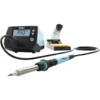
To solder a PC board, you need a temperature controlled soldering station.
This
1591773592291.png

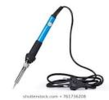
Not This
1591773663789.png
 
Last edited:
Where are you located?

You can run 6550, but still you must change that resistor. 6550 requires -52 volts DC on pin 5.
You can run EL34. But still you must change that resistor. EL34 requires -42 VDC on pin 5.

And so, change resistor and the amp will "work."
If you do not change the resistor, the tubes will overheat. The fuse can blow again...

That is why I am trying to find a technician in your area that knows how to work on PC boards.
There are certified techs, who have test equipment, and know just what to do.

You could do it yourself, but I am worried that ability to solder may prevent you from getting it done right.
To solder a PC board, you need a temperature controlled soldering station.
This
View attachment 44442

Not This
View attachment 44443
I think I have a stand alone unit, and in part, because of that, I'm disqualified. What is so much better about the base unit?

I'm willing to learn and get the right equipment. I might end up making my own kit amp, and other electronic projects like a power attenuator, especially if this amp does not turn out reliable. I prefer more robust point to point wiring, so we never have this delicacy of treating the main board like it's exotic fussy business. If the wattage is the same, makes one wonder what the difference is.

I never said you did not discourage me from working on the PCB. Not all things in life, are as we wish. Unless the amp tech is close by, it could be very costly for me to get the amp to the repair shop as I do not have transportation, despite formerly being a skilled truck driver. Being poor sucks.

Can't I be that one exceptional guy, who does it right?.. This might be more difficult, but, is it just not recommended for the average person, or is it not recommended for the most careful as well? I can practice proper soldering technique and prove my skills on the iron. But although this seems like something I also prefer the experienced professional to do, it may be the way it gets done. I can't force a trustworthy amp tech to move to a reasonable distance from my location and make it just off the bus lines. So there's all that to factor in.
 
And the red bias resistor is assumed correct value at 220. My readings were 218 and 221 when I reversed the leads.

220 What? 220 K ohms?
You can't assume anything. You have to know definitely.

You must change that 1 resistor to get into the ballpark.

He put the wrong caps in the bias circuit. The filter caps are supposed to be 10uF.
Not 47uF.
This will cause low frequency resonance.

A. Take it back to the tech and tell him to make it right.
B. Don't try to solder the PC board.
He put the wrong caps in the bias circuit. The filter caps are supposed to be 10uF, not 47uF. This causes low frequency resonance!!!!!!!!!!! You finally touched on the tonal issue that I noticed after he fussed with it!!!!!!!!!!! I hate that change to no end!!! And I want those filter caps back to proper spec like crazy. That screw up, really pissed me off.
 
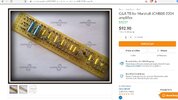
Wait a second. I'm also wondering about replacing caps on the board, upgrading them to the nicer do dads. So I go online and did a search for replacement main boards for my model. And I am shocked at how low the prices are.

How about a mainboard swap out, for point to point goodness, and all the caps are already maxed out for tone! I am tempted!!!

point to point amp.jpg
 
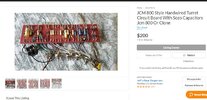
However this one has a trim pot for biasing, so I guess this one is better, but includes too much and is twice as expensive. So I messaged the seller about if they could provide one without the pots attached, and how much for it. But then I just realized, it's out of stock, so I'll be lucky if i get a response back. I would not mind paying $150 for a nicely appointed main board, and just swap the entire board out. I much prefer better caps and point to point wiring.

I don't want to pay 200 for it, without pots and jacks. although it would save me soldering time. I guess I could sell my brand new pots I just purchased. But I'd much prefer just not buying what I already have. I am brand new to turret, point to point, main boards, but have long desired it. Let me know what you think.

better amp.jpg
 
Wait a second. I'm also wondering about replacing caps on the board, upgrading them to the nicer do dads. So I go online and did a search for replacement main boards for my model. And I am shocked at how low the prices are.

How about a mainboard swap out, for point to point goodness, and all the caps are already maxed out for tone! I am tempted!!!

View attachment 44444
No don't do that.
Get the amp fixed right.
You don't need to "up grade" anything.
 
Back
Top