'82 Marshall JCM 800 4010 combo blowing fuses

  • Thread starter Thread starter BluesManRocker
  • Start date Start date
B

BluesManRocker

Guest
This started out recently when I accidentally unplugged one of the two speakers for my amp, and so when I turned it on, that blew a fuse and unfortunately, I've been blowing fuses every since. I found a bad power tube, but also, AmpMadScientist is helping me diagnose that my bias circuit is not in the correct range yet. Prior to me, it was perfect for I think 6550's, but I wanted EL34's, so I paid to have the bias changed, but he did not complete the change. He got it most of the way there.

I think there's maybe two places to change the bias, not sure about that, and he spoke like he dreaded lifting the main board which probably was required to fix the bias correctly. I have a pair of new production Telefunkin power tubes arriving tomorrow evening, and a new Telefunkin for the preamp as well, so I can't wait to hear those tubes for the first time, plus I have a new set of Mullards as well, so I'm well set as far as tubes go. Same with speakers!

The bias wont adjust properly, it rises but only to -35.5 V, and we were going to shoot for -42, but can't get there. Why that is, has not yet been fully determined, as the resistor seems to be the right value at 220 k, when measured with the amp unplugged and the power switch off, and the standby switch on, or both in the same physical position. However I have not yet un-soldered the white wire from the post, just took a local reading right at the resistor. And it read 218-221 (reversing leads) consistently and steady. So that seems to be the correct resistor.
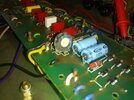
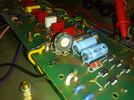
amp 12.jpg
 
From my discussions with my last amp tech, I have in my head there's two places, not just one, for the adjustment range. Sometimes this problem makes me consider going with the 6550 tubes and just give up on the EL34's. But so far, I like EL34's better. This is still not making sense to me, why I can't go over -35.5 VDC for the bias for the power tubes. Do I need to lift the main board to see what's underneath? Then I could stick a mirror under the board and see if there are more resistors on the other side, if that helps..
 
From my discussions with my last amp tech, I have in my head there's two places, not just one, for the adjustment range. Sometimes this problem makes me consider going with the 6550 tubes and just give up on the EL34's. But so far, I like EL34's better. This is still not making sense to me, why I can't go over -35.5 VDC for the bias for the power tubes. Do I need to lift the main board to see what's underneath? Then I could stick a mirror under the board and see if there are more resistors on the other side, if that helps..

Everything so far tested OK?
The bias pin 5 held steady?
The bias pin 5 adjusted OK?
The high voltage insulation tested OK?
The screen grid resistors tested good?

Did you do all those tests?

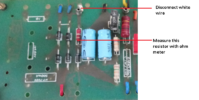
The only thing we didn't check so far was this bias voltage resistor.
What is the value of the resistor?

4010 resistor.png

The color code of the resistor is non standard. Red Red White.
 
  • Like
Reactions: RVA
Everything so far tested OK?
The bias pin 5 held steady?
The bias pin 5 adjusted OK?
The high voltage insulation tested OK?
The screen grid resistors tested good?

Did you do all those tests?

The only thing we didn't check so far was this bias voltage resistor.
What is the value of the resistor?

View attachment 44370

The color code of the resistor is non standard. Red Red White.
Bias pin 5 steady at -35.5 max, that's a problem as I want full range adjustment.
Bias pin5 adjustment is not ok, needs to gain higher values.
High voltage insulation tested ok, yes.

And the red bias resistor is assumed correct value at 220. My readings were 218 and 221 when I reversed the leads. So I assume that's correct reading, but I don't know if it's 220, or 220 k. I was waiting on you to explain something JohnH came over and said, why don't you just measure it with the amp off and the standby on, so both switches are in the same position, and the amp is unplugged. So I did, and I have been waiting every since. Sorry for not already un-soldering the resistor, but after taking the reading, people were accepting that was the correct value.

And it was pointed out that the white looked more yellow in another photograph, so it was generally accepted that this was the proper resistor. Or is this wrong? Sorry but I was left with the advice from those left over at MF's. Good to have you back.

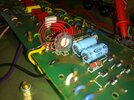
amp 13.jpg
 
Then I could stick a mirror under the board and see if there are more resistors on the other side
Ha ha... there shouldn't be any resistors on the other side.

Your pic:
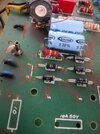
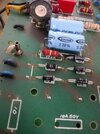
20200609_062213.jpg

Resistor 1 should be a 57K: blue/green/orange. Yours looks like a 47K: yellow/violet/orange. This is probably limiting your bias range.

Resistor 2 should be a 15K: brown/green/orange. Yours looks correct.

R 3 should be 220K: red/red/yellow. Yours looks correct.
 
OK Bluesman., I am nowhere near the expert tech AMpMad and a few others are here, but I do know some questions to ask from my own faults that have occurred in some of my amps.

1st, What are the condition of and when were the Filter caps last changed?
2nd, Has the amp been modded to either of the 6550 or EL34 specs? Does it NOT make a difference in biasing if you are using EL34's in the amp that is set up for 6550 or vice versa?
3rd. Are we checking things with the speakers hooked up and ohms set properly, all tubes verified good and lots of other possible factors?

Sorry if any of my questions are open ended, don't apply or are only part of the detailed process to diagnose. Just going from incomplete info on the scenario to date.
 

If any unsafe practices are seen by our members, please point it out. I am posting this primarily because of the visuals showing what the various tube pins are etc.

Also as a disclaimer note, if I ever go to diagnose, bias, modify my amps or service those of others, I fall into the category of " if I don't know what I am doing, let a qualified tech do it." BUT, in order to do my own, I follow this safety protocol. First, I have my friends on here review and explain things. These are members who have decades of electronics/ amp knowledge, I make sure they review my problems, pictures and schematics of my amps, and then I ask questions to make sure I understand the principles, and then verify my understanding of what the guys like Ampmad, Neikeel, IvanH, Bastarddon etc when it comes to doing anything inside the amp. MY novice amount of experience and infrequency, lead me to only proceed and feel safe is if I do NOTHING until I check with the experts.
 
Last edited:
Check out this link too. I see post 7 seems to address the 6550/EL34 scenario, other posts mention other people's preferences for either tube.


I also just noticed at the bottom of the page, " sister sites" Gimme a break

  • About us
    The Gear Page is the leading online community and marketplace for guitars, amps, pedals, effects and associated gear.


OK Bluesman., I am nowhere near the expert tech AMpMad and a few others are here, but I do know some questions to ask from my own faults that have occurred in some of my amps.

1st, What are the condition of and when were the Filter caps last changed?
2nd, Has the amp been modded to either of the 6550 or EL34 specs? Does it NOT make a difference in biasing if you are using EL34's in the amp that is set up for 6550 or vice versa?
3rd. Are we checking things with the speakers hooked up and ohms set properly, all tubes verified good and lots of other possible factors?

Sorry if any of my questions are open ended, don't apply or are only part of the detailed process to diagnose. Just going from incomplete info on the scenario to date.
No problem, much appreciated, I welcome assistance. I believe my last amp tech (9 yrs ago) replaced everything simple and suspect, like the large caps on topside. I am going by memory from nearly a decade ago, plus my careful inspection, and so far, the caps look good, and highly suspect he replaced anything suspect, as I paid him 230 for two visits to not do that much.

Just change the bias from 6550's to EL34's, and to maybe take out some of the bright sound at lower volume. I was concerned that it would be returned to stock form, so if there was any mod's to get it back to stock. He found it was mostly just changed to run 6550 type tubes, and that was a bid deal.

The rest we did not talk very deeply about, or I understood less, so it's vague to me. My amp was otherwise in good shape. Overall I love the tone and sound of my amp, when it's working.
 
No problem, much appreciated, I welcome assistance. I believe my last amp tech (9 yrs ago) replaced everything simple and suspect, like the large caps on topside. I am going by memory from nearly a decade ago, plus my careful inspection, and so far, the caps look good, and highly suspect he replaced anything suspect, as I paid him 230 for two visits to not do that much.

Just change the bias from 6550's to EL34's, and to maybe take out some of the bright sound at lower volume. I was concerned that it would be returned to stock form, so if there was any mod's to get it back to stock. He found it was mostly just changed to run 6550 type tubes, and that was a bid deal.

The rest we did not talk very deeply about, or I understood less, so it's vague to me. My amp was otherwise in good shape. Overall I love the tone and sound of my amp, when it's working.

There's a major difference between 6550 and EL34 bias voltage.
This voltage must be adjusted by selecting resistors when changing the amp from 6550 to EL34.

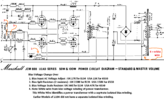
1. Now if you look on the factory schematics, you will see the different resistors (USA VS UK) according to which tubes were factory installed when the amp was new.
USA was 6550
UK was EL34

2. Then let us not forget, that all 6550s are not the same either.
And EL34s are not all the same.
Therefore, they are matched into sets.

Click Image to Enlarge

4010 bias.png

But what you will see is:
You only really need to change 1 resistor, and the amp will bias correctly.

You don't really "need" to change all 4 resistors; but if you want to it's OK. The factory changes all 4 resistors when using the alternate output tube.

2204 resistors.png
 
Last edited:
There's a major difference between 6550 and EL34 bias voltage.
This voltage must be adjusted by selecting resistors when changing the amp from 6550 to EL34.

1. Now if you look on the factory schematics, you will see the different resistors (USA VS UK) according to which tubes were factory installed when the amp was new.
USA was 6550
UK was EL34

2. Then let us not forget, that all 6550s are not the same either.
And EL34s are not all the same.
Therefore, they are matched into sets.


Yes Ampmad. This is why I call on folks like you to confirm the little details I have gleaned in my General learning.
Anyway, my '72 JMP runs EL34's and is hand wired and not all original but it sounds awesome. BUT my 1978 JMP MkII 100 watter has PCB board, 6550Astr tubes in it, and has had some wires clipped to certain coupling caps/ resistors in certain preamp sections, and varying resistor specs which make it neither a pure Superlead or Pure Superbass, missing ohms selector cap, hard wired to 4 ohm I think. This amp came to me working, but then as soon as I powered it up with the 4x12 Speakers it came with, it blew fuses when I hit the Standby off.. Among the obvious issues, I wound up discovering red plated tubes, arcing tubes, and 5 of the 7 tubes to be tested as junk. How it ran long enough for test drive is still mystifying me. After discussing the amp in here, finding a local guy with a good tester and supply of tubes, I got it running and no longer blowing tubes. Once I felt the amp is safe, then it was on to addressing the overall health of the amp. Caps, Fixing the wire anomalies, ohms selector etc. There lies another potential problem you may find as the cause.

Some folks may also suggest you do some wooden chopstick probing. This is how I found my Ohms selector as the cause of my intermittent loss of signal to my speakers and even fuse blowing issues in my 1972 JMP. Having had it to a tech and had him tell me my Transformer was bad, I was not learned enough to doubt his diagnosis. Having had caps done, him replacing the EL34's, Original Marshall PT with a Marstran I bought from Bryan Wallace, my going over the amp with IvanH and DonP, Neikeel etc, I had added Screen grid resistors, fixed some improper wires, and had the thing working in numerous occasions. Then one day I went to play it some, and voila, the sound would cut out and I was dumbfounded after virtually checking every cap, resistor, wire, transformer, etc. The Chopstick method is WHAT did the TRICK. I poked around inside and once I hit one of the wires to the ohms selector, I caused the amp to make sound, then lose sound and now had what I could attribute the flaw and failure to.

As I have discussed this with my forum pro's and done my research online, I learned that to have the ohms selector fail, can result in a regrettable damage to the transformer. This makes me understand why the tech thought my trans was bad, but I also would think he would have done like I have learned on here, checking the specs on the trans and see what the actual voltages were. Sadly I am almost positive I lost a perfectly good OEM transformer due to poor tech diagnosis and my lack of education, plus the perfect storm of the bad OHM's selector.
 
Yes Ampmad. This is why I call on folks like you to confirm the little details I have gleaned in my General learning.
Anyway, my '72 JMP runs EL34's and is hand wired and not all original but it sounds awesome. BUT my 1978 JMP MkII 100 watter has PCB board, 6550Astr tubes in it, and has had some wires clipped to certain coupling caps/ resistors in certain preamp sections, and varying resistor specs which make it neither a pure Superlead or Pure Superbass, missing ohms selector cap, hard wired to 4 ohm I think. This amp came to me working, but then as soon as I powered it up with the 4x12 Speakers it came with, it blew fuses when I hit the Standby off.. Among the obvious issues, I wound up discovering red plated tubes, arcing tubes, and 5 of the 7 tubes to be tested as junk. How it ran long enough for test drive is still mystifying me. After discussing the amp in here, finding a local guy with a good tester and supply of tubes, I got it running and no longer blowing tubes. Once I felt the amp is safe, then it was on to addressing the overall health of the amp. Caps, Fixing the wire anomalies, ohms selector etc. There lies another potential problem you may find as the cause.

Some folks may also suggest you do some wooden chopstick probing. This is how I found my Ohms selector as the cause of my intermittent loss of signal to my speakers and even fuse blowing issues in my 1972 JMP. Having had it to a tech and had him tell me my Transformer was bad, I was not learned enough to doubt his diagnosis. Having had caps done, him replacing the EL34's, Original Marshall PT with a Marstran I bought from Bryan Wallace, my going over the amp with IvanH and DonP, Neikeel etc, I had added Screen grid resistors, fixed some improper wires, and had the thing working in numerous occasions. Then one day I went to play it some, and voila, the sound would cut out and I was dumbfounded after virtually checking every cap, resistor, wire, transformer, etc. The Chopstick method is WHAT did the TRICK. I poked around inside and once I hit one of the wires to the ohms selector, I caused the amp to make sound, then lose sound and now had what I could attribute the flaw and failure to.

As I have discussed this with my forum pro's and done my research online, I learned that to have the ohms selector fail, can result in a regrettable damage to the transformer. This makes me understand why the tech thought my trans was bad, but I also would think he would have done like I have learned on here, checking the specs on the trans and see what the actual voltages were. Sadly I am almost positive I lost a perfectly good OEM transformer due to poor tech diagnosis and my lack of education, plus the perfect storm of the bad OHM's selector.

Yup, the loose ohm selector can cause the output transformer or tubes or sockets to fry.
 
Yup, the loose ohm selector can cause the output transformer or tubes or sockets to fry.

Ampmad, my sad response is not at your statement but the effect this issue can present.

Also, do you concur that a good chopstick check throughout a diagnosis can help not only locate the precise problem but possibly more than one, and to even eliminate false assumptions of more serious failures as the root causes?
 
Ampmad, my sad response is not at your statement but the effect this issue can present.

Also, do you concur that a good chopstick check throughout a diagnosis can help not only locate the precise problem but possibly more than one, and to even eliminate false assumptions of more serious failures as the root causes?
I appreciate it. Like as part of a better visual and smell, inspection. Without this kind of careful diagnostics, it's gotta be harder to find the culprit. I will keep this in mind, and give it a careful try. Using a proper bamboo stick, as I had a calendar that was made from bamboo around here "somewhere".
 
Bluesman, I have a number of fine Youtube videos I return to for Safety.

This is my number one and one I wish was a BIG STICKY in our FORUM


Glad you are here with us and asking very knowledgeable folks and those of us with less knowledge but actual walking our way through failures to fix scenarios too.
 
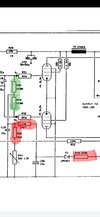
Those grid leak resistors highlighted in green really need to be changed to 220K's to keep the EL34's happy.
View attachment 44390
And the procedure for accomplishing this task, is done by,,, I don't know yet,,, please explain the steps, like does the mainboard require lifting and if so, how far? What all needs to be done underneath? I wish to know what I'm getting into before proceeding. I hope to be ordering parts soon so I can get this project going.

I may need to have this finished by an amp repair shop, but I am starting from ground zero where I live now, as I don't know of any, let alone which ones are more trustworthy. It might take weeks and months to get it in to be worked on, IDK. I don't mind doing anything I can do myself.
 
Back
Top