And you and me know those dealers. It's got thinner though. And prices higher.
I'm glad I got to hear the diff. Before we ran out.
Yes, yes, yes & yes. When some (maybe quite a few) of us were young, valves that are now very desireable & called NOS/NIB were current production.
Mullard ceased production of valves in the early 80's, of the other manufacturers around the globe, some earlier than this, some later. Luckily, valves were produced in very large numbers so some of them are still available to us, though the number of NOS available only gets less & prices only get higher.
6CA7 Original Tung Sol = Pentode
6CA7 Svetlana = Pentode
Sylvania 6CA7 = Pentode
Amperex 6CA7 = Pentode
JJ 6CA7 = Pentode
JJ Electronic - Vacuum tubes, Capacitors, Amplifiers

www.jj-electronic.com
EHX 6CA7 = Tetrode
So as far as I can gather, the only vendor that is calling 6CA7 a "tetrode" is Electro Harmonix.
IMHO:
A real 6CA7 is a pentode.
The tube which EHX is selling ---- is not a real 6CA7.
It's a substitute which has been re-labled, and is not a pentode at all.
I've already spoken on the subject of what valve type a "true" USA produced "fat bottle" 6CA7 really IS, so the only reason I'm responding is that I like our TTR fellowship members to have the full picture & accurate information on given topics where-ever possible.
As I've never seen a Tung Sol (USA) or Ampere "fat bottle" 6CA7 I can't comment on them, but of the other old production data sheets that you linked, these are the "very source" of the mis-information (falsehood) that the "true" fat bottle 6CA7 is a pentode. If you look for discussion online etc regarding the "type" of valve a (true) 6CA7 is, you'll find mention of the fact that the data sheets do not give the full, accurate story in calling it a pentode & also showing it schematically incorrectly.
So once again, valves "types" are defined by the electrodes they contain.
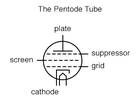
A "Pentode" contains;
Cathode,
Control Grid,
Screen Grid,
Suppressor Grid,
Anode (plate).
It is shown schematically as this
Below we can see the difference between a Tetrode & a Pentode.
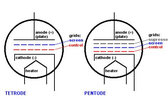
The suppressor grid is a defining factor of a pentode. Note, the suppressor grid can be utilised in a number of ways & DOES NOT need to be at the cathode's electrical potential for the Pentode to properly operate as an audio amplifier (the suppressor grid can be electrically manipulated, thus is seen as a "seperate" electrode). Traynor amps utilities the EL34 pentode's suppressor grid in one of these "other" ways in not keeping at the cathode's potential.
A "Beam Tetrode" is a Tetrode that incorporates "Beam Forming Plates." It contains the following;
Cathode,
Control Grid,
Screen Grid,
Beam Forming Plates,
Anode (plate).
It is "correctly" shown schematically as this
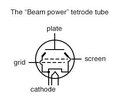
Compared to the Tetrode diagram earlier in this post, the beam forming plates are easily recognised. Note that in the diagram the beam forming plates are tied to the cathode. This is not the case in "all" Beam Tetrode's, however, whether the beam forming plates are internally tied to the cathode or not, they MUST be operated at the same potential as the cathode for proper operation (tied to the cathode "externally"). So the Beam Tetrode's beam forming plates CANNOT be utilised as a seperate electrode, unlike the suppressor grid of a Pentode. This is why a "true" USA fat bottle 6CA7 can't be just plugged into a Traynor amplifier.
Here is a cut-away view of a Beam Tetrode
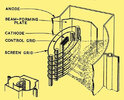
Note, NO suppressor grid (a defining factor of a Pentode).
Now here's a cut-away of a Pentode
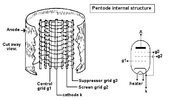
This time the suppressor grid is shown "externally" connected to the cathode. Remember, it does not need to be connected to the cathode AT ALL for proper Pentode operation.
So again we've defined the difference between a Beam Tetrode & a Pentode.
If you need "proof" that the USA made "fat bottle 6CA7" was in all fact a Beam Tetrode, & that the datasheets that refer to & show it schematically as a Pentode, do so INCORRECTLY, then get yourself hold of an old USA fat bottle 6CA7 example (can be well used, just not "failed") & carefully dissect it, then compare it's internal structure to the cut-away diagrams I posted above,,,, you'll easily see that they are in actual fact a Beam Tetrode.
Regarding the Electro Harmonix 6CA7 being the only new production 6CA7 that is not a real 6CA7 & being a Fake that has been re-labelled,,,, mate, before you come out with statements like this that are in complete error & pass it on to TTR members as gospel, do yourself a favour & get an old Sylvania, RCA or GE USA made fat bottle 6CA7 & dissect it. You'll see it is a Beam Tetrode, as per the diagrams above, as is the EHX 6CA7.
Regardless what one may think of Mike Matthews' (EHX proprietor) bussisnes practices, at least he had the foresight to somewhat reverse engineer "real USA fat bottle 6CA7's" before going into production of the Electrons Harmonix 6CA7, rather than just look at the (errornous) datasheets to see "oh it's a pentode" (which it freaking well ain't), then look back through Eastern Block pentode designs that they've previously produced to find one that they can adapt to call a 6CA7 (which is exactly what at least one of the "other" manufacturers you mention "did").
This is why the EHX is the only current production 6CA7 to even slightly reassemble an old USA fat bottle 6CA7
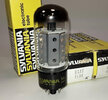
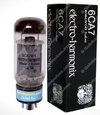
& is also the only current production 6CA7 that is a BEAM TETRODE, just like the old USA made 6CA7's were.
One thing worth mentioning, the Philips Mullard EL34 had a much greater input sensitivity than the fat bottle 6CA7.
What this meant was that the EL34 would overdrive much earlier than the 6CA7 & the EL34's overdrive characteristic up to full clipping (saturation) was gradual.
The onset of overdrive was much later for the 6CA7 & it's transition to full clipping much more abrupt.
The EHX 6CA7 has the input sensitivity of an EL34, so the overdrive characteristics differ from the old production USA fat bottle 6CA7.
Cheers
Edit:
Open up a USA fat bottle 6CA7 & you'll see something similar to this
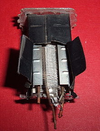
Here the (black) plate has been partially cut & opened outward. Looking closely, there is two wire grid structures, one inside the other. The "inside" wire grid is the control grid. The "outter" wire grid is the screen grid. The "beam forming plates" are the two silver sheet metal items on either side, partially between the screen grid & the black plate structure. Cheers


 yes there is a lot of fake NOS tubes.
