You are using an out of date browser. It may not display this or other websites correctly.
You should upgrade or use an alternative browser.
You should upgrade or use an alternative browser.
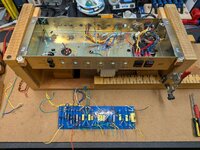
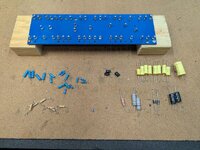
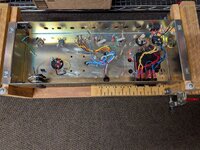
2204 clone gut job
- Thread starter fitz
- Start date

PelliX
Active Member

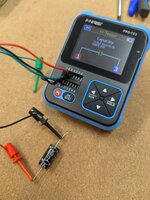
Be very careful to discharge electrolytics before testing them on there, those testers are surprisingly good often but they can't handle even relatively small residual charges. That cap measures fine, but just be aware that it tests them at ~5V instead of the 50V rating so there *may* be false positive readings for DC leakage, etc. There's no harm in reusing the components if they check out, but it's also the best moment to put in new parts if you feel so inclined, your call...
OP

fitz
Ambassador of DIY

So I have a question about the 22nF (0.022uF) capacitors.Be very careful to discharge electrolytics before testing them on there, those testers are surprisingly good often but they can't handle even relatively small residual charges. That cap measures fine, but just be aware that it tests them at ~5V instead of the 50V rating so there *may* be false positive readings for DC leakage, etc. There's no harm in reusing the components if they check out, but it's also the best moment to put in new parts if you feel so inclined, your call...
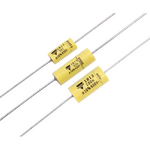
Mojotone specs 630v and Amplified Parts has a few brand options like Mallory, Vishay (ERO) & Illinois.
But what about something like the "legendary" Zoso caps that are 500v?
My Hammond PT has an output voltage around 440v.
PelliX
Active Member
My Hammond PT has an output voltage around 440v.
Is that the AC peak voltage, AC RMS or DC after rectification? If that's your DC HT then 500V would be sufficient, though I'd be tempted to go with a higher spec for more tolerance. It would be fine either way though.
OP
fitz
Ambassador of DIY
Yeah, those other ones are about 1/3 of the price.Is that the AC peak voltage, AC RMS or DC after rectification? If that's your DC HT then 500V would be sufficient, though I'd be tempted to go with a higher spec for more tolerance. It would be fine either way though.


CoyotesGator
Ambassador of Reptilian Rum Bar Affairs
I can not remember ever having an issue with all of the Mallory caps I have installed.So I have a question about the 22nF (0.022uF) capacitors.
Mojotone specs 630v and Amplified Parts has a few brand options like Mallory, Vishay (ERO) & Illinois.
But what about something like the "legendary" Zoso caps that are 500v?
My Hammond PT has an output voltage around 440v.
OP
fitz
Ambassador of DIY
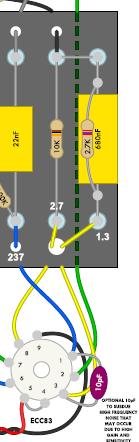
This 680nF (.68uF) cap & parallel 2k7 1w resistor from V1 pin 3 to ground is spec's as 150v on the Mojotone parts list.There's no harm in reusing the components if they check out, but it's also the best moment to put in new parts if you feel so inclined, your call...
The TAD branded cap that came with the amp says 680nF 150v.
I can't find an exact match from what's available on Amplified Parts.
The wiring diagram has 1.3v as the expected voltage at the turret connection from V1.
- How important is the 150v spec?
The only available Mallory .68uf is 100v. ($3.95)I can not remember ever having an issue with all of the Mallory caps I have installed.
I have a Vishay 250v in my list ($2.55), and there's also a 400v Vishay ($5.95).
Or a Zoso 200v ($11.40)
I had put all Vishay 22nF coupling caps in my list because of this cap.
Just so they all match brand - I know it doesn't matter...
If the 100v Mallory is sufficient, I could also go with all Mallory caps.

PelliX
Active Member
How important is the 150v spec?
Not important, or better said; it's massively over spec'd. 100V would be sufficient. While fairly inconsequential it would be best to orient this cap correctly, i.e. the outer foil side to ground. Some caps are marked (Mallory I believe can be trusted in this regard), others aren't and some are even labeled reversed. If you have a scope it's easy to test - alternately clip each end of the cap to the scope and leave the other floating. The side with the biggest "noise" deflection on screen is the outer foil end.
Not very important for this position, but worth getting right if you're re-doing it anyway. Particularly for coupling caps this is more important.

syscokid
Ambassador of War & Peace
Yes you have…Welp, I've gone and done it...
… And you have gone deep too. Might as well go deeper!So now I need to decide if I should test everything with the gizmo and reuse what is spec, or just buy all new do-dads.
For Marshall builds, I’m quite satisfied with the modern Mallory 150’s. Even more satisfied with the Vishay MKT-1813’s, which happen to have a smaller profile compared to others.