2016 Gibson SG T Series Road Test:

Been using the SG exclusively lately. The band have all commented on how loud it is without hurting your ears (the bassist is very voume sensitive) I am going to pull the pickguard tonight and bend the tabs on the neck pickup so I can move it parallel to the strings and thereby raise it a little higher. The relative low output of the GFS Alnico II pickups (7.93k/7.88k) and 9 feet of copper tape, allow me to run at incredible volume levels without squealing.

Just a minor clarification/correction...the copper tape (your shielding) has no impact on squealing, i.e., feedback.

The lower output of your pickups is the more likely reason you are able run at high volumes and avoid feedback.
 
Just a minor clarification/correction...the copper tape (your shielding) has no impact on squealing, i.e., feedback.

The lower output of your pickups is the more likely reason you are able run at high volumes and avoid feedback.

57 Classic's were nearly identical ohms ratings.
 
57 Classic's were nearly identical ohms ratings.

No argument there. However, the mechanism of induced noise and an audio feedback loop are two entirely different matters. Shielding can be effective against certain varieties of electronically induced noise. However, feedback is an acoustically-driven condition.

There are multiple potential reasons why your current pickups may be less sensitive to feedback that go well beyond an ohms rating. Output is one factor. Keep in mind, the ohms reading does not directly determine output. It is one indicator, but all it tells us is the DC resistance of the wire in the coil. Fewer turns of a smaller gauge wire may actually provide a higher ohms reading than more turns of a larger gauge wire. In my current quest for pickups, I've run across a few that have rather high ohms ratings, but actually have less output than other pickups with lower ohms ratings. The DiMarzio site is good in that they indicate not only the DC resistance of a pickup, but also the output in millivolts.

Frequency response is another important factor in feedback. Feedback does not usually happen across all frequencies at once. From venue to venue, some frequencies will be more likely to cause feedback. You can EQ feedback out of a room (to an extent) by determining the frequency that is contributing to the feedback and EQ'ing that frequency down. This is how "feedback eliminators" work. They automatically isolate the frequency that is feeding back, and they notch it out of the signal feeding the speakers. It may be that your GFS pickups are not as sensitive to the frequencies that were generating feedback in your 57 Classics. The thoroughness of the wax potting is another issue. No potting, or insufficient potting, can contribute to microphonics and feedback under very high gain. I realize 57 Classics are supposed to be wax potted, so that is likely not the reason for your feedback issues. But, if it was done poorly or incompletely, its effectiveness will be lessened.

The point is, your shielding will help alleviate certain electronically-induced noises by shunting those interferences to ground. But, feedback results from sound, not electronically-induced interferences.
 
Last edited:
No argument there. However, the mechanism of induced noise and an audio feedback loop are two entirely different matters. Shielding can be effective against certain varieties of electronically induced noise. However, feedback is an acoustically-driven condition.

There are multiple potential reasons why your current pickups may be less sensitive to feedback that go well beyond an ohms rating. Output is one factor. Keep in mind, the ohms reading does not directly determine output. It is one indicator, but all it tells us is the DC resistance of the wire in the coil. Fewer turns of a smaller gauge wire may actually provide a higher ohms reading than more turns of a larger gauge wire. In my current quest for pickups, I've run across a few that have rather high ohms ratings, but actually have less output than other pickups with lower ohms ratings. The DiMarzio site is good in that they indicate not only the DC resistance of a pickup, but also the output in millivolts.

Frequency response is another important factor in feedback. Feedback does not usually happen across all frequencies at once. From venue to venue, some frequencies will be more likely to cause feedback. You can EQ feedback out of a room (to an extent) by determining the frequency that is contributing to the feedback and EQ'ing that frequency down. This is how "feedback eliminators" work. They automatically isolate the frequency that is feeding back, and they notch it out of the signal feeding the speakers. It may be that your GFS pickups are not as sensitive to the frequencies that were generating feedback in your 57 Classics. The thoroughness of the wax potting is another issue. No potting, or insufficient potting, can contribute to microphonics and feedback under very high gain. I realize 57 Classics are supposed to be wax potted, so that is likely not the reason for your feedback issues. But, if it was done poorly or incompletely, its effectiveness will be lessened.

The point is, your shielding will help alleviate certain electronically-induced noises by shunting those interferences to ground. But, feedback results from sound, not electronically-induced interferences.

Lots of good observations you described here and your classification of the different noises are spot on too.

My 2017 Gibson Les Paul 50's Tribute would pickup and play a local radio station. It was unshielded and I think we can call this EMI.

The light hiss in my 2016 Gibson SG is not influenced by any external sources. This, I believe, is in the pickups themselves.

I guess I want to better understand all of this, even though I may not be able to change it...
 
Just a minor clarification/correction...the copper tape (your shielding) has no impact on squealing, i.e., feedback.

The lower output of your pickups is the more likely reason you are able run at high volumes and avoid feedback.

I think Eddie Van Halen said something like that about lower output pickups. He also got a Variac for his amplifier not to boost the voltage but lower it for a better sound.


;>)/
 
Pulled the SG out of the case last night. Haven't played it in a while. Good guitar. Fat .951" neck. I think the Burstbucker Pro's need to go in it.

I'm thinking I need to stick with Alnico II's in my 50's Tribute...
 
Robert that is a great story, and testament as to why the SG has been with us for so long. I love the SG myself.
I have played many others but the SG just feels the best to me.
Sound and tone are legendary.

I am happy you have reach the point of trust with yours.
 
Robert that is a great story, and testament as to why the SG has been with us for so long. I love the SG myself.
I have played many others but the SG just feels the best to me.
Sound and tone are legendary.

I am happy you have reach the point of trust with yours.

When I'm worn out from yardwork, its nice to grab such a lightweight guitar.
 
The Gibson product page says these are 8.3kΩ
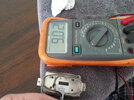
Your DCR reading of 9.02 seems to be normal when researching on the Web. In fact, quite a few results are showing the 57 Classic's DCR's at up to 8.3. I see various readings from 8.5 to over 9 for the 57 Classic Plus. Maybe Gibson took their readings while inside a cold meat locker... :dancepoo:
 
I just measured two guitars 1960 LPS DCR neck 8.02 ohms bridge 7.62 ohms 1958 LPS 7.77 ohms neck 7.87 ohms bridge so you can see that there not the same at all but are real PAF Gibson pickups. I have no clue what magnets were used. But they sound great.
 
Back
Top