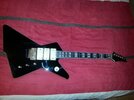
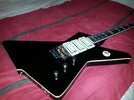
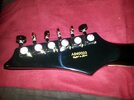
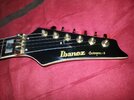
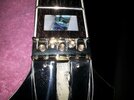
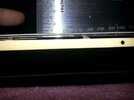
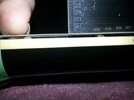
1984 Ibanez DT 555 Destroyer Replica Build:

Easy enough. Press down the strings at the first fret and see if it exceeds 1 semitone, when it begins to exceed 1 semitone, and how much it exceeds 1 semitone when fully depressed. That will give some indication of how high it is from a functional perspective.

Here's the tuner I currently use for intonation. With everything set and trem balanced, fretting the 1st fret will yield about 4-5 of those red blocks sharp. 3rd fret about 2-3 blocks...
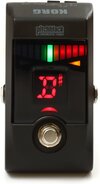
Pitchblack-large.jpeg
 
I will measure the first fret action later and post results...but its really high. Just guessing, I would say .045"/.050" at first fret with 12 fret set about .060" unfretted.
 
Here's the tuner I currently use for intonation. With everything set and trem balanced, fretting the 1st fret will yield about 4-5 of those red blocks sharp. 3rd fret about 2-3 blocks...

View attachment 7567
OK, so the conventional wisdom is that the action height at the nut should be the same as at the second fret with a capo on the first fret (near the nut).

The one thing this does not take into account is YOU. How tall are the frets? How hard do you press when you play? Those who press hard should get guitars with lower frets or learn to press less hard.

In your case, how hard did you press to get it to go that sharp? Is that how hard you normally press or did you over[press? Remember, this guitar is being set up for YOU.

So now, if you have not already done so, press at the first fret how you usually press them and see how sharp it gets. I would make my adjustments based on this.

This is true of all the frets. If they all go sharp when you play, you have 3 choices - learn to press lighter; shave down the frets and re-crown; play sharp all the time!
 
OK, so the conventional wisdom is that the action height at the nut should be the same as at the second fret with a capo on the first fret (near the nut).

The one thing this does not take into account is YOU. How tall are the frets? How hard do you press when you play? Those who press hard should get guitars with lower frets or learn to press less hard.

In your case, how hard did you press to get it to go that sharp? Is that how hard you normally press or did you over[press? Remember, this guitar is being set up for YOU.

So now, if you have not already done so, press at the first fret how you usually press them and see how sharp it gets. I would make my adjustments based on this.

This is true of all the frets. If they all go sharp when you play, you have 3 choices - learn to press lighter; shave down the frets and re-crown; play sharp all the time!

Good points. In setting guitars up, I am very aware of my touch. I use only enough for a clean note. In this case, the string is so high at the nut its being pushed sharp on its way to the fret like a tightrope.

In my case, I just refer back to my 2005 Schecter C1 Hellraiser - the best playing guitar I own - which has only .012"/.015" @ the first fret.

I swear the DT555 must have at least .060"/.080" @ 1st fret!
 
Last edited:
Here's the tuner I currently use for intonation. With everything set and trem balanced, fretting the 1st fret will yield about 4-5 of those red blocks sharp. 3rd fret about 2-3 blocks...

View attachment 7567

I would get a tuner that has more resolution in it's readings when setting intonation and doing setups. That tuner is good for tuning for gigs, but you need something more specific for setups.
 
Strobe Tuner
I would get a tuner that has more resolution in it's readings when setting intonation and doing setups. That tuner is good for tuning for gigs, but you need something more specific for setups.

Agreed. I'm slowly amassing more tools as we move along. I have a strobe feature available on the Korg Pitchblack, but I have always found it to be pretty close. I tune by ear first, then when it's close, I fine tune with a tuner....
 
I would get a tuner that has more resolution in it's readings when setting intonation and doing setups. That tuner is good for tuning for gigs, but you need something more specific for setups.
Strobe Tuner

The more I mess with guitars in general, the more respect I have for Schecter. On my 2016 Gibson SG, it intonates OK and it's fairly close along the board...but the Schecter is DEAD ON at every fret - from 'e' to 'E' all the way to the 24th fret....
 
i get mine close with strob tuner, then play under high gain and see which notes quiver and are sour no matter what that strob tuner says,then i adjust intonation by ear till i get it to sound good under high gain.if you can do this it will sound fantastic with low gain.see i factor in my bad playing habits and such. i actually run the EAD strings a hair flat tuned to pitch and i run the GBE strings a hair sharp.then adjust the G String to pitch and the B string a hair flat cause a big ol cowboy G chord sounds better with the B string a hair flat.then just adjust your small e to were it sounds good.i can relate to Robert cause i can hear all these imperfect notes in a guitar no matter what that strobe tune says so i factor all this in.Sorry Rober but i could care less about floor noise and wolftones lol
 
i get mine close with strob tuner, then play under high gain and see which notes quiver and are sour no matter what that strob tuner says,then i adjust intonation by ear till i get it to sound good under high gain.if you can do this it will sound fantastic with low gain.see i factor in my bad playing habits and such. i actually run the EAD strings a hair flat tuned to pitch and i run the GBE strings a hair sharp.then adjust the G String to pitch and the B string a hair flat cause a big ol cowboy G chord sounds better with the B string a hair flat.then just adjust your small e to were it sounds good.i can relate to Robert cause i can hear all these imperfect notes in a guitar no matter what that strobe tune says so i factor all this in.Sorry Rober but i could care less about floor noise and wolftones lol

Totally understand...

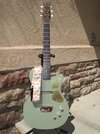
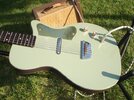
My obsession with "Wolftones" comes from having a really crappy Silvertone for years with the funky sliding cork bridge - it was never correctly intonated. Take a look:

1959 Silvertone  Guitar Strap.jpg

Silvertone Body.jpg


My playing style also amplifies ANY anomoaly with intonation, not to mention my hyper-sensitive ear....If you listen to "Still Got The Blues" by Gary Moore, you can hear how precise the opening notes are played. If you are having a Wolftone issue, the song will sound horrible...
 
Last edited:
You get that B string to flat then the cowboy E chord sounds crappy,also i do this on the GBE because for what wver reason the A string seems to be sharp,im sure its the presure i apply so that why i run the G string intonation a hair sharp but tuned to pitch,this seems to compensate. insanity i know
 
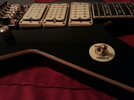
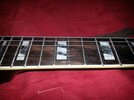
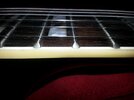
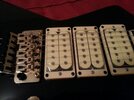
A few pics I shot tonight....haven't switched out the pickups yet or added the .022uf K40Y tone capacitor, so these are pre-modification shots.

The gold plated brass switch tip is visible. Thinking about a gold played brass poker chip and gold and black witch hats...:)

@RVA take a close look at the fretwork.

IMG_20170813_189.jpg

IMG_20170813_34276.jpg

IMG_20170813_6993.jpg

IMG_20170813_17435.jpg

IMG_20170813_18181.jpg

IMG_20170813_33795.jpg

IMG_20170813_44354.jpg

IMG_20170813_53259.jpg
 
Last edited:
Got fed up with the ridiculously high first fret action pulling everything sharp. So, I decided to set it up just like my Schecter.

IMG_20170815_59333.jpg
Slotted the R3 nut with a set of gunsmith files...

IMG_20170815_7409.jpg
Unfretted 2nd fret. I started with over .060" here.

IMG_20170815_15254.jpg
. 010" 2nd fret action when fretted at 1st fret.

I could have drastically cut the nut shelf or the nut itself. Instead, I opted to cut each slot in a radius that matched the fretboard.

Bedtime now...
 
My biggest complaint right now is getting the low E to sound in pitch at the 3, 5 & 7th fret positions. Its been tough splitting hairs, but I'm close now because a "Cowboy G" sounds good and a fretted "G" note on the low E sounds close to the open G.

My notes are a tad sharp at 3,5 & 7th fret, despite being almost dead on at the 12th.
 
So why didnt you just pull that locking nut off and sand the wood down ? just wondering

A couple of reasons....first of all, the distance between the bottom of the strings and the first fret was over .060" and the amount to remove from the shelf, in my opinion, would have weakened the neck in this area., as it's already pretty thin. Secondly, my sandpaper wrapped Arkansasa stone isn't the best way to cut the shelf either.

What's interesting was the G/B/e were not that bad, but the E/A/D were over .060" up off the frets, so I just approached it like a regular nut.

Did I do it wrong????
 
A couple of reasons....first of all, the distance between the bottom of the strings and the first fret was over .060" and the amount to remove from the shelf, in my opinion, would have weakened the neck in this area., as it's already pretty thin. Secondly, my sandpaper wrapped Arkansasa stone isn't the best way to cut the shelf either.

What's interesting was the G/B/e were not that bad, but the E/A/D were over .060" up off the frets, so I just approached it like a regular nut.

Did I do it wrong????

I would have taken material off the bottom of the locking nut.
Would have left no outwardly visible evidence.
But different minds see things differently...
And you were able to follow the radius the way you did it.

The clamps will cover the mod when reinstalled so I say Bravo Sir.
Job well done.

By the way, that's one sexy beast.
 
Back
Top