Do you top-wrap your TOM?

Here's a little illustration I made to illustrate my point.

Angle AB shows the string angle as it passes over the bridge. The angle shown is 166^ which equates to a 14^ break angle (180 - 14 = 166). This angle is bisected by ray CD. The bisector indicates the direction of force exerted by the string at the point of it's bend.

The angle of this bisection relative to the vertical line of the bridge posts (Line CE) gives some indication as to how much tendency there will be for the bridge to be pulled forward.

The point is, the angle of the string on the other side of the nut will not affect these angles, thus the tendency to exert a forward pull on the bridge.


View attachment 12325
Very nice! So if that is not an appropriate way to judge the best angle for direct downward pressure at the bridge, how would us guitar enthusiasts with no math skills make this determination?
 
Very nice! So if that is not an appropriate way to judge the best angle for direct downward pressure at the bridge, how would us guitar enthusiasts with no math skills make this determination?

Don’t misunderstand!

I’m not saying down pressure has no value. I mean, you gotta have some or the strings would flop around in the saddles!

When working with a stop tail guitar, I just set the stop bar as low as I can without letting the strings hit the back of the bridge. That’s pretty much it.

I don’t like top wrapping because I don’t want to scratch up my stop bar. But, I like to lower the stop bar as far as possible because that leaves more of the stud in the body for better anchoring.

I really don’t think about trying to make the break angles over the bridge and nut match because I don’t think it’s that important.
 
Don’t misunderstand!

I’m not saying down pressure has no value. I mean, you gotta have some or the strings would flop around in the saddles!

When working with a stop tail guitar, I just set the stop bar as low as I can without letting the strings hit the back of the bridge. That’s pretty much it.

I don’t like top wrapping because I don’t want to scratch up my stop bar. But, I like to lower the stop bar as far as possible because that leaves more of the stud in the body for better anchoring.

I really don’t think about trying to make the break angles over the bridge and nut match because I don’t think it’s that important.
Understood, thank you. So would you say that any variance with respect to the angle would not have a significant impact, so don't worry about it, or is there an optimal angle to be discerned?
 
Understood, thank you. So would you say that any variance with respect to the angle would not have a significant impact, so don't worry about it, or is there an optimal angle to be discerned?

I don’t know if there is an “optimal” angle. I know Gibson uses 14 to 17 degrees on their headstock angle, so there is a natural tendency to want to duplicate this at the bridge. I don’t think that’s necessarily a wrong idea. It seems a workable rule of thumb. I just don’t see it as an obligatory goal. Like I said, I lower my stop tail as far as I can while still clearing the back of the bridge and pretty much leave it at that.

Interestingly, many lutes have a 90 degree headstock angle and tie-on bridges like a classical guitar. Break angle symmetry pretty much goes out the window with those!

As for the effect of different angles, you could play around with the stop bar height of one of your LP-type guitars and see what the effect is.

I know my 2014 SG with a really flat angle has less sustain than my Les Paul, but there are other potential causes for that, so it’s an apples and oranges comparison.

My personal sense, though, is that a few degrees really won’t make much difference.
 
Last edited:
I don’t know if there is an “optimal” angle. I know Gibson uses 14 to 17 degrees on their headstock angle, so there is a natural tendency to want to duplicate this at the bridge. I don’t think that’s necessarily a wrong idea. It seems a workable rule of thumb. I just don’t see it as an obligatory goal. Like I said, I lower my stop tail as far as I can while still clearing the back of the bridge and pretty much leave it at that.

Interestingly, many lutes have a 90 degree headstock angle and tie-on bridges like a classical guitar. Break angle symmetry pretty much goes out the window with those!

As for the effect of different angles, you could play around with the stop bar height of one of your LP-type guitars and see what the effect is.

I know my 2014 SG with a really flat angle has less sustain than my Les Paul, but there are other potential causes for that, so it’s an apples and oranges comparison.

My personal sense, though, is that a few degrees really won’t make much difference.


I just clear the bridge....
 
The less that comes in contact with the strings the better. Retarding the vibration of the strings an mess up the tone you had or wanted. Less contact is less friction is one thing I work at on my guitars. Roller bridge and if I can I use roller nuts. Running strings over a half inch of metal is not what I want to do. I raise the stop bar to clear the bridge. I changed both of my Telecasters to top loaders. I changed both of the bridges to the older brass saddle type.
 
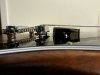
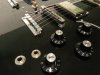
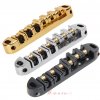
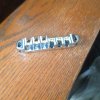
IMG_7270.JPG IMG_7273.JPG IMG_7300.JPG Most of my TOMs go in the dust bin. Drag strings over what looks like a blade of a bread knife is no way to make sweet music. When I play hard the thin E has tried to commit suicide by jumping out of its place. The roller bridge has fixed some problems. My old friend from senior school said I dropped the value of the guitar. I play them till they are near dust. I did not go to all the trouble of talking Lina to buy me the the perfect Christmas or birthday or ? gift to sell it. Gibson guitars don't grow on trees and there are not to many women with that kind of loot in their underwear drawer.
 
Back
Top