Well...my story took place when I was working for a university police department in Central California in May of 1994.
It was an ordinary day, roughly 3pm, when one of the front desk ladies called my issued cell phone.
She reported a white male, 45-50 years, wearing a tan suit and fedora, acting strangely in the front office. The clerk said he seemed disoriented.
As I walked in the west door, I caught a glimpse of the man walking through the east exit door, which is glass. The clerk pointed to the door and I stepped through it seconds later.
This door opens into a grassy area, about 250 feet from State Highway 63, which serves as one of Visalia's main thoroughfares.
The man was gone. Visibility was unlimited and he simply disappeared. I radioed a description of the man to surrounding units and described him as a possible "at risk" subject, perhaps a person suffering from dementia.
I then returned to the office and interviewed the clerk. She advised the man walked into the office, looking disoriented. She asked him if he wanted some water. The man nodded and she handed him a clear, plastic cup from the water cooler.
He then asked her for the date and the clerk advised him of the month and day of the week. He replied, "What year?" Puzzled, the clerk replied "1994," and the man walked out as I was walking in.
Thinking the man might be an endangered adult, I sought to identify him by the fingerprint evidence on the cup. I booked it into evidence and sent it to the Cal-ID unit at the sheriff's office and marked the request as urgent.
I used a PC based facial composite system to create a 'sketch' of our victim and prepared to issue a press release for a possible missing/endangered adult.
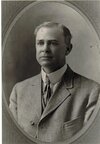
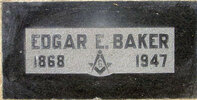
The Cal-ID tech called me and advised that he identified two persons from the fingerprints on the cup - the clerk and a Visalia resident named Edgar Baker. The problem was that Baker died in 1947 and was buried in Visalia Cemetery.
I was stunned when we found a photo of baker - it matched the composite sketch exactly.
I reported my findings to the Chief of Police in written format.
The next morning, I was advised the university president, Douglas Ketchter, wanted to see me. He asked me to describe what took place and the results of my investigation. Ketchter told me to forget about the event and to speak to no one about it. When I questioned his rationale, the Chief of Police walked in and directed me to never speak of the event and to destroy all my notes. The case number was deleted from the ledger and all electronic and physical copies of the report were destroyed - except for the hard copy i had in my possession.
Baker was a distinguished member of the local Masonic Lodge. I later interviewed the Cal-ID tech to ask what the probability was that two people could have matching fingerprints. He told me not only was it impossible, but Baker had a pronounced scar on one finger that could not be duplicated.
The mystery has never been solved...