A Question Of White Noise:

Inspector #20

Ambassador of Tone
Fallen Star
Country flag
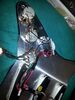
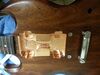
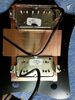
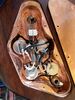
I'm intrigued by this....as many of you know, I have extensively shielded my guitars. My 2016 Gibson SG has some light "white noise" from the Alnico II pickups (7.93/7.88k) that is always present, but never changes. I've just accepted this as the noise gate keeps it quiet.

However, my 1987 Stratocaster with ancient DiMarzio Stacked Single Coils is dead quiet - I mean at full gain there is no hiss, no nothing.

The bridge is a 1992 Virtual Vintage Solo measuring 10k. It has the original, 1987 pots, caps and wiring.

Same with my 2005 Schecter C1 Hellraiser with EMG'S.

So, this light hiss when the humbuckers in my SG are engaged is very light. But, because I run so much volume and gain, the noise is amplified exponentially.

I've encountered this sound on a number of humbuckers in other guitars as well, with and without the high quality cloth/Bourn harness/pots.

Now what really surprises me is the quietest humbuckers I have ever seen were a set of cheap Epiphones I put in my Mom's Les Paul Custom Replica.

The noisiest were my Gibson 57 Classics without question.

I am curious as to how some humbuckers seem to exhibit this "white noise" and others do not. It is clearly an attribute of the pickup and has nothing to do with shielding

Thoughts??? Experiences???
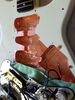
IMG_20170917_4357.jpg IMG_20170306_36990.jpg IMG_20170121_4928.jpg IMG_20170122_24511.jpg IMG_20170307_5510.jpg
 
Okay...this can get into some interesting territory. This introduces a concept called, "Common-Mode Rejection" (CMR). The ability of a device to reject a common-mode is called its "Common-Mode Rejection Ratio" (CMRR).

So, what is a common-mode? Simplistically speaking, a common-mode is a signal that is present simultaneously and in phase on two or more conductors. Most often the term is meant to describe some type of interference, such as EMI, that is induced onto two conductors at the same time, such as the two coils in our humbucking pickups.

As you know, our typical humbucking pickups are made of two coils, which are electrically out of phase with each other. Also, the slugs protruding through each coil are in contact with opposite poles of the magnet. One side is north, the other side is south. So, the two pickups are also magnetically out of phase with each other. This is what is meant by Reverse-Wound, Reverse-Polarity (RWRP). This will be important in a minute.

Back to CMRR...

So, when the outside interference is induced onto both coils, that interference falls on each coil at the same time and in the same phase. This is why it is called a "common" mode. It is common to both coils. But, since the coils are electrically out of phase, when the signals on each coil meet, they cancel each other out.

But, why doesn't the pickup cancel out the desired sound, too?

The reason is that the coils are also magnetically out of phase, as mentioned above. The magnet does not play a role with interference induced externally, but it does play a role in generating the desired signal. So, if you have two coils that are electrically out of phase by 180 degrees, but those coils are also magnetically out of phase by 180 degrees, when the signals meet where the coils join, the signals will be back in phase (180 + 180 = 360). Consequently, they will be additive. This is one of the big reasons why humbuckers are generally louder than single coils.

So, the induced noise only deals with the coils that are electrically out of phase, so the noise cancels out. But, the desired signal deals with coils that are both electrically and magnetically out of phase, which has the net result of the desired signal being in phase.

This gets to why some humbuckers are better at hum cancellation and why others are noisier. Passive common-mode rejection using coils is not as effective as active electronic CMR using differential amplifiers. However, to be most effective, the two coils have to be as perfectly matched as possible. Any mismatch, as may result from a different number of coil windings, will result in less effective hum cancellation.

Incidentally, cloth-covered wire and PIO caps are not high quality. They are revered in the guitar world. But, from the standpoint of electronics, they are really considered to be rather sub-par items.
 
Last edited:
Okay...this can get into some interesting territory. This introduces a concept called, "Common-Mode Rejection" (CMR). The ability of a device to reject a common-mode is called its "Common-Mode Rejection Ratio" (CMRR).

So, what is a common-mode? Simplistically speaking, a common-mode is a signal that is present simultaneously and in phase on two or more conductors. Most often the term is meant to describe some type of interference, such as EMI, that is induced onto two conductors at the same time, such as the two coils in our humbucking pickups.

As you know, our typical humbucking pickups are made of two coils, which are electrically out of phase with each other. Also, the slugs protruding through each coil are in contact with opposite poles of the magnet. One side is north, the other side is south. So, the two pickups are also magnetically out of phase with each other. This is what is meant by Reverse-Wound, Reverse-Polarity (RWRP). This will be important in a minute.

Back to CMRR...

So, when the outside interference is induced onto both coils, that interference falls on each coil at the same time and in the same phase. This is why it is called a "common" mode. It is common to both coils. But, since the coils are electrically out of phase, when the signals on each coil meet, they cancel each other out.

But, why doesn't the pickup cancel out the desired sound, too?

The reason is that the coils are also magnetically out of phase, as mentioned above. The magnet does not play a role with interference induced externally, but it does play a role in generating the desired signal. So, if you have two coils that are electrically out of phase by 180 degrees, but those coils are also magnetically out of phase by 180 degrees, when the signals meet where the coils join, the signals will be in phase (180 + 180 = 360). Consequently, they will be additive. This is one of the big reasons why humbuckers are generally louder than single coils.

So, the induced noise only deals with the coils that are electrically out of phase, so the noise cancels out. But, the desired signal deals with coils that are both electrically and magnetically out of phase, which has the net result of the desired signal being in phase.

This gets to why some humbuckers are better at hum cancellation and why others are noisier. Passive common-mode rejection using coils is not as effective as active electronic CMR using differential amplifiers. However, to be most effective, the two coils have to be as perfectly matched as possible. Any mismatch, as may result from a different number of coil windings, will result in less effective hum cancellation.

Incidentally, cloth-covered wire and PIO caps are not high quality. They are revered in the guitar world. But, from the standpoint of electronics, they are really considered to be rather sub-par items.

Thank you, Smitty. I really do appreciate the in depth analytics....here's my question...what is it that a humbucker creates that light buzz/hum when activated...a nise that is ever-present, never goes away or changes under any conditions????
 
Even humbucking pickups are not immune to having at least some noise.

Are you sure some of this isn't your effects and amp?
 
Just curious, is this more of a hum or hiss? And does it change when you select both pickups?
 
Robert...If your NS2 is set up properly, there should be nothing but any signals generated by anything downstream...fx pedals, and/or amp. The NS2 is a gate...an electronically actuated off switch for your instrument cable. When it's set to reduction, and the second little red light comes on full, the signal from your guitar is cut off at that point in the chain.
As it starts to dim, it fades the signal back in.
If your NS2 is not doing this, it has been doing nothing.
 
Robert...If your NS2 is set up properly, there should be nothing but any signals generated by anything downstream...fx pedals, and/or amp. The NS2 is a gate...an electronically actuated off switch for your instrument cable. When it's set to reduction, and the second little red light comes on full, the signal from your guitar is cut off at that point in the chain.
As it starts to dim, it fades the signal back in.
If your NS2 is not doing this, it has been doing nothing.

It's when the gate opens you hear it....like on recordings....very pronounced on tape.
 
It's when the gate opens you hear it....like on recordings....very pronounced on tape.
Then I'm with Smitty...unbalanced coil windings are a likely contributor.
My 2x P90 Gladiator has a rwrp pickup set. With the pickup selector in the middle position, and volume controls set to balance the pickups at unity, it's near perfectly quiet. I am able to dial in noise by slowly, slightly, adjusting one volume knob or the other. I think that the tone knobs even have a slight effect on the noise too. Anything that brings the two coils out of unity brings in the noise....they wind some humbuckers off balance "on purpose".
 
Ech, just rev it up and go. This is Rock-and Roll, right? Who cares about a little noise. You ever listen to the isolations of your favorite recordings? A mess - hum, hiss, finger noise, etc. All of it glorious.

LOL very true....
 
Back
Top