

PelliX
Active Member

While seeing if there's any way to organize imagines/media here that I overlooked, I uploaded a few pics of the last project on the bench (spoiler, it's fully functional and calibrated, off the bench now). Here's an old TV-7B/U that I guesstimate to have been made by Hickok in 1958. It was a bargain and came with no lid, no documentation, no probes and even the schematic had been torn out of the bottom. The important parts proved to be in OK condition, though. Obviously it all needed a bit of a good clean, the bathtub cap came to life only to die during initial testing without the rectifiers installed. While I could have re-stuffed it I opted to simply leave it as is, sealed and safe and mounted a new capacitor above it. Its only purpose is to smooth the needle movement. Next up, every switch and contact needed a little cleaning while paying care not to get too much of anything on the old phenolic boards.


The insides were actually not bad, given the units' age and presumed military history together with a case that looks as if it endured several significant wars. Or one trip with your parcel service of choice.... [ahum]
Three 47 Ohm CC resistors were removed from the selector switches and replaced with 1W wirewound replacements. Two of them had drifted up to nearly 50 Ohms. Within tolerance and no signs of overheating but they've seen their finest days likely.
The AC mains lead was the original and it was cracking around the entry point through the faceplate. As I run it on a step down transformer (I'm in 230VAC land) I opted to replace it with a longer flex, giving me about 5m to move it from one spot to another without lifting the transformer, too.

That's a #83 mercury vapor rectifier and a smaller 5Y3 behind it. Both could well be original by date and origin and still function. I reconditioned the #83 according to the RCA manual, yet I'm not convinced it was necessary. A fair deal of the plate coating has come loose inside the #83 and lays in the bottom of the envelope, presumably harmlessly. The bulb has separated from the base, but without damaging anything. This may have happened in transport, as the retainer ring for the valve was also loose in the bottom...


I have a couple of spare 5Y3's and GZ34's which would also do the trick, but this one seems just fine and dandy...

You can just faintly make out the blue glow of the mercury vapor in the #83. It lights up a little more when delivering anode current, but nothing spectacular. I'm honestly not very familiar with these, but I'm sourcing a couple of spares to compare and test with.


The Army service manual is a little back-to-front if you ask me. After dutifully working through the various steps it more or less ends with the filament voltage which cannot be calibrated and comes straight from the transformer's various secondary taps for this purpose. It would make more sense to *start* with the filament voltage, adjust the meter accordingly for the line test, and *then* proceed to adjust the various values for the things that *can* be tweaked (grid voltages, etc). Just why they suggest to do it the other way around escapes me.
Obviously, not having the leads means I'm missing a couple of adapter sockets (though socket savers were preinstalled on the octal, noval and mini-7 pin sockets, yay) and the grid/plate caps. I didn't have a suitable pair of clips for the purpose but I do have a little drawer full of the pin connectors used for the connections on the unit itself... so with a little disrespect to safety, I quickly knocked up a couple of improvised leads for testing.
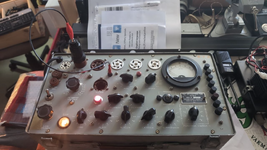
The meter and all the voltages now check out well within spec, though some of the heater voltages are a little 'off', despite their neighboring settings being fine. As they're overall a little higher than anticipated on the 'problematic' settings I don't believe there are any shorted windings in the transformer. Obviously, unloaded voltages will read high but I have a Low-Z meter to compensate. On the bright side they *are* within tolerance. The main drawback is that aging valves' performance tends to depend more and more on filament voltage (temperature) as they get older. This means it the test could be higher than actual operation in the target equipment, but one can drop the line voltage to match the filament spec and test that way. A slightly lowered plate voltage is less critical when testing IMHO. I've calibrated it so that the 6.3V, 5V and 12.6V taps are correct-ish. It unfortunately lacks a 40V setting for the European Pxxxx valves of which I have a box but this can be compensated for by abusing the line voltage or feeding in DC from a lab power supply through a special socket adapter.
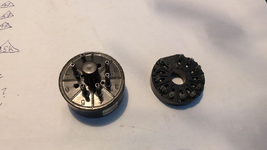
On the note of special adapters, I also have some old AM/FM final stages that use Compactron type sweep valves. These were never supported by the TV-7, but if one adds some ferrite beads to the leads/sockets it's possible to test high mu valves (even an EL84 is a challenge without). I have a Compactron 12-pin socket which allows me to test my 6KD6's... but I needed to make an adapter.
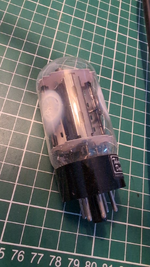
"TAD make da bestest toobs..."
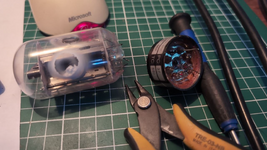
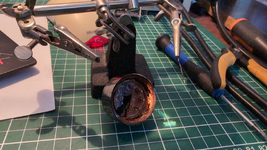
This old 6L6 has 6 pins in its octal base. Technically, that should be enough; 2x filament, 1x control grid, 1x screen grid, 1x suppressor grid, 1x cathode. The plate uses an anode cap. To be continued.
The insides were actually not bad, given the units' age and presumed military history together with a case that looks as if it endured several significant wars. Or one trip with your parcel service of choice.... [ahum]
Three 47 Ohm CC resistors were removed from the selector switches and replaced with 1W wirewound replacements. Two of them had drifted up to nearly 50 Ohms. Within tolerance and no signs of overheating but they've seen their finest days likely.
The AC mains lead was the original and it was cracking around the entry point through the faceplate. As I run it on a step down transformer (I'm in 230VAC land) I opted to replace it with a longer flex, giving me about 5m to move it from one spot to another without lifting the transformer, too.
That's a #83 mercury vapor rectifier and a smaller 5Y3 behind it. Both could well be original by date and origin and still function. I reconditioned the #83 according to the RCA manual, yet I'm not convinced it was necessary. A fair deal of the plate coating has come loose inside the #83 and lays in the bottom of the envelope, presumably harmlessly. The bulb has separated from the base, but without damaging anything. This may have happened in transport, as the retainer ring for the valve was also loose in the bottom...
I have a couple of spare 5Y3's and GZ34's which would also do the trick, but this one seems just fine and dandy...
You can just faintly make out the blue glow of the mercury vapor in the #83. It lights up a little more when delivering anode current, but nothing spectacular. I'm honestly not very familiar with these, but I'm sourcing a couple of spares to compare and test with.
The Army service manual is a little back-to-front if you ask me. After dutifully working through the various steps it more or less ends with the filament voltage which cannot be calibrated and comes straight from the transformer's various secondary taps for this purpose. It would make more sense to *start* with the filament voltage, adjust the meter accordingly for the line test, and *then* proceed to adjust the various values for the things that *can* be tweaked (grid voltages, etc). Just why they suggest to do it the other way around escapes me.
Obviously, not having the leads means I'm missing a couple of adapter sockets (though socket savers were preinstalled on the octal, noval and mini-7 pin sockets, yay) and the grid/plate caps. I didn't have a suitable pair of clips for the purpose but I do have a little drawer full of the pin connectors used for the connections on the unit itself... so with a little disrespect to safety, I quickly knocked up a couple of improvised leads for testing.
The meter and all the voltages now check out well within spec, though some of the heater voltages are a little 'off', despite their neighboring settings being fine. As they're overall a little higher than anticipated on the 'problematic' settings I don't believe there are any shorted windings in the transformer. Obviously, unloaded voltages will read high but I have a Low-Z meter to compensate. On the bright side they *are* within tolerance. The main drawback is that aging valves' performance tends to depend more and more on filament voltage (temperature) as they get older. This means it the test could be higher than actual operation in the target equipment, but one can drop the line voltage to match the filament spec and test that way. A slightly lowered plate voltage is less critical when testing IMHO. I've calibrated it so that the 6.3V, 5V and 12.6V taps are correct-ish. It unfortunately lacks a 40V setting for the European Pxxxx valves of which I have a box but this can be compensated for by abusing the line voltage or feeding in DC from a lab power supply through a special socket adapter.
On the note of special adapters, I also have some old AM/FM final stages that use Compactron type sweep valves. These were never supported by the TV-7, but if one adds some ferrite beads to the leads/sockets it's possible to test high mu valves (even an EL84 is a challenge without). I have a Compactron 12-pin socket which allows me to test my 6KD6's... but I needed to make an adapter.
"TAD make da bestest toobs..."
This old 6L6 has 6 pins in its octal base. Technically, that should be enough; 2x filament, 1x control grid, 1x screen grid, 1x suppressor grid, 1x cathode. The plate uses an anode cap. To be continued.


