✧ Project: Orpheus - Imagine Create Share ✧

Who knows? You could very well already bring better at this than me! I certainly don't want this a full cookie-cutter process for all... different approaches will provide us variations in our results.
Neither of those should be your concern. I didn’t even make a dent last year but I had fun trying. As far as cookie cutter, the process is under your control.
 
22865d4b8b7e517dce1b60a2988c8482.gif


I'm finding I want to try to incorporate almost every idea into something larger. Even while I do this I know it's a mistake. I've had a lifelong problem of not knowing when to let go or judiciously filter.

I've already roughly penned lyrics for one song, halfway through another, and have formed a loose plot narrative. You absolutely don't need to be there yet!!!

I'm trying to stay ahead of the pack so I can better plan and guide others. I also still have lots of chapter reveal planning work to do in the background.

Being just slightly ahead, I'm hoping to discover some traps and problems so maybe I can warn about them.

What I'm trying to say is, I'm feeling my lyrics are trying a bit too hard to jam ALL my sparks in. Too literal. Maybe this is natural. Some serious editing and revising will need to happen. It's like cooking with too many ingredients.

But having a full pantry is GREAT place to start!
 
I now can see how AI can help without it creating the song. I have a title in mind but I was struggling for ideas. I went to ChatGPT and typed in a paragraph with the song title and what I wanted the song to be about. The results were not very good but I did get a couple of ideas for a chorus. If it's used to spark your creativity I have no problem with that. I remember reading that Bowie would cut up newspaper and magazine articles then randomly chose snippets to spark his creativity. As long as the creativity comes from you where the spark came from doesn't matter.
 
Interestingly, i am doing another concept Album right as this going on, it's is just a way of life in my world i guess. Tend to capture REALITY and let the music and lyrics reflect what i am feeling or reacting to.. so the concept albums have done literally are time capsules of my life. When i go back and listen, oh man does the emotion and reflection rise back up. What is so cool there aint a fake device that could out create or take from me what is my ART ! Carry on gents.....
 
Did two test runs yesterday with two rough lyric sheets. I was flabbergasted how well they came out. Saw how a few tweaks would nudge them even better. But, I shrugged it off. "Nah... I'll just stick with the FREE version."

Then... this appeared on the reddit user group (tons of tips and user cases there).

8PiewPiS_o.jpg


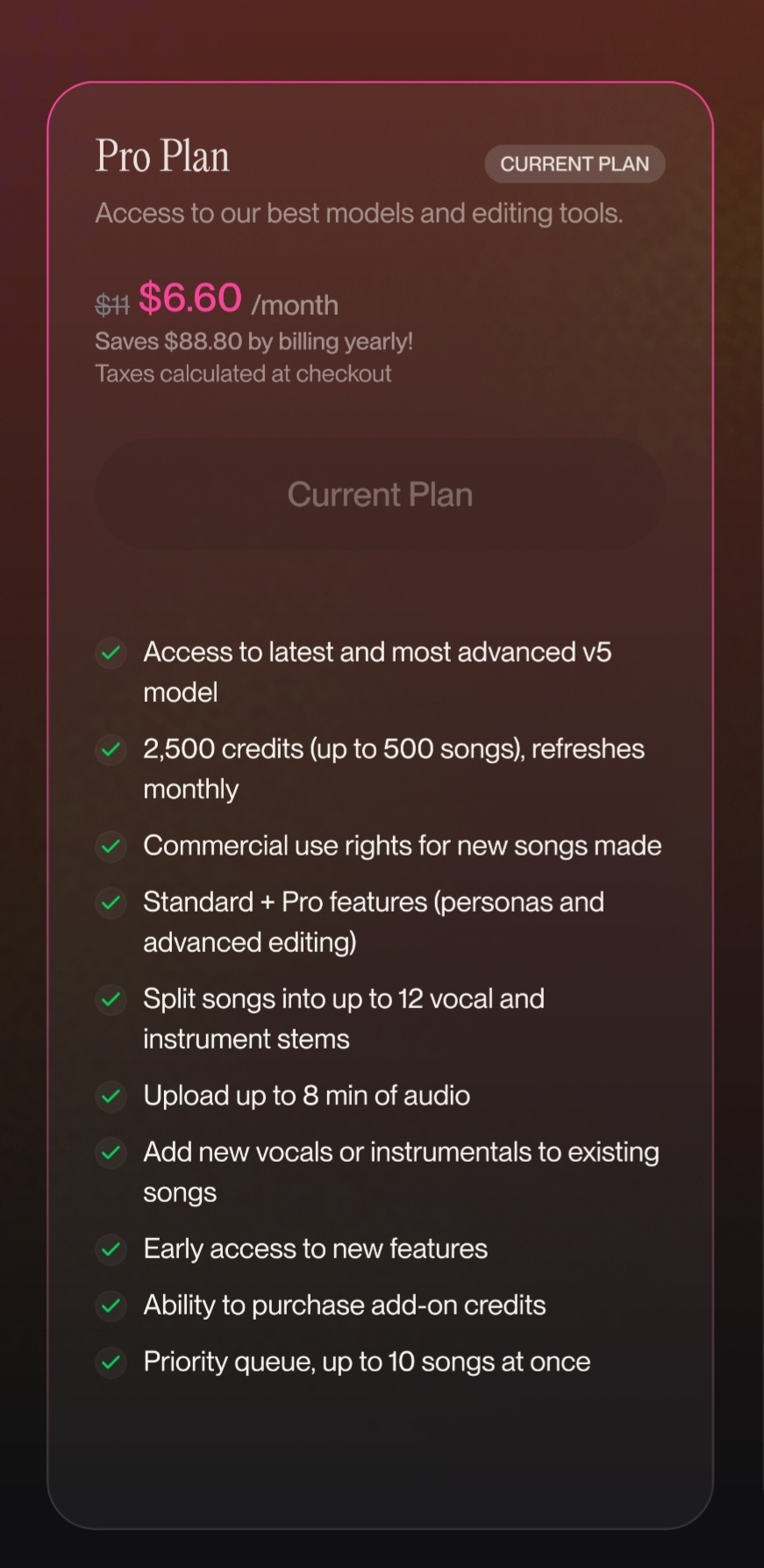
Too timely. Knocked down to nearly 1/2 price. Black Friday thing. Pro Plan

This gives you much more power. Stems, persona, many more credits etc.

I succumbed this morning.


EDIT bit of a warning, this does NOT give you Suno Studio, but does give you "stems"
|In a quick test this morning, it's still clunky. But might be partially useable.
 
Last edited:
Breaking news... Suno and Warner announced some sort of partnership deal today... the "Sunoverse" of users seems rather upset. The website is under extreme stress today with people mass-downloading their generated content..
I don't know enough about the topic to say good/bad either way but the general word is they "sold out to the man" and it will limit the learning capabilities, creation models, and likely cost users much more in the future. Suno has promised a significant "upgrade" in 2026. Things seem rather fluid in the world of AI companies.

If you scratch-make all your content, you can just smile!
 
One word of warning... file management! in a notebook, fine... but once you start recording or typing notes, lyrics and charts,

Organization is crucial for a bigger project like this and best planned out in advance and try to stick to it. I'm already a bit buggered up, and need better to sort out where stuff needs to go so I'm not searching for it later. A big part of my issue is I'm writing sparks, notes and lyric bits on my phone, my desktop AND in my physical notepad.
 
One week since soft launch... we "officially" begin probably Sunday night.
At this point it's likely you have fallen into one of these categories:

1. No sparks, no interest
2. few sparks, mostly uninspired
3. Lots of sparks, mind reeling to make sense of it all
4. You've already written lyrics for a song or two, maybe made music too!

The next steps for December I'm gonna divide into sections... though you as artists and creatives are fully free to go your own directions.
I think actually December may be one of the harder months, because this pre-planning is extra work, so I won't be adding collaboration or side projects
for December. By the end of December I hope we can all share at least one track, likely our "opener" or "overture" which will help set our tone.

There is some advantage in considering the methodical approach, to help keep you on track. Slower and steadier is solid advice... This is why Orpheus was devised as a year-long process. What can happen in larger undertakings like this is the half-written novel syndrome. A HOT creative fire ignites for 3 or four chapters, then the novelist hits a wall and the book remains unfinished forever. Even worse, it'll then gnaw away at an artist's self-esteem years into the future.

Why does this happen?

Most often, not enough care in planning out a compelling plot or storyline. One offering a path forward, that keeps you inspired. Other problems that arise via bad planning are disjointed stories which make little sense, too much repetition and/or tracks which end up feeling like fillers because they don't help propel the story.

Slowing things down allows you to put more thought and care into each "chapter" or song in this case.
Collections of work like this should always be more than the sum of individual parts, so let's make each part as strong as possible.

NEXT STEP
I'm hoping within the first few days Orpheus participants will be ready to share our simple "elevator pitches" for the epic tales we are each about to build.
If you want to keep your cards close to your chest that's fine too, but at least have a very basic one-sentence description. A lot of the fun to be had here
will be watching how others develop what they are working on.

tumblr_n9tce2qPTN1qedb29o1_500.gif


After we get our Elevator Pitches down, we begin "plot mapping" to round out Week One.
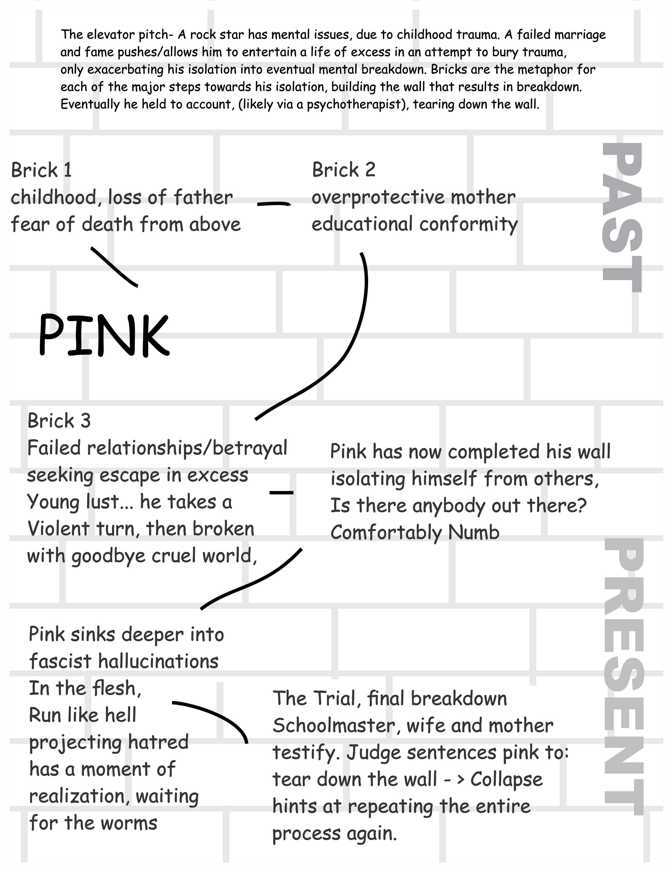
To prime you in that direction, here's a rather rough one I made of Pink Floyd's "The Wall" for your consideration.
I figure most of your are somewhat familiar with it, and it's famously one of the best of all concept album works.
Take note of the Elevator pitch. Yours may not be quite so detailed.

Do we know if Roger Waters actually completed this process? Possibly intuitively.
The band was already pretty much masters of the craft at this point.

UcYrJybR_o.jpg


Anybody want to share something which has happened with them so far? A spark? Anything?

VqzZtPr0_o.gif
 
Sure got quiet in here! Is everybody intimidated AF? Who's grindin' away already?

I'm not sure how my Sunday/Monday will go with health shuttle duty for various family members, No reason to wait.

So I'm releasing the first OFFICIAL Project Orpheus installment tonight.

Let's talk about

dbmqjUzk_o.gif


This first month, there’s quite a lot of extra prep work before we get to the funnest part, the music-making, but if you do this work I GUARANTEE you the other chapters will fall into place way easier.

From my limited experience and research, seems like every good concept album can be broken down into big conceptual chunks such as the following:

1. Central theme
2. Narrative structure or story (the theme broken down into plot "chapters" or songs)
3 Overall vibe or stylistic approach

4. Characters

For our starting purposes, only the first two are most important for this chapter. Your elevator pitch is due here in the next couple days, your central theme,
or “Core Concept.” Be sure to choose one that fires you up a little bit, gets your creative juices flowing... or your next year is probably gonna really suck LOL!

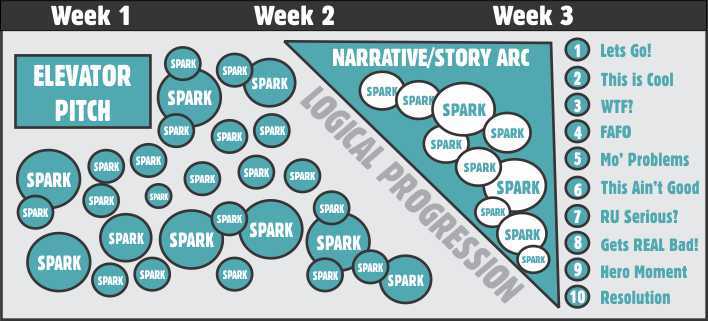
Once that's nailed down, shared here, we get to brainstorm and organize our numerous idea sparks into a beginning, middle and end, a rough narrative plan -> individual plot steps. These plot points become the basis for individual songs. Also at this time understand yourvnarrative planning does not absolutely tie you down. As we go, I fully expect all of us will change our minds from our original plans as better notions arise and we figure out what we're doing. However, if you don’t have at least some kind of rough plan in place by week two, it’s going to be real hard to move towards individual components.

We do all this to build a logical story. Properly done, it'll have highs, lows, and a flow which keeps listeners engaged and interested in what's around each next corner.

May sound challenging but your narrative plot plan is basically just a more fleshed-out elevator pitch, broken down into steps, like chapters of a book.

A simple way I found to help myself down this road was 10 dummy song titles that reminded me of each plot step.

Probably wouldn’t hurt at all to do a word map like you saw I did for The Wall in the previous post for your own plot planning. I found that exercise somewhat helpful in rearranging possible song order, which I expect to continue to struggle with for a few months I think.

I'm a bit ahead now with four titles I think are solid, the rest sort of up in the air, still loosely positioning themselves for overall album flow. That flow is another thing I will bring up more on in coming days.

L6mC3Mcl_o.jpg


Note there are a LOT more sparks, and I hope you have a load of 'em like I did. When you start organizing them in some sort of logical story order, you'll find you can often double or triple them up into one chapter, plus maybe you'll think of new ones, or set aside some that don't fit quite right.

Don’t feel you have to reveal any titles as of yet if you don’t wish to, you can expect this will likely adapt and change as you go. Perhaps just the title of our very first song, our “Overture” or introductory musical piece. By the end of week three, you should have a rough narrative plan, and a list of ten working titles (which will NOT have to be public... yet).

My hope is through all this "Lego Brick" organizing you’ll automatically begin thinking about an overall vibe for your concept record, probably characters too, and how to set the tone or mood with your first introductory piece.

We want to start on that by the end of week three, so you’ll still will have three weeks left to work on that.

My hope is we can reveal/ share work on our first piece after week six. It will likely be a rough version. You may finish it at your leisure even into the next chapter if required.

l1dRjr5F_o.gif
 
Last edited:
To free up my next couple of days, my elevator pitch goes like this:

A highly successful tech utopia springs up in an unlikely place inspiring deep national and international envy. This sparks amplifying stages of conflict causing the society to desperately pin hopes on a surprise hero-class to save them from dark geo-political destruction.
 
Last edited:
One week since soft launch... we "officially" begin probably Sunday night.
At this point it's likely you have fallen into one of these categories:

1. No sparks, no interest
2. few sparks, mostly uninspired
3. Lots of sparks, mind reeling to make sense of it all
4. You've already written lyrics for a song or two, maybe made music too!

The next steps for December I'm gonna divide into sections... though you as artists and creatives are fully free to go your own directions.
I think actually December may be one of the harder months, because this pre-planning is extra work, so I won't be adding collaboration or side projects
for December. By the end of December I hope we can all share at least one track, likely our "opener" or "overture" which will help set our tone.

There is some advantage in considering the methodical approach, to help keep you on track. Slower and steadier is solid advice... This is why Orpheus was devised as a year-long process. What can happen in larger undertakings like this is the half-written novel syndrome. A HOT creative fire ignites for 3 or four chapters, then the novelist hits a wall and the book remains unfinished forever. Even worse, it'll then gnaw away at an artist's self-esteem years into the future.

Why does this happen?

Most often, not enough care in planning out a compelling plot or storyline. One offering a path forward, that keeps you inspired. Other problems that arise via bad planning are disjointed stories which make little sense, too much repetition and/or tracks which end up feeling like fillers because they don't help propel the story.

Slowing things down allows you to put more thought and care into each "chapter" or song in this case.
Collections of work like this should always be more than the sum of individual parts, so let's make each part as strong as possible.

NEXT STEP
I'm hoping within the first few days Orpheus participants will be ready to share our simple "elevator pitches" for the epic tales we are each about to build.
If you want to keep your cards close to your chest that's fine too, but at least have a very basic one-sentence description. A lot of the fun to be had here
will be watching how others develop what they are working on.

tumblr_n9tce2qPTN1qedb29o1_500.gif


After we get our Elevator Pitches down, we begin "plot mapping" to round out Week One.
To prime you in that direction, here's a rather rough one I made of Pink Floyd's "The Wall" for your consideration.
I figure most of your are somewhat familiar with it, and it's famously one of the best of all concept album works.
Take note of the Elevator pitch. Yours may not be quite so detailed.

Do we know if Roger Waters actually completed this process? Possibly intuitively.
The band was already pretty much masters of the craft at this point.

UcYrJybR_o.jpg


Anybody want to share something which has happened with them so far? A spark? Anything?

VqzZtPr0_o.gif
Somewhere around 4. I am most concerned about the music and that has been my focus since day 1.
This is all a lot to digest. I have never had an idea about making an album worth of songs at one time let alone a concept.
I do have a single question at this time, could the album be one side concept and the other be non concept. Reason being, 10 songs about one subject is going to be stressful for me. The other thing is it worked for Rush.
 
@ibmorjamn ...interesting. would definitely make for a "tighter" story.
I don't have any objection, I know I've heard several examples of that. I would probably keep the non-related work outside this thread. You do you brother! The main thing is to be creating. There is also the chance as you go you find ways to fit songs into the concept. I feel that is how parts of The Wall may have came together.
 
I'm no expert authority here, I'm fully relying on outside research to aid me. I understand my way of explaining/guidance may not work for everyone. This is an artistic endeavor after all and we creatives all think a bit differently. You and I and may even have very different ideas of what a concept album actually is. Therefore, it's timely here to lay in some alternate reading on the topic with some real life examples. I want the pieces to start to click for everyone on where they are going. Better now than later.

What makes a concept album?
While there’s no standard definition of what a concept album is, there are several elements that set a concept album apart from its traditional counterparts. If a traditional album is a collection of songs (Revolver by The Beatles is a stellar example), a concept album might revolve around a central theme (The Suburbs by Arcade Fire), tell a narrative story (Tommy by The Who), exhibit a cohesive stylistic approach (Time Out by Dave Brubeck), or be tied together by a unifying mood (In the Wee Small Hours by Frank Sinatra).

Some different types of concept albums, and I hope we see may examples of all of them from TTR participants.

A Central Theme
Some concept albums are built upon a central theme as the foundation for the entire musical journey — lyrically, musically, or both. This theme can be a singular idea, emotion, or even a social/political commentary. The theme serves as a guiding force, shaping the lyrics, melodies, musical passages, and overall atmosphere of the album. Pink Floyd’s seminal rock music album from 1979, The Wall, explores themes of isolation and disillusionment, reflecting on barriers that separate individuals from one another. The central theme of the album influences every song, from multiple angles, resulting in a cohesive and thought-provoking work that goes well beyond any individual songs.

Narrative structure
Many concept albums tell a story, with each song carefully arranged to create a coherent flow that allows listeners to immerse themselves in the overarching storyline. The narrative can be linear (The Wall also fits this description), non-linear, or opaque and abstract.

Consider Kendrick Lamar’s good kid, m.A.A.d city, which takes the listener through Lamar’s experiences growing up in Compton. The album presents a vivid narrative that unfolds across the tracks, inviting listeners to get a street-level view of Lamar’s hometown of Compton.

Cohesive mood
This type of concept album’s success lies in its ability to create a seamless connection between musical and lyrical aspects. The songs complement each other and can feature repeating melodies, motifs, or leitmotifs — thematic musical passages associated with a character or situation — which recur throughout the album.

Take Frank Sinatra’s In the Wee Small Hours. Every song contributes to the album’s mood of heartache and introspection. The lyrical themes of lost love and longing intertwine with the melancholic melodies, enhancing the emotional resonance of the album as a whole.

Character study
In some concept albums, the artists introduce characters that play a significant role in the narrative or symbolize different perspectives. In the best examples, these characters evolve and grow throughout the album, adding depth and dimension to the music.

David Bowie’s The Rise and Fall of Ziggy Stardust and the Spiders from Mars is a good example of this. Bowie created the androgynous rock-star character of Ziggy Stardust to explore themes of identity and alienation. The character’s journey and experiences unfold through the songs — and continued into later albums and Bowie’s stage persona — taking the concept and expanding it beyond this album’s introduction.

A Cohesive Stylistic approach
These kinds of concept albums are unified in their (often experimental) approach to making music. Consider Dave Brubeck’s landmark jazz album Time Out, in which every song is written and performed in an unusual time signature. Or Ornette Coleman’s Free Jazz, which took group improvisation to an extreme.

Jazz? Calling @frostyjr2

GjPhREJ.gif


As you can see there are SEVERAL differing approaches/definitions for creating a concept album.
Mine is headed in the thematic/narrative direction - more like a Musical/Opera.

Here's another short guide I found which may resonate better than my gobbledy-gook:


How to write music for a concept album

Creating music for a concept album requires careful planning and a deep connection to the central theme.

Start by brainstorming the concept. Once you land on an idea that resonates with you, consider the emotions, stories, or messages that can be conveyed through your music and lyrics. For example, if you want to explore the notion of social justice, your concept could revolve around advocacy, inequality, activism, or human rights. Of course, the concept that you explore over the course of an album should be something that genuinely resonates with you and aligns with you as an artist and a human being.

Refine the central theme. Once you have a general concept, refine and solidify the central theme that will guide your songwriting. This theme will serve as the backbone of your album, providing cohesion through a narrative or conceptual framework for your songs.

Develop your characters. If your concept album involves characters, spend time defining their personalities, motivations, and roles within the narrative. This character development will add depth and relatability to your songs, and may present opportunities to use musical motifs, keys, or vocal styles that associate with each character. Explore their backstories, struggles, and character arc. As you write your songs, keep the character’s perspective in mind and allow their experiences to shape the lyrics and melodies.

Create the songs based on your theme/narrative. With the central theme and characters in mind, begin crafting your songs. Explore different musical styles, melodies, and lyrics that align with your concept. Experiment with the narrative structure, using transitions, and work your recurring motifs to contribute to the coherence of the album.
Consider the emotions and stories you want to convey within your concept. If it’s a story-driven concept album, make the songs progress logically in order to advance the narrative.

Somewhere in all that reading, you should have a general idea on where we are headed.

But the key right thing now is we are in the Brainstorm the Concept/ Theme/Narrative planning stage
At least for the next couple of weeks, with a bit of an eye possible characters emerging and moods, that's what's coming ahead.

Now stop reading and get planning!

ENojKs5F_o.gif
 
Do we post our stuff here or should this thread be for discussion and another thread for the work? In any case here's my elevator pitch.

The album is ten songs that cover the story of my life. The style of the songs will change as the stages of my life change. The first song will be an acoustic folkie song. The title is “When I Started Remembering” It’s about my first memories. It will go through several styles including pop, country, blues, rock, prog rock, then back to country and blues. That’s where my musical journey went.

The title came from an interview I heard with an Inuit elder. He was asked about his early life. He started with, "When I started remembering". It stuck with me.
 
Back
Top