
You are using an out of date browser. It may not display this or other websites correctly.
You should upgrade or use an alternative browser.
You should upgrade or use an alternative browser.
Verifying If My Simple Switching Layout Is Correct???
- Thread starter syscokid
- Start date
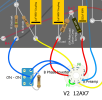


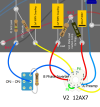


I hate switch pole layouts…I always forget about that.The first illustration didn't work, and now I know why. This second illustration definitely works... YEA!!!
View attachment 101375


DirtySteve
Ambassador of Hold My Beer
Glad you figured it out. May I ask what this resister does? ...and why is the switch only temporary?

OP

syscokid
Ambassador of War & Peace
I have very recently slapped together a Deluxe 5E3 build, and it was brought to life about three weeks ago. This last week I began experimenting with some simple mods. One of these mods is to add a grid stopper resistor to the circuit’s cathode phase inverter to reduce blocking distortion when the amp is pushed hard.May I ask what this resister does? ...and why is the switch only temporary?
If still interested, scroll down to the Table of Contents and find: Phase Inverter Grid Stop Resistor at:
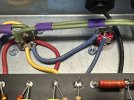
Now that I have tried the mod, I just might keep the switch where I have located it. First of all, I’m really digging the results of adding this resistor to the circuit. Second, I was afraid that because of the location of the switch, that it might create extra unwanted noise because it is kind of close to the AC heater wiring. But in reality, it doesn’t seem to inject any hum! It can stay for now.
OP
syscokid
Ambassador of War & Peace
What’s happening is that when the switch is set to engage that resistor, the switch is internally connecting the south pole with the middle pole like a jumper. The electricity is going to follow the path of least resistance of the jumper, which ends up bypassing the resistor and making it non effective.I don’t see a difference. In each circuit the toggle switch puts the 470 ohm resister in series when engaged. What am I missing? I assume it’s a DPDT switch.
I do plan to post a thread of my new amp build, but I’m waiting for the amp’s head cabinet to arrive which is scheduled five days from now.

I still don’t get it. The switch is binary. It either connects the center to the north or the center to the south (assuming it’s not a center off switch). When connected to the north, no resister in the circuit, and B+3 is connected directly to pin 7.
When connected to the south, B+3 is connected to one side of the resistor and the other side of the resistor is connected to pin 7, hence the resistor is in series in the circuit.
When connected to the south, B+3 is connected to one side of the resistor and the other side of the resistor is connected to pin 7, hence the resistor is in series in the circuit.

I still don’t get it. The switch is binary. It either connects the center to the north or the center to the south (assuming it’s not a center off switch). When connected to the north, no resister in the circuit, and B+3 is connected directly to pin 7.
When connected to the south, B+3 is connected to one side of the resistor and the other side of the resistor is connected to pin 7, hence the resistor is in series in the circuit.
But, in the pic in the OP, there is a plain wire connected to both throws, so regardless of the switch position, the current will bypass the resistor through a wire.
In the pic in post #5, when the center lug is connected to the lower throw, the current will flow though the resistor, then through the attached wire to the tube socket. When the center lug connects to the upper throw, the current will flow through the attached wire directly to the tube socket, essentially bypassing the resistor.
OP
syscokid
Ambassador of War & Peace
I should have clarified the switch a bit better. I know the illustrations shows a double pole switch, and it’s supposed to be a DPDT (ON - ON). I didn’t really need the second pole, so in reality I’m using a SPDT (ON - ON). Which is what you’re seeing in the photo of post #10.Got it. Didn’t have enough coffee yet, duh. So if the switch was a center off type, the center position would have worked.
OP
syscokid
Ambassador of War & Peace
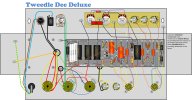
In my world, this is a possibility. I would build another head cabinet amp for this circuit (Tweedle Dee Deluxe). The Modulus Amplification chassis that I'm using for my new build was designed to build a stock Deluxe 5E3 circuit or a Tweedle Dee Deluxe circuit. And if I ever get serious enough to build a Tweedy Dee, I have Mr 67plexi here at TTR for some coaching...


Ghostman
Ambassador of the SuperNatural
First one puts the resister in parallel with the pin to center which negates it.I don’t see a difference. In each circuit the toggle switch puts the 470 ohm resister in series when engaged. What am I missing? I assume it’s a DPDT switch.