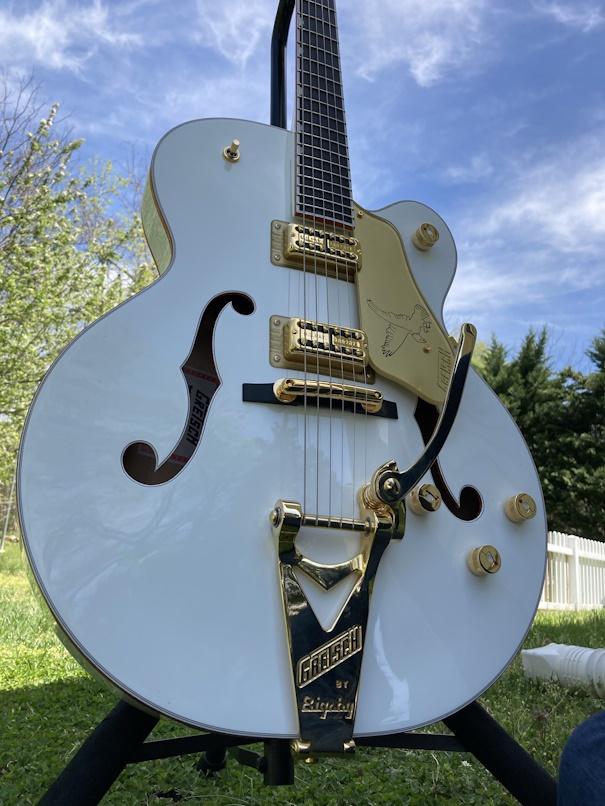
How many of you guys have a Gretsch or other guitar with a 3x3 headstock that won't stay in tune after using the Bigsby?

3bolt79

Well-Known Member
Country flag
United-States
Just curious if you all have had problems, taken the guitars to techs to correct the problem, or gotten a complete set up only to be disappointed with the results.

Can you do a deep dive on the bar and have it return to pitch? If not I'd like to help.

I have four Bigsby equipped Gretsch's that I can do multiple dives on, not just a little wiggle, and they stay in tune. I've also set up some for customers that were disappointed after paying for a complete setup at the local shops in town. They were happy with my results.

There are certain things you want to do when setting up these guitars and certain things you want to avoid doing.

If enough of you are interested, I will share my process. I will also be interested in hearing any setup tricks for Bigsby equipped guitars that you might have.

What has your experience been with Bigsby equipped guitars, particularly archtops?
 
There are certain things you want to do when setting up these guitars and certain things you want to avoid doing.

If enough of you are interested, I will share my process. I will also be interested in hearing any setup tricks for Bigsby equipped guitars that you might have.
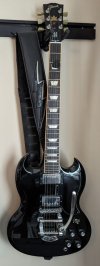
I have a Bigsby B5 on my SG 50th.
It's on a Vibramate adapter, and I've been thinking about moving it to my Firebird.
Don't really do dive bombs - but interested in any set-up tips & tricks you may have.

sg bigsby.jpg
 
I have a Bigsby B5 on my SG 50th.
It's on a Vibramate adapter, and I've been thinking about moving it to my Firebird.
Don't really do dive bombs - but interested in any set-up tips & tricks you may have.

View attachment 100356
Well, in the case of that being on a flat top, you won't make the mistake that so many do on an arch top, and that is over tightening the mounting screws to the point that the wings bend, binding the roller and not allowing it to turn freely.

If your nut is setup right, you should be able to dive it and have it return to pitch. Are you able to do that?
 
Well, in the case of that being on a flat top, you won't make the mistake that so many do on an arch top, and that is over tightening the mounting screws to the point that the wings bend, binding the roller and not allowing it to turn freely.

If your nut is setup right, you should be able to dive it and have it return to pitch. Are you able to do that?
Not sure ATM, but speaking of nuts, the nut on my Firebird is an adjustable titanium nut that was the only useful part of the original moronic HP robo-tuner configuration.
Been contemplating adding a roller bridge if I do the switcheroo.

Edit: with the Vibramate adapter, the Bigsby is mounted to the guitar body with big machine screws into the stop bar mounts.
 
Just curious if you all have had problems, taken the guitars to techs to correct the problem, or gotten a complete set up only to be disappointed with the results.

Can you do a deep dive on the bar and have it return to pitch? If not I'd like to help.

I have four Bigsby equipped Gretsch's that I can do multiple dives on, not just a little wiggle, and they stay in tune. I've also set up some for customers that were disappointed after paying for a complete setup at the local shops in town. They were happy with my results.

There are certain things you want to do when setting up these guitars and certain things you want to avoid doing.

If enough of you are interested, I will share my process. I will also be interested in hearing any setup tricks for Bigsby equipped guitars that you might have.

What has your experience been with Bigsby equipped guitars, particularly archtops?
Definitely share your process!

But, to answer the question. I have two Bigsby-equipped guitars (an SG and a White Falcon) and a Maestro vibrola-equipped guitar (another SG).

I've been able to get them to stay in tune well given reasonable use.

But, yes, share whatever you've discovered. We're here to learn from each other!
 
Definitely share your process!

But, to answer the question. I have two Bigsby-equipped guitars (an SG and a White Falcon) and a Maestro vibrola-equipped guitar (another SG).

I've been able to get them to stay in tune well given reasonable use.

But, yes, share whatever you've discovered. We're here to learn from each other!
If there's enough interest, I will do a complete article on it. I haven't had the opportunity to study a Vibrola yet. But I may get a Vibrola equipped guitars. If I write an article on that, I can write the guitar off. It depends on if the guy I'm writing for wants to pay me to do one on a Vibrola. When I do get one, it will be a Gibson SG or the new Epiphone Les Paul SG Custom.
 
Definitely share your process!

But, to answer the question. I have two Bigsby-equipped guitars (an SG and a White Falcon) and a Maestro vibrola-equipped guitar (another SG).

I've been able to get them to stay in tune well given reasonable use.

But, yes, share whatever you've discovered. We're here to learn from each other!
Can you dive on the white Falcon and return to pitch? I can dive three or four times on mine and it returns to pitch.
 
If there's enough interest, I will do a complete article on it. I haven't had the opportunity to study a Vibrola yet. But I may get a Vibrola equipped guitars. If I write an article on that, I can write the guitar off. It depends on if the guy I'm writing for wants to pay me to do one on a Vibrola. When I do get one, it will be a Gibson SG or the new Epiphone Les Paul SG Custom.

I've treated the vibrola very much like I would a Bigsby. Though the mechanism is obviously different, there are key similarities. Most notably, both require the strings to pass over the bridge. All the same considerations pertaining to the nut apply, as well.

But, whether the subject matter is a Bigsby or the vibrola, I would be very interested to read an article you may create. There's always room for me, and others, to learn something new.
 
Can you dive on the white Falcon and return to pitch? I can dive three or four times on mine and it returns to pitch.

Dive? Not quite. Mine has a rocking, bar bridge. (see pic below). Believe it or not, the intonation is quite good with this bridge - better than I would have expected.

ju130Sc.jpg


But, it is more reliable than one might imagine.

Typical shimmering use is pretty solid and I can do that pretty confidently that the guitar will return to pitch.
 
@3bolt79 , another idea:

Instead of writing an article, maybe it would be easier to create a video and post it on Youtube?

Just a thought...
 
My Epiphone Casino has a Bigsby. When I got it, it wouldn't hold tune at all--not just after a dive on the Bigsby, but also after a string bend. It wouldn't stay in tune through a single song. I put a roller bridge on it, that made a night-and-day difference. Plus a bit of graphite from a pencil on the nut--solved the issue completely.
 
Just curious if you all have had problems, taken the guitars to techs to correct the problem, or gotten a complete set up only to be disappointed with the results.

Can you do a deep dive on the bar and have it return to pitch? If not I'd like to help.

I have four Bigsby equipped Gretsch's that I can do multiple dives on, not just a little wiggle, and they stay in tune. I've also set up some for customers that were disappointed after paying for a complete setup at the local shops in town. They were happy with my results.

There are certain things you want to do when setting up these guitars and certain things you want to avoid doing.

If enough of you are interested, I will share my process. I will also be interested in hearing any setup tricks for Bigsby equipped guitars that you might have.

What has your experience been with Bigsby equipped guitars, particularly archtops?
Does your Gretsch have a tuneamatic bridge on it? Often makers pair up a bigsby with a fixed tuneamatic which is where all your tuning issues lie. It has nothing to do with the headstock. A bigsby is designed to have the bridge rock with it. The string should NEVER lose its contact point with the saddle when using the whammy. Bigsby’s come with an aluminum rocking bridge which works great. The 1446 Silvertone guitars I use have Bigsby’s and they use a wooden bridge that rocks. I can use the Bigsby aggressively all night with zero tuning issues. The roller bridge helps somewhat, but not as well as a rocking bridge.
 
Does your Gretsch have a tuneamatic bridge on it? Often makers pair up a bigsby with a fixed tuneamatic which is where all your tuning issues lie. It has nothing to do with the headstock. A bigsby is designed to have the bridge rock with it. The string should NEVER lose its contact point with the saddle when using the whammy. Bigsby’s come with an aluminum rocking bridge which works great. The 1446 Silvertone guitars I use have Bigsby’s and they use a wooden bridge that rocks. I can use the Bigsby aggressively all night with zero tuning issues. The roller bridge helps somewhat, but not as well as a rocking bridge.
I have the standard issue Tunomatic style bridge on three of my Electromatics and a Compton brass bridge on my White Falcon. I am writing an article for a publication or website, I'm not sure which. I'm just getting paid to write the article

I know that if anybody can make a Bigsby guitar stay in tune it would be you. Your skills precede your reputation. I've only seen two YouTube videos where the guys got it right. My procedure is a little different than a lot of guys, but I can dive the crap out of the bar, as long as the floating bridge will stay put. Mine does. I'm going to do an article with pics, and I will post my procedure here, if there's enough interest.

Unlike you Scott, I'm not an actual Luthier. But I started rehabbing wrecked guitars almost as soon as I started playing them. I have some woodworking experience, making furniture,etc.

I started repairing other people's guitars starting in 2008. Just small jobs. But the repairs got bigger and more complex as the years went on. I dona lot of setups and fret leveling. And the occasional refret here and there.

The publication I'm writing the 2 articles that I'm working on is aimed at beginner to intermediate players.

We should compare notes sometime. I'm sure I could learn a lot more from you than I already have.
 
Dive? Not quite. Mine has a rocking, bar bridge. (see pic below). Believe it or not, the intonation is quite good with this bridge - better than I would have expected.

ju130Sc.jpg


But, it is more reliable than one might imagine.

Typical shimmering use is pretty solid and I can do that pretty confidently that the guitar will return to pitch.
When I got my White Falcon It came with a Compton Bridge, but the windings on the D string were hanging up on a sharp corner where the string exits the nut slot on the way to the tuner. The G string did too but not as bad as the D.

My way of rounding off those corners is a little different than other guys that used a regular nut file to do it an wind up moving the strings contact point halfway back to the front of the nuts slots. And when you see the repurposed tool that I use for this, you will laugh I'm sure.
 
My way of rounding off those corners is a little different than other guys that used a regular nut file to do it an wind up moving the strings contact point halfway back to the front of the nuts slots. And when you see the repurposed tool that I use for this, you will laugh I'm sure.

I’m not sure I’ll laugh at all!

I love ingenuity.

When I want to round off or smooth out a nut groove, I often use welding tip cleaners. I may also wet sand with folded-over 1000 to 1500 grit paper.
 
Back
Top