Mods for the old Marshall Pre Phase Inverter Master Volume?

syscokid

Ambassador of War & Peace
Country flag
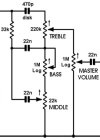
I believe that adding one or two resisters to this type of MV is supposed to keep the tone from thinning out as much when reducing the MV to very low settings. Just want to know how each added resistor is adjusting the frequencies and possibly changing the taper of the pot... :hmmm:

Stock JCM800 MV:
JCM800 Stock Schematic.jpg

Some amp builders are adding just one resistor, like a 220K from the output of the Treble pot to the input of the MV pot to do the trick. Friedman adds a second resistor, 1M, from the MV's input to ground.

Modded Type 4 MV as seen in some of Friedman's Hot Rodded Marshall style amps:
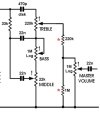
Modded Type 4 MV.jpg

Any juicy info on all this?
 
I believe that adding one or two resisters to this type of MV is supposed to keep the tone from thinning out as much when reducing the MV to very low settings. Just want to know how each added resistor is adjusting the frequencies and possibly changing the taper of the pot... :hmmm:

Stock JCM800 MV:
View attachment 99683

Some amp builders are adding just one resistor, like a 220K from the output of the Treble pot to the input of the MV pot to do the trick. Friedman adds a second resistor, 1M, from the MV's input to ground.

Modded Type 4 MV as seen in some of Friedman's Hot Rodded Marshall style amps:
View attachment 99684

Any juicy info on all this?
The secret is to take out the tone controls, then it will sound good.
As it turns out the tone controls are what spoils it.
 
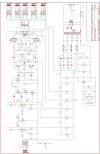
This is a Blackheard BH15H schematic. VR1 Gain, VR2 master volume, VR3 treble, VR4 middle, VR5 bass, VR6 presence. They use a 220K and 1M resistors before 1M master volume pot but different way than Friedman.

bh15-schematic-e1274275616315 (0).jpg

In other hand I installed a serial FXLOOP on this amp after R9 I think. But I think I should mod some board tracks to get a properly serial FXloop because R10 it's in parallel. How will be a proper way to do It?
 
In other hand I installed a serial FXLOOP on this amp after R9 I think. But I think I should mod some board tracks to get a properly serial FXloop because R10 it's in parallel. How will be a proper way to do It?
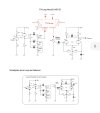
Here how I need connect this FX loop. Should I remove R9 and R10 from the circuit?

Screenshot_2024-05-28-15-49-36-838_com.adobe.reader~2.jpg
 
They use a 220K and 1M resistors before 1M master volume pot but different way than Friedman.
Comparing the differences in the schematic of the Blackbeard and of the Friedman, it looks like the location of those two resistors are flipped. I’m still clueless on how the tone reacts to those resistors as the MV is reduced.


In other hand I installed a serial FXLOOP on this amp after R9 I think. But I think I should mod some board tracks to get a properly serial FXloop because R10 it's in parallel. How will be a proper way to do It?
My amp that I’m experimenting the MV mod on is my old JCM800 2204 with a Metro Amp FX Loop added to its circuit. I’ve added the two experimental resistors after the loop and before the MV pot. Don’t know if this is the proper way to do it, but so far I don’t hear anything negative doing it this way. The 220K resistor from the loop to the MV pot does make a subtle difference, but adding or disconnecting the 1M resistor from the MV pot to ground doesn’t seem to be doing anything! I barely have committed any time to testing, so I can’t confidently elaborate on my results.
 
Here how I need connect this FX loop. Should I remove R9 and R10 from the circuit?

View attachment 99701
The input of the FX board has it's own adjustable attenuator...
the 1 meg R9 resistor adds a significant amount of noise...
and so, you can probably remove R9.
There is usually a 2.2 meg resistor on the FX board input anyway, which takes the place of R9.

R10 is used to attenuate the signal to input of the phase inverter.
Somebody decided that the phase inverter input would be overloaded by too much signal.
The output of the FX board is supposedly adjustable to set the correct amount of signal.
(but will it be adjustable enough?)

Overall what I learned about these FX boards:

1. The boards are built from under rated parts.
the provision for DC power filtering is also somewhat inadequate for lower noise operation.
(too much ripple in the power supply)

2. The output from the return side of the board may or may not have enough gain to fulfill the need. Depends on the amplifier design.

3. If you don't have an oscilloscope and signal generator, it's going to be somewhat difficult; measuring and adjusting proper levels is going to be difficult especially when you are guessing...guessing based on "just listening" instead of actually measuring.

4. If you expect a really good result:
Low noise
clean signal with minimum coloration and minimum added distortion
Adequate signal level, to achieve "zero loss"...
Then
It's more difficult than it looks.
It takes more effort than you have been led to believe.
It's not simple or easy even for an experienced technician.

Are these FX boards really "that" great?
IMHO these type boards are under-built, primitive, inaccurate considering performance.
The design of these boards could have been a lot better. The audio quality suffers.
 
Are you talking about bypassing the tone stack and then using the MV?
Bypassing the tone stack is part of the secret to the dumble overdrive sound.

We're all hung up on tone controls, and that's where the failure is.

If we want the ultimate guitar amp sound:
start by eliminating the tone stack. It's the weak point.
 
The input of the FX board has it's own adjustable attenuator...
the 1 meg R9 resistor adds a significant amount of noise...
and so, you can probably remove R9.
There is usually a 2.2 meg resistor on the FX board input anyway, which takes the place of R9.

R10 is used to attenuate the signal to input of the phase inverter.
Somebody decided that the phase inverter input would be overloaded by too much signal.
The output of the FX board is supposedly adjustable to set the correct amount of signal.
(but will it be adjustable enough?)

Overall what I learned about these FX boards:

1. The boards are built from under rated parts.
the provision for DC power filtering is also somewhat inadequate for lower noise operation.
(too much ripple in the power supply)

2. The output from the return side of the board may or may not have enough gain to fulfill the need. Depends on the amplifier design.

3. If you don't have an oscilloscope and signal generator, it's going to be somewhat difficult; measuring and adjusting proper levels is going to be difficult especially when you are guessing...guessing based on "just listening" instead of actually measuring.

4. If you expect a really good result:
Low noise
clean signal with minimum coloration and minimum added distortion
Adequate signal level, to achieve "zero loss"...
Then
It's more difficult than it looks.
It takes more effort than you have been led to believe.
It's not simple or easy even for an experienced technician.

Are these FX boards really "that" great?
IMHO these type boards are under-built, primitive, inaccurate considering performance.
The design of these boards could have been a lot better. The audio quality suffers.
It's a good FXloop kit I think. It comes with some extra resistors to adjust input and output signals. Actually it's working good. It has send and return pots. But could be better. The amp has a digital reverb mod across R9 too. I'll need take a look. The problem I had was FXloop and digital reverb in parallel on R9. I don't remember what I did. I will take a look. It's a nice amp.

Also I added a two 6V relays kit to get a reverb and FXloop footswithable by footswitch.
 
Last edited:
It's a good FXloop kit I think. It comes with some extra resistors to adjust input and output signals. Actually it's working good. It has send and return pots. But could be better. The amp has a digital reverb mod across R9 too. I'll need take a look. The problem I had was FXloop and digital reverb in parallel on R9. I don't remember what I did. I will take a look. It's a nice amp.

Also I added a two 6V relays kit to get a reverb and FXloop footswithable by footswitch.
I'm going to be looking for something better than LND 150.
Right now I have to put 4 of those LND 150 in parallel, to get the drive signal up to speed...
I need a better Mosfet with a gain of about 250 - 300, so I can use 1 transistor instead of 4 in parallel.
 
The input of the FX board has it's own adjustable attenuator...
the 1 meg R9 resistor adds a significant amount of noise...
and so, you can probably remove R9.
There is usually a 2.2 meg resistor on the FX board input anyway, which takes the place of R9.

R10 is used to attenuate the signal to input of the phase inverter.
Somebody decided that the phase inverter input would be overloaded by too much signal.
The output of the FX board is supposedly adjustable to set the correct amount of signal.
(but will it be adjustable enough?)

Overall what I learned about these FX boards:

1. The boards are built from under rated parts.
the provision for DC power filtering is also somewhat inadequate for lower noise operation.
(too much ripple in the power supply)

2. The output from the return side of the board may or may not have enough gain to fulfill the need. Depends on the amplifier design.

3. If you don't have an oscilloscope and signal generator, it's going to be somewhat difficult; measuring and adjusting proper levels is going to be difficult especially when you are guessing...guessing based on "just listening" instead of actually measuring.

4. If you expect a really good result:
Low noise
clean signal with minimum coloration and minimum added distortion
Adequate signal level, to achieve "zero loss"...
Then
It's more difficult than it looks.
It takes more effort than you have been led to believe.
It's not simple or easy even for an experienced technician.

Are these FX boards really "that" great?
IMHO these type boards are under-built, primitive, inaccurate considering performance.
The design of these boards could have been a lot better. The audio quality suffers.
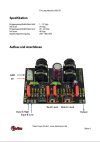
I don't have FXloop schematic. The PDF document it's so large. German language. Here a link.
The amp it's so quite. No noise at all.
Some pics.

Screenshot_2024-05-28-22-47-12-116_com.adobe.reader~2.jpgScreenshot_2024-05-28-22-47-22-146_com.adobe.reader~2.jpgScreenshot_2024-05-28-22-47-31-700_com.adobe.reader~2.jpg


You can wires It serial or parallel send and return pots.
If I remove R9 where do I connect the digital reverb?
I throught Install a tube FXloop but the amp has a switchable EZ81 tube to solid state rectification too. I use 6V output from powertransformer to use EZ81heater filament, digital reverb and two 6V relays.
Digital reverb and FXloop has a switch to bypass them.
It's a quite silence amp but just 15W one.
 
Back
Top