

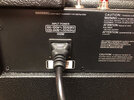
So Fender markets this flat response amp as a 1000W class D amp. But the max AC input is only 325W. What am I missing?


| Power Rating (Watts) | 1400 watts (4400 watts peak) |
| Max SPL (dB) | 133dB Peak (128dB Continuous) |
| Power Consumption (typ/max) | 2.4A/3.0A @ 120Vac |

Nitrous Oxide… :dood:What am I missing?
It had better be. 1000w on peaks. As I showed our PA tops are 1400 w program and total peaks (kick drum kinda thing) are 4400 somthe speakers have to be rated at 4400 peaks.Still marketing hype in my book. I get the capacitor instantaneously doing the power (measured in milliseconds probably). So now I wonder if the speaker is rated at 1000W ?

The fun of converting AC into DC, especially with Class D digital amplifiers, you can get a lot more "power" out of an amp than you appear to take in. Take an 80% efficiency rate you would need to take the 3 amps of input based on 350w max power in and provide 1000watts out of 2.4amps of power. With voltage multipliers and digital relay control of your voltage rails and outputs, you can get up to the 450VDC to give the 1000+wattts of power.Watts is Watts.
P = I *E
AC or DC

Mine does not. I skipped the read for the sake of it. Lol.My head hurts now.
Man, that sums it up well! Thanks GhostThe fun of converting AC into DC, especially with Class D digital amplifiers, you can get a lot more "power" out of an amp than you appear to take in. Take an 80% efficiency rate you would need to take the 3 amps of input based on 350w max power in and provide 1000watts out of 2.4amps of power. With voltage multipliers and digital relay control of your voltage rails and outputs, you can get up to the 450VDC to give the 1000+wattts of power.
Bob Carver proved this theory back in the 70's but he couldn't make it work because of the processing and digital tracking it would require. He was successful in getting the design to work in the 90's when technology caught up. I read his white papers on them and studied them about 20+ years ago. I forgot most of the details but essentially, you get more "power" out than in, because you are actually calculating two circuits in two different ways.
Here's a quick tip:
1 amp at 1000Volts is 1000 watts.
100amps at 10volts is 1000 watts.
Current is a constant in that you can only get what your supply can handle. Voltage is a potential, so you can very easily manipulate this figure in a given circuit. Kind of why you can get 10million volts out of a stun gun from a 9volt battery.
I get the PWM, the MOSFETs switching and capacitors storing energy. Class D amp are typically over 90% efficient. I guess my brain thinks in joules sometimes meaning if the amp draws 100w for 10 seconds it could output 1000w for 1 second. So basically the 1000w marketing claim is peak power (maybe 1000w for a millisecond) and not continuous RMS power (a 100W Marshall dimed). It’s all about the amount of work the amp can do over a period of TIME.The fun of converting AC into DC, especially with Class D digital amplifiers, you can get a lot more "power" out of an amp than you appear to take in. Take an 80% efficiency rate you would need to take the 3 amps of input based on 350w max power in and provide 1000watts out of 2.4amps of power. With voltage multipliers and digital relay control of your voltage rails and outputs, you can get up to the 450VDC to give the 1000+wattts of power.
Bob Carver proved this theory back in the 70's but he couldn't make it work because of the processing and digital tracking it would require. He was successful in getting the design to work in the 90's when technology caught up. I read his white papers on them and studied them about 20+ years ago. I forgot most of the details but essentially, you get more "power" out than in, because you are actually calculating two circuits in two different ways.
Here's a quick tip:
1 amp at 1000Volts is 1000 watts.
100amps at 10volts is 1000 watts.
Current is a constant in that you can only get what your supply can handle. Voltage is a potential, so you can very easily manipulate this figure in a given circuit. Kind of why you can get 10million volts out of a stun gun from a 9volt battery.
