The “Inspector” guitar tribute build

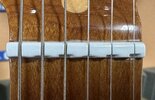
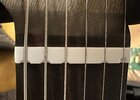
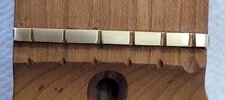
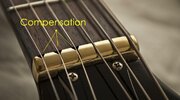
Yes, the leading edge of the nut for each string is at a different point. Maybe to increae the room for intonation adjustments?

Looks lime a co.pensated nut to me.
I’d string it up, and see how it handles(intonates), before digging it out and replacing it….but hey…
I mean, there’s no doubt he liked his brass nut…but he put this one in play originally…where’s the harm in trying it out for a few?
 
I’d string it up, and see how it handles(intonates), before digging it out and replacing it….but hey…
I mean, there’s no doubt he liked his brass nut…but he put this one in play originally…where’s the harm in trying it out for a few?
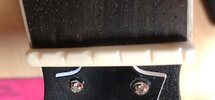
My only thought on the nut goes back to the many examples and instructions Rob has posted on a properly cut nut. And in every example, the “relief”, for lack of a better term, has always faced the tuners…. Not the bridge direction. Thinking had he been able to complete this guitar he would have caught his mistake and made a new nut…… or as Don just suggested do a proper job on the back side of the nut and see how it goes. Got nuthin’ to lose.
 
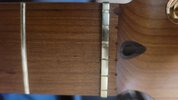
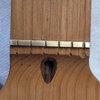
I don’t think this nut is compensated. I have two Music Man guitars with their version of a compensated nut, and have two other guitars with Earvana’s version of a compensated nut. I’m thinking that the “relief” was created on the wrong side of the nut. I do remember that Robert liked to press down on the strings behind the nut. He even created relief divots into the wood behind the nut. He might have been experimenting with a newer technique involving the nut.

Music Man:
IMG_0949.jpeg

Earvana:
IMG_0948.jpeg
 
I don’t think this nut is compensated. I have two Music Man guitars with their version of a compensated nut, and have two other guitars with Earvana’s version of a compensated nut. I’m thinking that the “relief” was created on the wrong side of the nut. I do remember that Robert liked to press down on the strings behind the nut. He even created relief divots into the wood behind the nut. He might have been experimenting with a newer technique involving the nut.

Music Man:
View attachment 95307

Earvana:
View attachment 95308
Was a thought I was having as well. Rob was experimenting. So maybe it should get strung up and see what happens and how it feels. It may be awesome.
 
Got the pups installed yesterday. I was going to put the strings on but then I looked at the nut and went WTF? Robert was OCD on nut profiles and I can’t see why he would have done this. Anybody venture to guess? It looks like it was done backwards.

I do think it was done backwards. Robert used to talk a lot about a cone-shaped fall-off at the back side of the nut. He was pretty adamant about it. I also recall he was somewhat frustrated with this guitar. He never mentioned the nut as being a mistake, but he did talk about the mistake he made with the bridge positioning.

Personally, I think this is a simple mistake he made - cutting the fall-off on the wrong side of the nut - and he just never bothered posting about it. Who knows? Maybe he was really tired one night when he decided to do a little work on it.

I know I don't necessarily post about every goof-up or false start I make!
 
I did some reading on compensated nuts. It looks like a compensation job. I never heard Robert talk about compensated nuts but he was OCD on the fall away angle and the horizontal fan opening. Here’s his brass one on the yellow Strat. I’m gonna put the strings on it and see what goes.

IMG_0190.jpeg
 
It looks like a compensation job. I never heard Robert talk about compensated nuts but he was OCD on the fall away angle and the horizontal fan opening.
Does it help after I flipped the photo? Because... This pic of the brass nut makes sense:
IMG_0190.jpeg

This flipped photo of the SG does not make sense:
IMG_0148.jpeg
But from that angle, and the fact the photo is a little blurry at the edges of this nut, It's hard to tell where the nut slot's leading edge towards the bridge is... :unsure:
 
Does it help after I flipped the photo? Because... This pic of the brass nut makes sense:
View attachment 95322

This flipped photo of the SG does not make sense:
View attachment 95321
But from that angle, and the fact the photo is a little blurry at the edges of this nut, It's hard to tell where the nut slot's leading edge towards the bridge is... :unsure:
I know Rob really liked the brass nuts. But to my feeble mind…. Wouldn’t that make the guitar incredibly bright? Especially on a single coil like a strat?
 
Does it help after I flipped the photo? Because... This pic of the brass nut makes sense:
View attachment 95322

This flipped photo of the SG does not make sense:
View attachment 95321
But from that angle, and the fact the photo is a little blurry at the edges of this nut, It's hard to tell where the nut slot's leading edge towards the bridge is... :unsure:
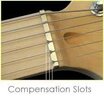
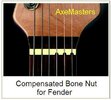
Here’s pics I found of compensated nuts. The opening/relief is on the fretboard side, mainly G/B/E strings. I don’t believe he was finished as the tuner side does not have his signature fanout or fall off trench. Also, the nut over hangs the edges. I think he put a 43mm nut on a 42mm neck.

IMG_0197.jpegIMG_0196.jpegIMG_0195.jpeg
 
Here’s pics I found of compensated nuts. The opening/relief is on the fretboard side, mainly G/B/E strings. I don’t believe he was finished as the tuner side does not have his signature fanout or fall off trench. Also, the nut over hangs the edges. I think he put a 43mm nut on a 42mm neck.

View attachment 95324View attachment 95325View attachment 95326
That’s what I’ve seen(aside from the commercial offerings, already posted) on a couple of guitars I’ve come across. I would think it unusual to have it completely “finished” without having a bridge in place. It’s more likely to be finished (dialed in) during initial setup.
 
Here’s pics I found of compensated nuts. The opening/relief is on the fretboard side, mainly G/B/E strings. I don’t believe he was finished as the tuner side does not have his signature fanout or fall off trench. Also, the nut over hangs the edges. I think he put a 43mm nut on a 42mm neck.

View attachment 95324View attachment 95325View attachment 95326
First time I've seen this design! Funny that, there are very noticeable differences between the Music Man and Earvana compensated nuts. And now I see that there's yet another different design for a compensated nut! And they are all supposed to give you better intonation? Something is fishy here!!!
 
First time I've seen this design! Funny that, there are very noticeable differences between the Music Man and Earvana compensated nuts. And now I see that there's yet another different design for a compensated nut! And they are all supposed to give you better intonation? Something is fishy here!!!
All it achieves is a shift of the saddle compensation to the nut…like…if you replace an old harmonica bridge with an ABR…you won’t have as much saddle adjustment available on the ABR….compensating at the nut would be a help. This is where I’ve seen it done in the past. I didn’t study them in depth…just have seen, and played, a couple in passing over the years.
 
First time I've seen this design! Funny that, there are very noticeable differences between the Music Man and Earvana compensated nuts. And now I see that there's yet another different design for a compensated nut! And they are all supposed to give you better intonation? Something is fishy here!!!
I had never seen them before either, hence my WTF comment. Makes sense now. Robert was always a perfectionist when it came to intonation, so maybe this was his first attempt at making a compensated nut. I’ll leave it in and file the slot/trench and rear fanout.
 
Back
Top