Possible SG Scratch Build:

I have a Fender TBX and a couple of treble bleeds given to me by one of the engineers at Fender.

I also have CTS Pro Push Pull Pots and I'm thinking of all the possible ways this could be wired up...
 
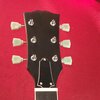
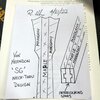
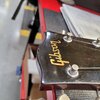
The idea behind this guitar was born out of the headstock i broke on one of my custom, Von Herndon, Gibson-scale Telecasters while working for Fender.

I thought the neck-through design would make it strong and lightweight, so wearing studs wouldn't harm a finely lacquered finish.

20220421_122243.jpg

It was also loosely based on Glenn Tipton's US Festival SG, which had always impressed me with ots tone during that performance.

Tipton_Glenn_83USFestival_1.jpg

The idea was to have the relatively light weight of a Stratocaster, the punch of a Les Paul and the 24.75" scale length.
 
Last edited:
Tipton states:

"On pickups for live work: “They’ve got to be hot! Most of my stage guitars are fitted with EMG 81s, which are of course active. All the EMG 81s are wired with the batteries in series so they run the pickups at 18 volts. That makes them last longer and the pickups sound hotter, with more edge and poke. This is partly for the signal-boosting active circuitry and partly so you’re not worrying about the danger of picking up the local radio station midway through a solo.”
 
When asked about the Gibson SG with chrome pickguard he used at the US Festival in 1983, Tipton states:

"Its just a Gibson SG with a chrome pickguard and stock PAF humbuckers..."
 
And how are we at correcting our misplaced/ mis-drilled Bridge stud holes?


IS the body now drilled for the bridge to be located in correct spot?
I paid a visit to Don on Saturday and dropped everything off with him. I believe the plan is to plug the body with Mahogany plugs, realign and redrill the tailpiece studs.

I never drilled the bridge posts once i noticed the tailpiece was off to the bass side by .100" or so.

Don is just a craftsman on an otherworldly level, Man....
 
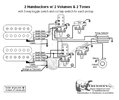
Ok, so with a pair of push-pull pots on a Gibson SG, what configurations are possible and is there a diagram for this arrangement???
 
Ok!

This looks like what i want. Unlike most diagrams i found, this one has the push/pull on the volumes - not the tones - which leave me free to use a TBX on the bridge humbucker and 0.0.01uf on the neck.

wd2hh3t22_02__28361.jpg
 
How Fender TBX works:


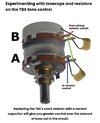
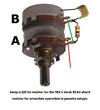
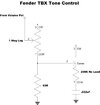
The basic configuration of the TBX control (Fender part no. 0992052000) changed several times over the years. Fender used several different values for the two pots, the capacitor, and the resistor. The first few versions also lacked a center detent function. The current version consists of a detented 250k/1 Meg stacked pot, a 0.022uF standard film capacitor, and an 82k-ohm carbon-film resistor. In a nutshell, the TBX tone control is a special pot that cuts either treble or bass instead of a normal tone pot, which cuts only treble. This is done with the dual-ganged pot, which is wired to work as a low-pass filter in one direction and a high-pass filter in the other. The center detent in the middle is provided for the off or “flat” position.

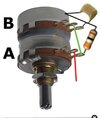
The dual-ganged pot is cleverly designed, meaning you can’t substitute a normal stereo pot to make your own budget TBX control. How does it work? The bottom pot (with the shaft up) is pot B on our drawing and is the normal tone control we all know. It’s a standard 250k audio pot with a range from 0 to 5 on the knob. At the detent (middle) position, it goes open and acts like a no-load tone pot, remaining out of the circuit from 5 to 10 on the knob.

The engineering behind this is actually very clever. Normally, the resistive material ring inside of the pot is a band of carbon-containing gunk that is printed onto the phenolic wafer. On the lower TBX pot, only half of the ring is conductive, as the other 50 percent is made out of a non-conductive material. So we can say it is a no-load tone control pot, but instead of going open at approximately 98 percent of its rotation, it goes out of the circuit at exactly 50 percent.

The other pot, which is labeled A, acts in the opposite direction. It also has a split resistive material ring inside, but instead of non-conductive material, metal is used for one half of the ring. This means that between 0 and 5 on the knob, its resistance is at maximum. After the detent position, the normal function takes place from 5 to 10 on the knob. This 1 Meg linear pot comes into the circuit in series with the resistor after the detent position. Because of the high resistance (1 Meg ohm), the load added to the passive guitar circuit is very low."

Screenshot_20230605_111815_Chrome.jpg
 
Here's how it works. There are 2 stacked pots with a single shaft - like a dual gang pot. One of the pots is a 250K Audio taper pot that goes no load at the center of rotation and stays no load from the center to fully clockwise. The other pot is closest to a 1 Meg Audio or Logarithmic taper pot. In the handful of TBX pots I've measured, the 1 Meg log pot isn't quite a normal logarithmic taper. At the center of its rotation, it measures about 1K Ohms (a true 1 Meg log pot would read about 10K at the center position).

From Fully Counter-Clockwise to the center, it acts like a typical 250K tone pot, but with an 82K resistor to ground also loading the guitar signal.

At the Center Detent, the 250K pot goes open (no load) and the 1 Meg pot is only about 1K, so the result is essentially the same as having an 82K resistor loading the guitar signal (in parallel to ground).

From the Center Detent to Fully Clockwise, the 1 Meg pot starts to increase in value - adding to the value of the 82K resistor loading the pickups. At Fully Clockwise, the load on the pickups is 1 Meg Ohms plus 82K Ohms. That is enough resistance to closely approximate a "no load" condition.

So, the Fender TBX gets you close to a no load pot, but it doesn't cut bass frequencies.

Screenshot_20230605_111959_Chrome.jpg

Screenshot_20230605_112006_Chrome.jpg
 
Ok!

This looks like what i want. Unlike most diagrams i found, this one has the push/pull on the volumes - not the tones - which leave me free to use a TBX on the bridge humbucker and 0.0.01uf on the neck.

View attachment 93451
Personally, with the 2 hummers w/ 2 volume and 2 tone controls scenario, I tried and didn’t care for the coil tapping results. I wish I knew how PRS and Music Man does it. However, I do like the push/pull option to reverse the phase of the neck pickup and set the pickup selector in the middle for that nasally tone… once in awhile.
 
Personally, with the 2 hummers w/ 2 volume and 2 tone controls scenario, I tried and didn’t care for the coil tapping results. I wish I knew how PRS and Music Man does it. However, I do like the push/pull option to reverse the phase of the neck pickup and set the pickup selector in the middle for that nasally tone… once in awhile.

Im just thinking outloud at this point. I had trouble with the shallow cavity on my 2003 and 2017 Gibson SG T-Series, specifically the tip of the cable would get so close to the shielded cover that it would cause a buzz from proximity interference.

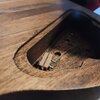
We made this cavity deep enough to accept a Les Paul switch.

20221106_062620.jpg
 
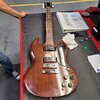
The real Gibson SG that we used at Fender as a reference for the neck-through SG build.

This was a headstock break fixed by my work partner at Fender.

20220601_103623.jpg

20220601_103659.jpg
 
Ok!

This looks like what i want. Unlike most diagrams i found, this one has the push/pull on the volumes - not the tones - which leave me free to use a TBX on the bridge humbucker and 0.0.01uf on the neck.

View attachment 93451

Boy, it drives me nuts to see things like this. This diagram literally shows a coil-split arrangement, yet they are calling it a "coil-tap".

The boys at Guitar Electronics need to get their terminology straight!
 
Dude, love those mini-humbuckers!

I don't care for the tone of Mini-Hums, Soapbars or anything that sounds like a P-90/94. but it was just a guitar that happened to need repairs at the same time we were toying with the concept of building this SG, so we drew as much as we could from it in terms of dimensions and appearance, but we routed this for full-size humbuckers.
 
Boy, it drives me nuts to see things like this. This diagram literally shows a coil-split arrangement, yet they are calling it a "coil-tap".

The boys at Guitar Electronics need to get their terminology straight!
True,

I was happy to find that diagram, because all the others I looked at showed the push/pull feature on the tones, which worked against my desire to use a Fender TBX Circuit.

Here's kinda what I was thinking of...but I am not sure it's possible/feasible:

Using the neck volume push/pull to give me a 180 degree out of phase tone

Using the bridge volume push/pull as a "supercharger" to bypass all tone controls and wire the bridge pickup direct to the output jack

Using the Fender TBX on the bridge side

Using a push/pull for neck tone with two tone caps - a 0.33 uF and a 0.01uf tone capacitor for two possible neck tones.

Again, I am not sure if there's enough room in the cavity for all of this, but I think it would give the greatest amount of tonal diversity, without going as far as the Jimmy page 21 tone setup.

Thoughts???

@Don O - Are these mods feasible?
 
Last edited:
The pickups i am considering for this build is Artec's HBB-XBB, which is basically a Dimarzio Super Distortion clone with two rows of allen head adjustable poles.
 
Back
Top