My 2x12 Cabinet Modification Thread:

Inspector #20

Ambassador of Tone
Fallen Star
Country flag
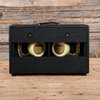
I had a local guy build me a ultra lightweight, finger-joint marine-grade mahogany 2x12 cabinet. It's patterned after a Mojotone Bluesbreaker 2x12, with about 1/3 of the back open. It has a metal plate with two "Cliff style" jacks and a "mono/stereo" switch.

I've been gigging with it ever since...
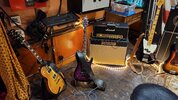
20201128_175225.jpg

I'm also running Weber Beam Blockers with good results.
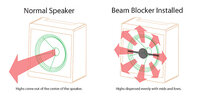
beam-blocker-diagram.JPG

Just for fun, I decided to start by calculating my cabinet volume:

21.0 x 26.75 x 10.5" = 5,898.375

Divide by 1728 = 3.41 cubic feet.

Should be plenty of room for two 12" loudspeakers???

I'll be using a pair of 12 inch, 250watt, 8 ohm Celestion Copperback Neodymiums. These models are English-made and weigh 5 pounds each.

What I liked about these speakers when I heard them in person is they do not color your sound.

Here's Celestion's description:

"The Neo 250 Copperback is a neodymium speaker that supplies tons of tone without the signature cone break-up immediately associated with the classic Celestion growl.

It’s definitely not the “brown sound” but for those wanting more transparency and less midrange vocal intensity, the Neo 250 reveals the best from your amplifier and playing without additional colouration. The speaker’s unique response has a tight low end neutral low mids a clear open upper-mid definition and well-controlled high treble..."

On paper, They are similar in frequncy response to a EVM12L.


I first considered using Thiele Small calculations to "see" how good the cabinet design might be (dimensions copied from an existing Mojotone cabinet) but, since guitar speakers do not really reproduce ‘low’ frequencies, (the low E string of a guitar has a fundamental of only about 82Hz) and so the frequencies at which Thiele Small parameters have significance tend to be below this sonic operating range.

Additionally, from what I've read, Thiele Small goes totally out the window in an open back cabinet, so I feel like my ultralight 2x12 - which weighs only 28 pounds with (2) Celestion 70/80's - is a good platform and I see no reason to upgrade/replace it.

Now, onto my new concept for the cabinet.

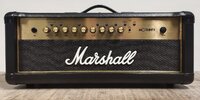
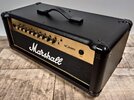
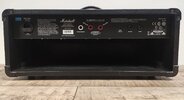
The plan is to run it (most likely) with a Solid State Marshall MG100HFX, which has (2) loudspeaker outputs, requiring only a minimum impedance of 4 ohms each.

Now, if I'm looking at my wiring correctly, in "stereo" each jack should function independently, allowing me to run each speaker with only one output from the head.
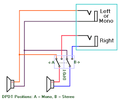
images.png

Am I looking at this right????
 
Now, if I'm looking at my wiring correctly, in "stereo" each jack should function independently, allowing me to run each speaker with only one output from the head.

View attachment 77412

Am I looking at this right????

Yes. That is correct. Looking at your wiring diagram, when in Position A (Mono Mode), the two speakers will be connected in parallel. So, for example, if you have two 8 ohm speakers, the impedance seen at the Left/Mono jack will be 4 ohms. The Right jack will not be connected to anything. When in Position B (Stereo Mode), the speakers will be connected independently to their respective jacks. The impedance seen at each jack will be the rated impedance of the speaker.
 
Yes. That is correct. Looking at your wiring diagram, when in Position A (Mono Mode), the two speakers will be connected in parallel. So, for example, if you have two 8 ohm speakers, the impedance seen at the Left/Mono jack will be 4 ohms. The Right jack will not be connected to anything. When in Position B (Stereo Mode), the speakers will be connected independently to their respective jacks. The impedance seen at each jack will be the rated impedance of the speaker.

Awesome!!

Thanks for the clarification!!!

That might keep me from using it with a head rated for only 8 ohms with a single output, like the Origin, but it will work great on the 100HFX.
 
Last edited:
@smitty_p - is there a way to have 8ohms when in mono and 8 in stereo?
you can only have 4 or 16 in mono. If you want 16 in mono you have to use a different switch diagram.
There is a 4/16 option if you rewire it...

I think you get more out of a cabinet if it's closed back / ported. However the back cover doesn't need to weigh a lot. It just needs to seal the back.
I was thinking of checking out some fiberglass marine board or other strong light weight more modern material to cut the weight down, compared to wood.
 
you can only have 4 or 16 in mono. If you want 16 in mono you have to use a different switch diagram.
There is a 4/16 option if you rewire it...

4/8 will be fine. It will work with my MG100HDFX, stereo mode with each output feeding one, 8 ohm speaker.

I can easily test fire a JCM, Origin or DSL on just one 8 ohm speaker, following a repair.
 
@smitty_p - is there a way to have 8ohms when in mono and 8 in stereo?

Not if you’re going to use both speakers. The speaker impedance is what it is. The only possible ways of connecting them together are to wire either in parallel or series. Parallel wiring will drop the total impedance to 4 ohms; series wiring will raise it to 16 ohms. That’s just Kirchoff’s Law.

Now, I could envision a scheme whereby you incorporate some power resistors into an enhanced switching system so that when you’re in Mono Mode, a resistor is placed in series with each speaker so that it is a 16 ohm assembly. Then when both assemblies are joined in parallel you’d have 8 ohms. It would be the same idea as an attenuator. But, this would not really be a desirable solution because some energy would be wasted as heat in the resistors and not produce any sound. You’d not get full energy to your speakers. There’s a possibility you’d have some tonal effect, too.

Or you could just remove the switching and just have your independent connections. Running in mono would consist of just one speaker.
 
Not if you’re going to use both speakers. The speaker impedance is what it is. The only possible ways of connecting them together are to wire either in parallel or series. Parallel wiring will drop the total impedance to 4 ohms; series wiring will raise it to 16 ohms. That’s just Kirchoff’s Law.

Now, I could envision a scheme whereby you incorporate some power resistors into an enhanced switching system so that when you’re in Mono Mode, a resistor is placed in series with each speaker so that it is a 16 ohm assembly. Then when both assemblies are joined in parallel you’d have 8 ohms. It would be the same idea as an attenuator. But, this would not really be a desirable solution because some energy would be wasted as heat in the resistors and not produce any sound. You’d not get full energy to your speakers. There’s a possibility you’d have some tonal effect, too.

Or you could just remove the switching and just have your independent connections. Running in mono would consist of just one speaker.

Makes sense.

One speaker would be fine for testing a single-output amp following repairs.

The MG100HDFX will run in "stereo mode" with each outlet powering one, 250 watt, 8 ohm Celestion Copperback.
 
I am curious to see how well this MG rig works out for you.

My only experience with the MG series is a small, 15 watt practice amp I bought for my son about 10 years ago. I do recall that it sounded better than I expected when I tested it in the store,

In 1999, I bought a brand new MG50RCD. At the time, I had just been to a Rob Zombie concert and guitarist Riggs had a wall of solid state MG100RCD's and his tone was crushing. Every amp was lit up.

After the show, I got to look at the amps up close and they were all hooked together via the FX loops. I was invited to fire off a few chords and the rig literally shook the elevated stage.

I was so impressed that I bought the little 50 watt 1x12 and it's been a great amp. No trouble keeping up in the mix. Sounds good at '4' sounds equally good at '10.'

afc3688dbff1fd334144f71463af7322.jpg

The MG100RCD had reverb, but no chorus. Otherwise, it would have been my first choice.

I really wanted a 8280 2x12 Bi-Chorus (like @Don O has) but every one of them I looked at had issues. I considered the 8200 Bi-Chorus Head and they also have issues.

I thought that maybe trying to gig a mid-1990's amp was just too risky. Parts are hard to come by. I'm not an amp tech and most techs refuse to service a Valvestate, so I started looking for options.

I found a one-owner, two year old MG100HFX that comes with all the original paperwork, for less than a banged up 8280 that only has output on one channel. The MG100HFX looks like brand new. It's not even dusty.

The MG100HFX will also replace the Blackstar ID-Core 100watt as my primary DAW interface.

You can line-out either from the 3.5 headphone jack or the FX send for recording. It also has chorus, reverb, delay, chorus/delay, flange and rotovibe onboard.

The clean and overdriven channels are footswitchable. U can run it without a pedalboard for small events. It produces more gain than the modded Origin with a TS-9, so I can eliminate a lot of FX.

I will trim 10" off my 34" Temple Audio board and just run wah, tuner, compressor, volume pedal, EQ for solo boost and noise gate.

From 12 FX pedals to only 6.
 
Last edited:
I'd like to modify my cabinet to this configuration, if i knew it worked.

Its based on a Swart Amp Cabinet. Anybody ever try this???

swart-amps-guitar-cabinets-swart-bv-30-2x12-stereo-cab-u2987134803-17363489751175_900x.jpg
 
Back
Top