DSL100HR Red Plating!

I’m not sure what year it is. It was the screen resistors. I’m trying to send pics but apparently they are too large. Anyone know how to get around this?
Resize photos. MS Paint is one option, many phones can resize from the options menu, etc. Kindof a pain but the forum's server couldn't handle the large photos anymore so we now have to scale them down a bit.

Pre 2005ish JCM2k 100w amps are pretty well known for having issues of this nature.

We have a dude here who you'd probably like to talk to about this one, he's helped me through mine and many others as well.

Summoning @Amp Mad Scientist
 
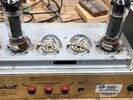
Pic 3 back of amp, no bias, 4 ohms switched with 8 ohm speaker.
6th week of the year 2000. It's an early one. Probably has the infamous runaway bias problem which caused your red plating, and may be fixable for as little as about 7 bucks. Maybe.

Seems like your intent here is a conversion rather than a repair though.

This is an interesting experiment, I am following your progress out of curiosity.
 
Wow, it didn’t take you long to date that amp. All in all I am happy with it so far.
Right? Usually I have to bring some chocolate or flowers or wine or something at least.


Bwahaha! Seriously though,


These ones can be deciphered by the serial number placed under the barcode stamp on the rear of the chassis. You just happened to post a picture of it quite conveniently.

I'm not a tech, btw. Just a dude with a JCM2k like yours who was was forced to learn a couple things through necessity. Don't take anything I say too seriously, don't be getting zapped on account of my dumb ass. Lol
 
Resize photos. MS Paint is one option, many phones can resize from the options menu, etc. Kindof a pain but the forum's server couldn't handle the large photos anymore so we now have to scale them down a bit.

Pre 2005ish JCM2k 100w amps are pretty well known for having issues of this nature.

We have a dude here who you'd probably like to talk to about this one, he's helped me through mine and many others as well.

Summoning @Amp Mad Scientist
you-rang.gif
 
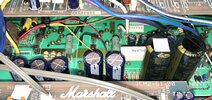
Pic 2 cathode bias board added in
you will need to remove the modifications and put it back to stock.

But basically
Disconnect power
Take out tubes
Set meter for ohms
connect red probe to pin 4 of output tube socket...
connect black probe to pin 5 of output tube socket.
Wait, wait...After the reading settles, stabilizes, note the ohm reading.
Now repeat for all four output tube sockets, and note the ohm readings for all sockets.

What is the ohm readings?
 
Leave tubes out.
Do not put the tubes in or attempt to operate the amp.
2.
Set meter for DC volts.
Connect red probe to pin 5 of output tube socket.
Connect black probe to chassis ground.

Turn power on, leave standby in "warm up" position.
Do not turn standby to operate position.

Test DC volts on pin 5 of each of 4 output tube sockets and note the readings.

What is the DC volts reading of each output tube socket pin 5?

DO not put the tubes in. DO NOT try to play the amp.
 
Hi Amp Mad Scientist,
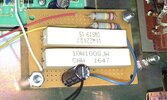
I have completed converting the amp to a 2 el34 cathode biased amp. The pics are after the changes. Prior to that I was seeing around 250 volts on g2 on either tube 7 or eight and toasted 1k g2 resistors on 1 side of the output transformer. I checked the transformer resistance and it matched up pretty close so I knew it wasn’t the transformer. I started doing a little reading and it didn’t take long to find a lot of documentation on main board problems. I thought cathode biasing a pair of el 34s would be a cheap solution. The slowest part was dialing in the cathode resistor value. 320 ohms sets the tubes at a dissipation of about 85%. I like the sound, but there is no channel switching because I had to lift the power transformer leads to the fixed bias. This also feeds the switching.
Any ideas on getting the channel switching back while keeping the negative dc disconnected?
Thanks
 
Hi Amp Mad Scientist,
I have completed converting the amp to a 2 el34 cathode biased amp. The pics are after the changes. Prior to that I was seeing around 250 volts on g2 on either tube 7 or eight and toasted 1k g2 resistors on 1 side of the output transformer. I checked the transformer resistance and it matched up pretty close so I knew it wasn’t the transformer. I started doing a little reading and it didn’t take long to find a lot of documentation on main board problems. I thought cathode biasing a pair of el 34s would be a cheap solution. The slowest part was dialing in the cathode resistor value. 320 ohms sets the tubes at a dissipation of about 85%. I like the sound, but there is no channel switching because I had to lift the power transformer leads to the fixed bias. This also feeds the switching.
Any ideas on getting the channel switching back while keeping the negative dc disconnected?
Thanks
Do the ohm meter tests written above post 70 and tell us the result.

Disconnecting the bias will only fix part of the problem...
we are trying to see if the insulation between pin 4 and pin 5 has failed (the board insulation fails) on any of the 4 sockets.
The ohmmeter tells you a lot between pin 4 and 5.

The amp needs to idle at 70% (no sound), 85% is too high.
 
Last edited:
V6 6.1 M
V7 180 K
V5 and V8 are open. Cathode biased.

I had pulled the tube sockets 7 and 8 to see if they were shorted early in the diagnostics. No issues.
you are running output tubes with nothing connected to pin 5?
Running 2 output tubes:
4 ohm out becomes 8 ohm
8 ohm out becomes 16 ohm.

There's not much we can do unless you put everything back where it's supposed to be.
You are running 2 tubes 85% almost class A, which is too hot.
There's no way to tell whats going on because parts are removed.

Normally we could test the board but modifications are preventing that.
Could be 3 main things:
A. the board is actually bad, unconfirmed.
B. The PI coupling caps have failed, possible.
C. the bias pots failed happens quite often.
We don't know if the board is actually bad. Maybe yes maybe no.

This problem can happen from bad bias pots or bad coupling capacitors to the PI.
Bad coupling caps would have caused 250VDC on pin 5 of output tubes. Didn't check that.
 
Hi Amp mad scientist,
I changed the coupling caps. If you look closely you will see a couple of the yellow tubular Mallory caps. No change
I also tested the bias pots. They were identical.
While I would agree with you on 85% being too high on a fixed bias amp this amp is now cathode biased.
I have played it for a few hours with no signs of red plating and the transformers are not excessively warm.
I also switched the impedance as you suggested.
Thanks for your help.
 
Hi Amp mad scientist,
I changed the coupling caps. If you look closely you will see a couple of the yellow tubular Mallory caps. No change
I also tested the bias pots. They were identical.
While I would agree with you on 85% being too high on a fixed bias amp this amp is now cathode biased.
I have played it for a few hours with no signs of red plating and the transformers are not excessively warm.
I also switched the impedance as you suggested.
Thanks for your help.
OK well if you take out 2 tubes, then you need to make the output load 1/2 as much...
4 ohm amp out - becomes 8 ohm.
8 ohm amp out becomes 16 ohm.

Now re-measure the tube current, after you correct the load, as above.
It should read lower than 85% ?

What you are doing is running the output as class A (cathode biased).
 
I am sorry but I have to disagree with 85% being too high. 85% just keeps the amp out of crossover distortion on my scope.
I would suggest you have a look at Rob Robinette’s website where he discusses cathode biasing. He is suggesting 100% cathode biasing and he is far more knowledgeable (and eloquent) than I am.
Please note that there is no disrespect intended and I do appreciate your help.
 
Back
Top