5010 Sizzle Noise - Help Please?

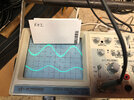
Fitz, any chance you have access to an oscilloscope? That would make finding the source of the oscillation a lot easier. You can look at each gain stage and see where it starts in the signal chain.
I don't have an oscilloscope, but It's on my maybe list.
This is not my only amp, and the noise is only noticeable when cranking the native amp gain past 8-ish.
I enjoy the learning experience, but at the same time, I question investing too much in a $300 amp.
 
Fitz, any chance you have access to an oscilloscope? That would make finding the source of the oscillation a lot easier. You can look at each gain stage and see where it starts in the signal chain.
Not exactly....in a solid state amp.
An o scope is handy but it doesn't remove the need to pull and test (power transistors) parts.
The o scope would be handy to test the amp after correcting the bad parts.
 
I don't have an oscilloscope, but It's on my maybe list.
This is not my only amp, and the noise is only noticeable when cranking the native amp gain past 8-ish.
I enjoy the learning experience, but at the same time, I question investing too much in a $300 amp.
The reason I am saying that is in many SS marshall amps, the problem was an output transistor.
Just based on past experience.
 
The reason I am saying that is in many SS marshall amps, the problem was an output transistor.
Just based on past experience.
Looks fairly easy to swap out the transistors.
If I yank them to test them, I could be halfway done replacing them.
For $25 do you think it's worth just popping in the new set?
Or is there something else I could look for that might be the source of the bacon sizzle noise?
 
Looks fairly easy to swap out the transistors.
If I yank them to test them, I could be halfway done replacing them.
For $25 do you think it's worth just popping in the new set?
Or is there something else I could look for that might be the source of the bacon sizzle noise?
First test the transistors. And don't mix them up.
Make sure the right transistor gets back to the right position.
A pair of transistors might cost $20 or less.
Test all the stuff first don't just randomly replace stuff.

I test the output first because of previous experience.

Constant hum: sign of blown transistor.
 
First test the transistors. And don't mix them up.
Make sure the right transistor gets back to the right position.
A pair of transistors might cost $20 or less.
Test all the stuff first don't just randomly replace stuff.

I test the output first because of previous experience.

Constant hum: sign of blown transistor.
New set of transistors inbound from UK (eBay).
Also got the 3 front panel jacks from Tubes & More on the way.
If I'm un-soldering the transistors, I'm just going to replace them and the jacks while the iron is hot.
I'll first test the new ones as described to make sure they operate correctly.

Thanks again for the advice.
 
New set of transistors inbound from UK (eBay).
Also got the 3 front panel jacks from Tubes & More on the way.
If I'm un-soldering the transistors, I'm just going to replace them and the jacks while the iron is hot.
I'll first test the new ones as described to make sure they operate correctly.

Thanks again for the advice.
Don't forget the heat sink compound and or insulator where applicable....
 
First test the transistors. And don't mix them up.
Make sure the right transistor gets back to the right position.
A pair of transistors might cost $20 or less.
Test all the stuff first don't just randomly replace stuff.

I test the output first because of previous experience.

Constant hum: sign of blown transistor.

On my 1993 Marshall Valvestate Bi-Chorus 200, i had a condition that sounded like the wind rushing through an open window.

IIRC, Don traced it to TR6???
 
On my 1993 Marshall Valvestate Bi-Chorus 200, i had a condition that sounded like the wind rushing through an open window.

IIRC, Don traced it to TR6???
Well you see?
when all the stages are connected to a common feedback rail, the problem looks like it's everywhere.
But it's not the same design as a bi chorus.

Without removing some parts first it may be difficult to know where the actual problem is...
besides which it takes more than just a scope.
a sine wave generator, load resistor, etc.
 
1st - Thanks for the response and the video. :yesway:

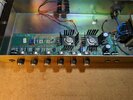
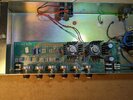
Amp has a MJ2501 (PNP) and MJ3001 (NPN)
PNP/NPN info is from a spec sheet I found on digikey.com
They are soldered and bolted to the board.

I'm getting readings, but not with the red on base for PNP / black on base for NPN as video says.
Open (no reading) when doing as the video describes.
Seems to get readings with black/red reversed, and I'm getting readings from emitter to collector.
No shorts anywhere.

Is the soldered to the circuit throwing everything off?
Amp seems to work fine except for the sizzle noise when cranked.

I can get a new set of transistors for about $25 and I'd replace the jack for $5 if I'm going to be heating up an iron.
(I'm getting no resistance across the jack switch contacts, btw)

View attachment 87578View attachment 87579
SINCE you had burned resistor on the board...
I don't see how that could happen unless the output transistor shorted and burned up.
In which case it could read open. (its blown)
 
SINCE you had burned resistor on the board...
I don't see how that could happen unless the output transistor shorted and burned up.
In which case it could read open. (its blown)
Replaced the output transistors & all 3 front panel jacks today.
Seems to have drastically cut back on the amp noise.
Still a little hiss when it's cranked that gets accentuated with some chorus in the BadCat loop.
Much more usable when it's cranked.
Thanks again @Amp Mad Scientist
5010-12.jpg5010-13.jpg5010-14.jpg
 
Back
Top