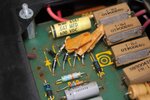
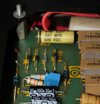
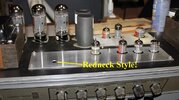
Very Cool Vintage Ampeg B-15-N rolled in for some TLC... Pic Heavy!!!

The above quote and info was submitted at jtcnj’s recent thread on his Silkyn amp problems. After reading the article on the difference between a 5881 and a 6L6GC, it got me thinking…:
The Ampeg B15N is fixed bias and designed around the 30 watt 6L6GC. And just like my old Ampeg VT-22, these amps do not have a bias trimpot to adjust the bias. The bias is set with a fixed resistor. I’ve yet to measure this B15N’s set bias, but if the Ampeg factory bias settings is aimed at a medium-ish 60% dissipation of a 30 watt tube, the same bias setting with the Sovtek 5881/6L6WGC’s 20.5 watt rating means that this tube is operating at 88% max dissipation… way too hot! This might be a logical reason why one of this amp’s Sovtek 5881 power tubes met a premature death… :unsure:
It's easy to make the bias adjustable....

There were many changes in output tubes design at the end of the 1960s.
Manufacturers made the tubes more efficient, to compete with transistors.
Several of the design specs changed at that time.
 
There were many changes in output tubes design at the end of the 1960s.
Manufacturers made the tubes more efficient, to compete with transistors.
Several of the design specs changed at that time.
Please, can you define tubes being made "more efficient" (in which way we're they) & offer evidence to support this, because we've been on this merry go round before, either here at TTR or on the Marshall forum, or possibly both.
You do understand transconductance, in particular "control grid to anode" transconductance, aka "mutual conductance". This, IMO, is one of the principal ways in which tube "efficiency" is demonstrated.
I have NOS & NOS/NIB tubes from the late 50's, early 60's, late 60's, early 70's & late 70's, many of them of the same "types" & from the same producer of valves, that being Philips, back then one of the worlds most prolific & well respected producer of valves (I won't list the many valve manufacturers around the world that Philips actually owned). Comparing the transconductance, mutual conductance, gm, etc of examples from the various era's simply does not support that there was an increase in tube efficiency in the late 60's, nor do the tube manufacturers published tube datasheets, specifications etc.
Hard evidence of tubes being made more "efficient" in the late 60's will be welcomed & appreciated. Cheers
 
Last edited:
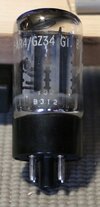
Why, yes it does. Can't figure out the date code though! My eyes see: B312
View attachment 87359
That code reads as B3I2, with the 4th character being a capital i. This will help you in deciphering Mullard date codes.
Note that the second character/digit gives us the last digit of the year of manufacture, but exactly which "decade" this is from must be determined by other factors. Cheers
Edit:
So yours is deciphered as
B = Blackburn plant manufacture.
3 = 1973 as it has a black base (among other things).
I = September.
2 = 2nd week of.
Cheers
 
Last edited:
if the Ampeg factory bias settings is aimed at a medium-ish 60% dissipation of a 30 watt tube, the same bias setting with the Sovtek 5881/6L6WGC’s 20.5 watt rating means that this tube is operating at 88% max dissipation… way too hot! This might be a logical reason why one of this amp’s Sovtek 5881 power tubes met a premature death… :unsure:
I'm not following this. How would you know what the Sovtek 5881 idles at with the Ampeg factory bias voltage (-50V)?
 
I'm not following this. How would you know what the Sovtek 5881 idles at with the Ampeg factory bias voltage (-50V)?
Good point. Actually, I don't know for sure. Uneducated theory perhaps. But since you made me think again, I just did a test. Measured: One pair of my 30-watt Svetlana Winged C 6L6GC versus one pair of the 20.5-watt Sovtek 5881/6L6WGC versus one pair of new-as-of-today 30-watt Svetlana SV6L6GC. Used a tube socket adapter for my meter that I can alternate between current and voltage at the amp's V4 position...

Svet Winged C: 39 mA @ 480 vdc... 62% dissipation (medium-ish)

Sov 5881/6L6 : 45 mA @ 478 vdc... 105% dissipation (insane!)

Svet 6L6GC : 52 mA @ 471 vdc... 82% dissipation ( hot!)

Can you or anybody else explain why the two Svet's are so different from each other? I'm blown away by the numbers of the Sov 5881!!
 
Good point. Actually, I don't know for sure. Uneducated theory perhaps. But since you made me think again, I just did a test. Measured: One pair of my 30-watt Svetlana Winged C 6L6GC versus one pair of the 20.5-watt Sovtek 5881/6L6WGC versus one pair of new-as-of-today 30-watt Svetlana SV6L6GC. Used a tube socket adapter for my meter that I can alternate between current and voltage at the amp's V4 position...

Svet Winged C: 39 mA @ 480 vdc... 62% dissipation (medium-ish)

Sov 5881/6L6 : 45 mA @ 478 vdc... 105% dissipation (insane!)

Svet 6L6GC : 52 mA @ 471 vdc... 82% dissipation ( hot!)

Can you or anybody else explain why the two Svet's are so different from each other? I'm blown away by the numbers of the Sov 5881!!
What was the bias voltage with the 5881/6L6WGC?
 
The voltage at the junction of R30 (270k) and R31 (270k). This is noted as -50V on the schematic.
Ok, I get it. Will this change depending on the power tubes, too? I’ll test this later today and post the results for all three pairs of the power tubes.

Another fact I would like to note is the differences between the power tube plate voltages from the schematic compared to the real voltages of this amp. Schematic shows 450 volts, but this amp is producing around 480 volts. The schematic was drawn on January 1974, but this amp was built in 1976. Schematic also shows a polarity switch with death-cap which was eliminated from these amps by 1976. I wonder if any changes were made to the trannies that would explain the voltage differences… :hmmm:
 
It's possible the 1976 Ampeg is using a 117 volt transformer would check filament voltages

Example my 1960 Fender Concert amp 110 volts 1964 Concert amp 117 volts
1960 Concert amp B+1 secondary voltage is designed 458 volts if I run wall voltage 505 volts AC

59 concert 001.JPG

1964 Concert 001.JPG
 
Why is there a 3A and 6A fuse in series on the AC mains? Makes no sense to me. Seems like the 6A fuse would never get blown since the 3A would go first.
 
Why is there a 3A and 6A fuse in series on the AC mains? Makes no sense to me. Seems like the 6A fuse would never get blown since the 3A would go first.

The 6A fuse is internal and not accessible from outside the chassis. It is in series with the regular 3A fuse in case somebody puts a way oversized fuse in the fuse holder or wraps a piece of chewing gum foil around a blown fuse. The internal 6A fuse is much larger than the 3A fuse so that the 6A one won't blow before the 3A one. It is internal because if a 6A fuse blows, then something catastrophic has happened with a possible fire hazard and the user cannot easily over ride this fuse and he will be forced to open up the amp. The internal fuse is not in a fuse holder making it difficult to use the chewing gum trick.
 
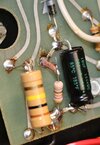
Yesterday, the man who brought me the amp, stopped by to drop off the new pair of power tubes, the SED 6L6GC's, which I've been testing yesterday and today. After he left, I measured them for voltages and current, and I'm surprised by hot they are running at. One tube is dissipating at a hot 78%, the other is dissipating at a hotter 82%, both at 476 volts at the plates. I added a 3.9k resistor to the 47k bias dividing resistor, and now the current is at 43mA & 46mA (485 volts @ plates) instead of 52mA & 55mA!!! Now I need to confirm with my friend if he and the owner wants to sacrifice the originality of the amp for the sake of tube life or back to business as usual... :unsure:

IMG_3747.JPG

Not very pretty, but it will be very easy and quick to return to normal!
 
Back
Top