RVA
Ambassador
Superblade once asked me to do a thread on this guitar and Big Daddy recently asked me some details, so here are she goes.
This is the first guitar I bought after resuming playing. All I owned was my 1983 Strat. I always wanted an LP too, but I felt bad because I had not resumed playing long enough. Well, after that the flood gates opened, hence the name of this guitar- Pandora. The original name for this guitar was "Houdini". It fell off a stand and landed flat on its face. It bounced off the pickguard and all that happened was that 1 knob cracked. It was bizzare
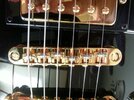
This model is a 2010 with certain details chosen by Sam Ash for a special run. I think they requested Ebony and maybe the knobs, but I do not imagine they had much latitude since it is a "VOS" reissue. Below are pics and the Sam Ash description of this guitar.


--------------
Gibson Custom 1960 Les Paul Standard VOS (Ebony)
Model: HB134C
Series: VOS - Vintage Original Spec
Body Style: Les Paul
Body Wood: Mahogany
Neck Type: Set In
Neck Wood: Mahogany
Machine Heads: Vintage Style tulip tuners
Fingerboard: Rosewood
Frets: 22
Controls: 2 Vol, 2 Tone, 3way switch
Bridge Type: Stop Tail
Scale Length: 24.75"
Body: Color Ebony
The 1960 Les Paul Standard Reissue from Gibson Custom is an accurate recreation of a truly classic and timeless instrument. It stays true to all of the original instrument’s features and characteristics, including Gibson’s traditional hand-carved maple top and solid, and non-weight relieved mahogany body. The headstock is made from Holly head veneer, as opposed to fiber, just like it was in 1960, and the vintage-style tulip tuners are mounted in a straight line, also as they were on the original.
The 24 ¾-inch scale length neck is made from one solid piece of mahogany, and attached to the body using a long neck tenon — one of the Les Paul’s more distinguishing characteristics of the late 1950s and early 1960s. The neck is topped by a 22-fret rosewood fingerboard outfitted with acrylic trapezoid inlays matching the size and color of the originals. Of course, two of Gibson’s legendary Burstbucker pickups deliver all the subtle variations of true, classic “Patent Applied For” humbucker tone by using historically “unmatched” bobbin windings and Alnico II magnets.
Other historical appointments include CTS potentiometers, bumble bee capacitors, single-ply crème-colored binding on both the top and fingerboard, a period-correct thin toggleswitch washer and jackplate, and ABR-1 bridge with lightweight aluminum stopbar tailpiece. The 1960 Les Paul Standard comes in a VOS finish and includes the standard Gibson Custom case, custom care kit and Certificate of Authenticity.
History
In hindsight, it’s certainly difficult to fathom Gibson’s Les Paul Standard of the late 1950s and early 1960s not appealing to the masses. Yet that’s exactly what happened, even as Gibson officials tried desperately to fine tune the instrument and make it suitable to the general guitar-playing public. Sadly, their efforts proved unsuccessful as the Les Paul Standard was shelved midway through 1960 to make way for a new design that featured beveled edges, twin cutaways and a much thinner body – the guitar known today as the SG Standard.
The Les Paul Standards manufactured in 1960 – all 635 of them – represented the last attempts by Gibson to modify the guitar’s existing design in an effort to improve sales numbers that had fallen steadily since 1956.
The guitars produced during the first half of 1960 were generally considered to be an extension of the 1959 Les Paul Standard, with the majority having thicker, rounded neck profiles (though not as thick as 1958), and many of them experiencing the same fading paint problem with the finish. By mid 1960, however, Gibson had begun manufacturing the Les Paul Standard with a much thinner neck profile, known today as the ’60s Slim Taper profile.
Of course, the rest of the 1960 Les Paul Standard embodied all of the changes of the previous three years – changes that had transformed the guitar into the iconic model that it would eventually become some years later. Among the modifications were Gibson’s legendary “Patent Applied For” humbucking pickups with metal covers, and jumbo-sized frets, all of which still adorns today’s Les Paul Standard. Also changed were the guitar’s volume and tone knobs, which went from what’s commonly referred to as “speed” knobs (clear tops) to the more stylish “Top Hat” knobs with a metal insert on top.
This is the first guitar I bought after resuming playing. All I owned was my 1983 Strat. I always wanted an LP too, but I felt bad because I had not resumed playing long enough. Well, after that the flood gates opened, hence the name of this guitar- Pandora. The original name for this guitar was "Houdini". It fell off a stand and landed flat on its face. It bounced off the pickguard and all that happened was that 1 knob cracked. It was bizzare
This model is a 2010 with certain details chosen by Sam Ash for a special run. I think they requested Ebony and maybe the knobs, but I do not imagine they had much latitude since it is a "VOS" reissue. Below are pics and the Sam Ash description of this guitar.
--------------
Gibson Custom 1960 Les Paul Standard VOS (Ebony)
Model: HB134C
Series: VOS - Vintage Original Spec
Body Style: Les Paul
Body Wood: Mahogany
Neck Type: Set In
Neck Wood: Mahogany
Machine Heads: Vintage Style tulip tuners
Fingerboard: Rosewood
Frets: 22
Controls: 2 Vol, 2 Tone, 3way switch
Bridge Type: Stop Tail
Scale Length: 24.75"
Body: Color Ebony
The 1960 Les Paul Standard Reissue from Gibson Custom is an accurate recreation of a truly classic and timeless instrument. It stays true to all of the original instrument’s features and characteristics, including Gibson’s traditional hand-carved maple top and solid, and non-weight relieved mahogany body. The headstock is made from Holly head veneer, as opposed to fiber, just like it was in 1960, and the vintage-style tulip tuners are mounted in a straight line, also as they were on the original.
The 24 ¾-inch scale length neck is made from one solid piece of mahogany, and attached to the body using a long neck tenon — one of the Les Paul’s more distinguishing characteristics of the late 1950s and early 1960s. The neck is topped by a 22-fret rosewood fingerboard outfitted with acrylic trapezoid inlays matching the size and color of the originals. Of course, two of Gibson’s legendary Burstbucker pickups deliver all the subtle variations of true, classic “Patent Applied For” humbucker tone by using historically “unmatched” bobbin windings and Alnico II magnets.
Other historical appointments include CTS potentiometers, bumble bee capacitors, single-ply crème-colored binding on both the top and fingerboard, a period-correct thin toggleswitch washer and jackplate, and ABR-1 bridge with lightweight aluminum stopbar tailpiece. The 1960 Les Paul Standard comes in a VOS finish and includes the standard Gibson Custom case, custom care kit and Certificate of Authenticity.
History
In hindsight, it’s certainly difficult to fathom Gibson’s Les Paul Standard of the late 1950s and early 1960s not appealing to the masses. Yet that’s exactly what happened, even as Gibson officials tried desperately to fine tune the instrument and make it suitable to the general guitar-playing public. Sadly, their efforts proved unsuccessful as the Les Paul Standard was shelved midway through 1960 to make way for a new design that featured beveled edges, twin cutaways and a much thinner body – the guitar known today as the SG Standard.
The Les Paul Standards manufactured in 1960 – all 635 of them – represented the last attempts by Gibson to modify the guitar’s existing design in an effort to improve sales numbers that had fallen steadily since 1956.
The guitars produced during the first half of 1960 were generally considered to be an extension of the 1959 Les Paul Standard, with the majority having thicker, rounded neck profiles (though not as thick as 1958), and many of them experiencing the same fading paint problem with the finish. By mid 1960, however, Gibson had begun manufacturing the Les Paul Standard with a much thinner neck profile, known today as the ’60s Slim Taper profile.
Of course, the rest of the 1960 Les Paul Standard embodied all of the changes of the previous three years – changes that had transformed the guitar into the iconic model that it would eventually become some years later. Among the modifications were Gibson’s legendary “Patent Applied For” humbucking pickups with metal covers, and jumbo-sized frets, all of which still adorns today’s Les Paul Standard. Also changed were the guitar’s volume and tone knobs, which went from what’s commonly referred to as “speed” knobs (clear tops) to the more stylish “Top Hat” knobs with a metal insert on top.