My Neck-Through-Body SG Finish Thread:

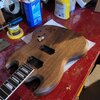
Stained and shellaced...

View attachment 87010
That may not necessarily be the ideal piece to use for a test piece.

That test piece is exposed end grain, whereas most of the guitar body uses face grain. Face grain is more resistant to absorbing finishes than end grain.

If you have some unused face grain wood, it would be a better sample to use for determining final finish color.
 
That may not necessarily be the ideal piece to use for a test piece.

That test piece is exposed end grain, whereas most of the guitar body uses face grain. Face grain is more resistant to absorbing finishes than end grain.

If you have some unused face grain wood, it would be a better sample to use for determining final finish color.

I agree, but dont have any scrap since we built it at Fender.

My only concern in the test piece was finish compatibility. Thats also clear shellac in the photo, but the body will receive amber shellac
 
TBH, the pics at post 33 and 36 have two very distinct lighting sources. It almost looks like two different guitars. I wouldn't go darker, though. Especially since the amber shellac is supposed to "warm" or "antique" the existing colors.
 
TBH, the pics at post 33 and 36 have two very distinct lighting sources. It almost looks like two different guitars. I wouldn't go darker, though. Especially since the amber shellac is supposed to "warm" or "antique" the existing colors.

Yep....

I did another application of stain after the photos posted, but there was no additional darkening, so that's as dark as its gonna get.

Im kinda thinking about applying the amber shellac with a brush and then just sand for smoothness....
 
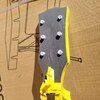
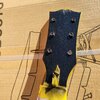
The headstock veneer is really gray looking, so i decided to paint it with black lacquer....

20221105_092653.jpg

20221105_092818.jpg

After blocking it with 1000# its starting to look right.

This is how grainy the headstock veneer looked after sanding and the first coat of black lacquer.
 
Last edited:
Gibson tuners, Gibson ABR-1, Gibson Tailpiece, Gibson Pickups, Gibson Top Hat Knobs still in the Gibson package....i've been going through all the parts that i have on hand.

I compensated the g/b/e on the nut by moving the intonation point on those strings towards the tuners.

Still need a BatWing and USA tailpiece stud inserts.
 
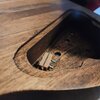
Very cool discovery. When we were routing this guitar, we were unsure of how deep to make the cavity, so we 'guessed' by cutting deep enough that a standard, 'short' pot would pass through and have enough threads to engage the nut.

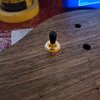
Here's a Gibson Les Paul Switch brand new in gold:

20221106_062444.jpg

This body is 1.640" thick.

20221106_062552.jpg

Last night, i performed a mock up and discovered that the long-shaft CTS pots that i have on hand and the long Les Paul switch, both fit in my cavity with room to spare.

20221106_062620.jpg

No special switch required!!!
 
Last edited:
For real…as in 10 times too large for normal guitar applocations!

Now, if these were .033 or .022 we might be in business. if such were the case, I’d lean toward the .022 capacitors.

It depends on what you want out of your tone control.

You will not get 360° use of a tone control until you drop under .015uf.

I have a few hundred box capacitors in .018uf which is a really good value with far more useable range than .022uf, even though the difference appears small on paper.

0.01uf will yield 360° of useable tone control without ever getting muddy.

I've started using Jonathan Parish Treble Bleeds on the neck pickup side with capacitor values between .010uf and .018uf.
 
Last edited:
It depends on what you want out of your tone control.

You will not get 360° use of a tone control until you drop under .015uf.

I have a few hundred box capacitors in .018uf which is a really good value with far more useable range than .022uf, even though the difference appears small on paper.

0.01uf will yield 360° of useable tone control without ever getting muddy.

I've started using Jonathan Parish Treble Bleeds on the neck pickup side with capacitor values between .010uf and .018uf.

I totally understand that it depends on what you want from your tone control. In mods I’ve done over the years, I’ve experimented quite a bit. I generally prefer .015 for humbuckers. I have used .033 caps as well. In fact, one guitar I had came stock with those until I changed them. I didn’t care for those.

But, if you find that .018 is better for your needs than .022, then understand that using a .22 capacitor is TEN TIMES the value of a .022 capacitor.

That was the point of my post…to indicate that a .22 is of pretty much no value as a tone cap in a normal guitar tone circuit.
 
Back
Top