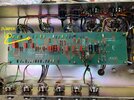
My 1982 Marshall 4010 combo needs a cap job, hums like a bugger. Originals still in. I ordered a set o FnT.
That said, it hasn't been fired up in over 2 years. Existing caps likely discharged by now? Or, best easiest way to discharge?
Thanks.
In this circuit, YES. But one should be in the habit of verifying, so go ahead and connect a meter from any of the filter cap's positive lugs to a chassis ground.
Jumper wire with clips method: Connect one end of the jumper wire to any of the two plate/anode resistors of V1. Other end of jumper wire goes to a chassis ground. The mounting holes of the chassis is a good and easy ground to connect to, or the pcb's mounting hardware is just as good. If there are any stored voltages in those filter caps, all the voltages will positively be drained through this connection.
Your amp should look like this (with jumper wire illustration):
My 1982 Marshall 4010 combo needs a cap job, hums like a bugger. Originals still in. I ordered a set o FnT.
That said, it hasn't been fired up in over 2 years. Existing caps likely discharged by now? Or, best easiest way to discharge?
Thanks.
First
take out the 3 smaller preamp tubes.
Turn the amp on...
Is the hum still there?
Install the small preamp tube closest to the power tubes. (phase inverter)
Leave the other 2 preamp tubes out.
Turn the master volume to zero.
Turn the amp on.
Is there hum now?
First
take out the 3 smaller preamp tubes.
Turn the amp on...
Is the hum still there?
Install the small preamp tube closest to the power tubes. (phase inverter)
Leave the other 2 preamp tubes out.
Turn the master volume to zero.
Turn the amp on.
Is there hum now?
While I haven't tried this, The hum is from within the power section. There is no way to make it stop and gets louder as volume is increased. Probably a good idea to change caps out as they are from 1982.
What would the above method show me? It is NOT from a preamp tube.
In this circuit, YES. But one should be in the habit of verifying, so go ahead and connect a meter from any of the filter cap's positive lugs to a chassis ground.
Jumper wire with clips method: Connect one end of the jumper wire to any of the two plate/anode resistors of V1. Other end of jumper wire goes to a chassis ground. The mounting holes of the chassis is a good and easy ground to connect to, or the pcb's mounting hardware is just as good. If there are any stored voltages in those filter caps, all the voltages will positively be drained through this connection.
Your amp should look like this (with jumper wire illustration): View attachment 86205
In this circuit, YES. But one should be in the habit of verifying, so go ahead and connect a meter from any of the filter cap's positive lugs to a chassis ground.
Jumper wire with clips method: Connect one end of the jumper wire to any of the two plate/anode resistors of V1. Other end of jumper wire goes to a chassis ground. The mounting holes of the chassis is a good and easy ground to connect to, or the pcb's mounting hardware is just as good. If there are any stored voltages in those filter caps, all the voltages will positively be drained through this connection.
Your amp should look like this (with jumper wire illustration): View attachment 86205
My 1982 Marshall 4010 combo needs a cap job, hums like a bugger. Originals still in. I ordered a set o FnT.
That said, it hasn't been fired up in over 2 years. Existing caps likely discharged by now? Or, best easiest way to discharge?
Thanks.
First
take out the 3 smaller preamp tubes.
Turn the amp on...
Is the hum still there?
Install the small preamp tube closest to the power tubes. (phase inverter)
Leave the other 2 preamp tubes out.
Turn the master volume to zero.
Turn the amp on.
Is there hum now?
While I haven't tried this, The hum is from within the power section. There is no way to make it stop and gets louder as volume is increased. Probably a good idea to change caps out as they are from 1982.
What would the above method show me? It is NOT from a preamp tube.
First
take out the 3 smaller preamp tubes.
Turn the amp on...
Is the hum still there?
Install the small preamp tube closest to the power tubes. (phase inverter)
Leave the other 2 preamp tubes out.
Turn the master volume to zero.
Turn the amp on.
Is there hum now?
If it gets louder as the volume increases, it's probably not the filter caps.
Ok i lied.
Lied a lot.
I recall last using the 800 at the dude's studio 2 yrs ago, it hummed like hell, no way to get it out. Started thinking today other amps have hummed at his too, maybe a potential ground issue or even his LED lites.
So...
I tried again here. It hummed really loudly at like 6 plus on volume. I switched out V2 for V1.
It got quieter.
I replaced the now V1 with a different tube from the stash.
It got quieter.
Hum? A little, sure, at like volumes loud enough to shake the windows.
Now, add the Lynch Mod into V2 which adds another tube gain stage. More hum?
Yep but that's expected. Monkeyed with a few combinations of tubes in the Mod and found 1 microphonic one. Works great as PI etc but not a gain stage.
So now, I can put up with what hum one gets using LM and without it is surprisingly quiet.
So I lied.
Won't hurt to change caps though as it is officially 40 years old.
Thanks for the help lads. @Amp Mad Scientist I did indeed remove V1 and V2 and had no hum. This precipitated my venture.
After I said it wasn't preamp...
OK I think I know what it is now...(brain is full of cob webs)
Plug into the LOW input jack with a guitar / cable.
The hum is gone now isn't it?
To fix this problem, you have to replace the LOW input jack.
The LOW input has a switch in the jack.
When the switch contact gets oxidized, it breaks the signal path, causes the hum.
Cleaning the LOW jack contacts is temporary.
The problem always comes back later.
Therefore replacing the LOW input jack is really the only reliable solution.
Warning- fake Cliff Jacks:
Be sure to use a REAL CLIFF UK jack. If the jack is not stamped: "CLIFF UK," it is a FAKE knock off jack- do not install the fake jack!
Look for the "UK." Make sure it's a real UK jack.
The fake jacks will fail very quickly.
Surprise The Jacks I bought from a very well-known vendor turned out to be FAKE knock-offs. The REAL Cliff Jack says: "Cliff UK." The FAKE Jack does not say "U.K!" That's how you can spot it. This is a REAL Cliff Jack. Says "U.K." This is the FAKE Cliff Jack. The REAL Cliff jack is made...
OK I think I know what it is now...(brain is full of cob webs)
Plug into the LOW input jack with a guitar / cable.
The hum is gone now isn't it?
To fix this problem, you have to replace the LOW input jack.
The LOW input has a switch in the jack.
When the switch contact gets oxidized, it breaks the signal path, causes the hum.
Cleaning the LOW jack contacts is temporary.
The problem always comes back later.
Therefore replacing the LOW input jack is really the only reliable solution.
Warning- fake Cliff Jacks:
Be sure to use a REAL CLIFF UK jack. If the jack is not stamped: "CLIFF UK," it is a FAKE knock off jack- do not install the fake jack!
Look for the "UK." Make sure it's a real UK jack.
The fake jacks will fail very quickly.
Surprise The Jacks I bought from a very well-known vendor turned out to be FAKE knock-offs. The REAL Cliff Jack says: "Cliff UK." The FAKE Jack does not say "U.K!" That's how you can spot it. This is a REAL Cliff Jack. Says "U.K." This is the FAKE Cliff Jack. The REAL Cliff jack is made...