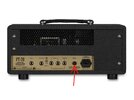
Trouble with my Friedman tonight

eclecticsynergy

Ambassador of Electric Synergy
Country flag
I love my PT20. Sounds fantastic and has performed flawlessly since I bought it used several years ago.
Sadly, tonight it let me down.

It powered up, and the tubes lit up & got warm. No cooked smells either, just no sound.
At first I suspected my speaker cab, which is old. Tried it through another cab, still nothing.
Seems too new to be needing new power tubes, though I'm not sure how many hours were on them before me.
Will have to open it up and see if there's anything obvious to a non-tech like me.

Wound up using someone else's Bandmaster through my own 2x12 tonight - zero breakup at today's levels.
But it was plenty loud and I keep an extra MIAB and FIAB in the back row on my board for just such an occasion.
One time years ago I arrived to find a solid state backline amp waiting; had to use a TS as my core tone the whole set.
Since then I come prepared.

Of course truly prepared would be a spare Friedman but operating at that level is way in the past for me.
Not even a stage tech to troubleshoot things these days.
 
I figure you are using a proven guitar and cable.
IF you have hum / hiss, the output transformer and power tubes are working, or at least in some capacity.
Swapping tubes is the easiest / safest route to start with, starting with V1 - (if you have hum / hiss).
And trying the other input jacks if more than one, which I figure you tried already.
 
I bought it used several years ago.

Seems too new to be needing new power tubes, though I'm not sure how many hours were on them before me.
"Several years" and the amount of time that you yourself has put those power tubes through, makes for a pair of very used power tubes!

Definitely check the 500mA (.5) amp HT (B+) fuse. A bad power tube will blow that fuse.

FA_PINK-TACO_BACK-1600-x-1200_DS.jpg
 
Check / swap speaker cable?
no guitar sounds, or no hiss or hum or anything at the speaker, if you turn it up full?
Is there a fuse for the B+? The heaters would still glow.

I figure you are using a proven guitar and cable.
IF you have hum / hiss, the output transformer and power tubes are working, or at least in some capacity.
Swapping tubes is the easiest / safest route to start with, starting with V1 - (if you have hum / hiss).
And trying the other input jacks if more than one, which I figure you tried already.

"Several years" and the amount of time that you yourself has put those power tubes through, makes for a pair of very used power tubes!

Definitely check the 500mA (.5) amp HT (B+) fuse. A bad power tube will blow that fuse.

View attachment 85931
Thanks for the advice, guys.
I checked the cables & speaker first thing. All worked just fine with the Bandmaster.
Also tried a cable in the loop send/return in case it was an interrupt jack not shorting.
There doesn't seem to be any hiss or hum, but the room wasn't quiet and i might not have heard it.

I did not check the fuse; figured if that were blown the amp wouldn't power up at all.
That's how my other amps have worked; it never occurred to me that a modern amp might be different.
Maybe it was a dumb assumption on my part. [Edit: Okay, not just maybe... It was.]

Blown fuse would be the easiest to see, and to replace. Of course, that'd mean something caused it to blow.
Will check the fuse first thing when I have the amp on my desk.

Probably ought to treat the amp to a new pair of EL84s anyway.
I think it's unlikely to be one of the 12AX7s, but will try swapping those too.
 
Last edited:
Yes the HT fuse can be blown, but it blows because the impedance setting is wrong (usually).
The amp and speaker need to be matched.
You need to test the speaker cabinet using an ohm meter.

Just because the speaker "works" does not mean everything is OK.
Common mistake.
Never assume the impedance is correct until you measure and verify first.

Connect a speaker cable to the cabinet. (never use a guitar cable to connect the speaker)
Measure the free end plug of the speaker cable with your ohm meter.

What is the ohm reading?
A 5 minute test saves a $300 repair bill.
 
Yes the HT fuse can be blown, but it blows because the impedance setting is wrong (usually).
The amp and speaker need to be matched.
You need to test the speaker cabinet using an ohm meter.

Just because the speaker "works" does not mean everything is OK.
Common mistake.
Never assume the impedance is correct until you measure and verify first.

Connect a speaker cable to the cabinet. (never use a guitar cable to connect the speaker)
Measure the free end plug of the speaker cable with your ohm meter.

What is the ohm reading?
A 5 minute test saves a $300 repair bill.
Thanks for that, too. Normally I run the PT20 through an oversized 1x12 loaded with a 16Ω Celestion Vintage 30.
I run it off the 16 Ohm output and it sounds amazing. But the V30 (like all Celestions IME) is rather beamy.
On Saturday I wanted wider dispersion so I decided to use my old Bandmaster tiltback 2x12, which is 4 Ohms.

Since the Friedman also has two 8Ω speaker outs, I had figured 4Ω would be enough of a load.
I guess that wasn't a wise assumption either; the manual says to use the two 8Ω jacks for two 16Ω cabinets.
8Ω, then, is a combined rating for both "8Ω" jacks together. Could've been labeled more clearly IMO.

However, since I couldn't get any sound out of the amp, I never actually used it into a 4Ω load.
So that can't be the cause of the problem this time.
But at least I know not to use it with the 2x12 in the future. :)

For now, I've checked the fuse and it isn't blown. I did hear a bit of a clunk when I tilted the amp so apparently something is loose.
Will have to open it up and take a look.
 
Thanks for that, too. Normally I run the PT20 through an oversized 1x12 loaded with a 16Ω Celestion Vintage 30.
I run it off the 16 Ohm output and it sounds amazing. But the V30 (like all Celestions IME) is rather beamy.
On Saturday I wanted wider dispersion so I decided to use my old Bandmaster tiltback 2x12, which is 4 Ohms.

Since the Friedman also has two 8Ω speaker outs, I had figured 4Ω would be enough of a load.
I guess that wasn't a wise assumption either; the manual says to use the two 8Ω jacks for two 16Ω cabinets.
8Ω, then, is a combined rating for both "8Ω" jacks together. Could've been labeled more clearly IMO.

However, since I couldn't get any sound out of the amp, I never actually used it into a 4Ω load.
So that can't be the cause of the problem this time.
But at least I know not to use it with the 2x12 in the future. :)

For now, I've checked the fuse and it isn't blown. I did hear a bit of a clunk when I tilted the amp so apparently something is loose.
Will have to open it up and take a look.
Parts can sometimes break off the circuit board...

But if you have a volt meter we can do some tests.
 
How is this coming along?

I just had the same thing happen (no sound) with my Silkyn 50 after I put in a "matched pair" of Tung-Sol 6l6gc str tubes I never got around to putting in, from 2018.

I played it fairly loud, but nowhere near cranked up for about 1 1/2 hours Friday, then low volume skill drills Sat it went silent after about 30 min.

Actually, back then I had the pair about 6 months, put them in and one failed right away. Since it was 6 months later, I just bought another and asked for one with the same "21ma" sticker. I never tried the new tube.

biased at @70% (64 on one tube, 71 on the other).
When I do this, first I measure the resistance across each of the OT windings.
I turn the amp on and watch the tubes for 2-3 min for red plating, then measure the voltage across the windings, do the math and set the initial bias.
I let it sit at least 10 min more, and recheck the voltage drop across the OT windings again, then adjust to target.


The B+ fuse did its job, turns out one of the tung sols failed. I have no voltage drop across the OT winding on that side / V7.
That tube was at 71% - from what I have read 70% is max safe dissipation.
Maybe that is a hard ceiling, I thought there was some wiggle room there.

Put it on the light bulb limiter, replaced the fuse.
Swapping the tube positions, the problem moved to V8 - with the tube.

Back when I bought the pair in 2018, they were $20.xx each, now they are over $40. YIKES.
I put the stock Sovtek 5881/6l6wglc (6p3s-e) pair back in for now, bias again around 70%. I say "around" because one tube is at 70% and the other a little less.
I had played the amp recently several sessions with these, at this bias point, with no problems.

Antique Electronics Supply has JJ 6l6gc around $40. matched / burned in pair, and a single tungsol to round up that pair.
I WILL try them right away.

I think I will bias around 60% to start. While I am waiting I will bias the Sovteks down a bit as well. I never tried different bias points and compared tone before.

Early on I tried a pair of 6p3s, and cooked V8 screen resistor open. I dont know if my bias was too high or, what I now read that tube does not last at 484v plate, not much less on screens. the ebay seller listed it as equal to 6l6gc.

I know better now. Neither the 6p3s or the 6p3s-e is exactly a 6l6gc, but the supposedly -e variant can handle the higher voltages.
 
Last edited:
How is this coming along?

I just had the same thing happen (no sound) with my Silkyn 50 after I put in a "matched pair" of Tung-Sol 6l6gc str tubes I never got around to putting in, from 2018.

I played it fairly loud, but nowhere near cranked up for about 1 1/2 hours Friday, then low volume skill drills Sat it went silent after about 30 min.

Actually, back then I had the pair about 6 months, put them in and one failed right away. Since it was 6 months later, I just bought another and asked for one with the same "21ma" sticker. I never tried the new tube.

biased at @70% (64 on one tube, 71 on the other).
When I do this, first I measure the resistance across each of the OT windings.
I turn the amp on and watch the tubes for 2-3 min for red plating, then measure the voltage across the windings, do the math and set the initial bias.
I let it sit at least 10 min more, and recheck the voltage drop across the OT windings again, then adjust to target.


The B+ fuse did its job, turns out one of the tung sols failed. I have no voltage drop across the OT winding on that side / V7.
That tube was at 71% - from what I have read 70% is max safe dissipation.
Maybe that is a hard ceiling, I thought there was some wiggle room there.

Put it on the light bulb limiter, replaced the fuse.
Swapping the tube positions, the problem moved to V8 - with the tube.

Back when I bought the pair in 2018, they were $20.xx each, now they are over $40. YIKES.
I put the stock Sovtek 5881/6l6wglc (6p3s-e) pair back in for now, bias again around 70%. I say "around" because one tube is at 70% and the other a little less.
I had played the amp recently several sessions with these, at this bias point, with no problems.

Antique Electronics Supply has JJ 6l6gc around $40. matched / burned in pair, and a single tungsol to round up that pair.
I WILL try them right away.

I think I will bias around 60% to start. While I am waiting I will bias the Sovteks down a bit as well. I never tried different bias points and compared tone before.
You can bias hotter than 70% for class AB1, though tube life will suffer the hotter you bias, & of course you'll want to be sure you don't bias so hot the tubes red plate, & this means from quiescent current condition right through to full clip (yes, tubes can red plate under applied signal conditions while they weren't red plating at quiescent, or no signal condition).

This brings up to tube "matching".
Aside from the fact that most tube testers do not test the tubes at real world "amp" voltages, when you buy tubes you should be given at least two sets of figures, these being plate current & transconductance (aka mutual conductance). Transconductance can be given as mA/V (mA plate current per control grid volts), or as umhos. Either way, this is an important figure, & aside from the small difference in DC resistance between the two halves of the OT primary, the tubes having different transconductance is why two tubes with the same plate current rating can bias up so differently in your amp (64mA vs 71mA).
If your tube supplier isn't giving you transconductance figures, it's better you find a new supplier. Really, they should also be telling you what type tester was used as well as the voltages applied to the plate, screen & control grids while under test.

I bias by ear, having first determined the minimum & maximum bias parameters.
First I bias to mid 50's% max plate dissipation (approaching the lower limit of class AB1 push pull fixed bias) & note the negative voltage at the output of the bias circuit (or junction of the bias splitter resistors, same thing).
This is my "minimum" bias parameter.
I then bias to 70% max plate dissipation or a tad over & again note the negative voltage at the output of the bias circuit. This is my "maximum" bias parameter.
I can then monitor the negative bias voltage while playing through the amp at volume, adjusting the bias voltage to find where the amp sounds best. So long as the negative bias voltage is between these minimum & maximum parameters, I know it's biased safely.
Cheers
 
Last edited:
I put the stock Sovtek 5881/6l6wglc (6p3s-e) pair back in for now, bias again around 70%. I say "around" because one tube is at 70% and the other a little less.
Are these the ones with the wafer bottoms? If so, I have a pair of those, the (EH) Sovtek 5881/6L6WGC, in my SLO-Clone 50. Are you biasing these tubes based on them being rated for 20.5 watts? My SLO-50 at 466 plate voltage is biased to around 27 mA's for 60% dissapation. I found out recently that some are mistaking these for 30 watt 6L6GC's!
 
You can bias hotter than 70% for class AB1, though tube life will suffer the hotter you bias, & of course you'll want to be sure you don't bias so hot the tubes red plate, & this means from quiescent current condition right through to full clip (yes, tubes can red plate under applied signal conditions while they weren't red plating at quiescent, or no signal condition).

This brings up to tube "matching".
Aside from the fact that most tube testers do not test the tubes at real world "amp" voltages, when you buy tubes you should be given at least two sets of figures, these being plate current & transconductance (aka mutual conductance). Transconductance can be given as mA/V (mA plate current per control grid volts), or as umhos. Either way, this is an important figure, & aside from the small difference in DC resistance between the two halves of the OT primary, the tubes having different transconductance is why two tubes with the same plate current rating can bias up so differently in your amp (64mA vs 71mA).
If your tube supplier isn't giving you transconductance figures, it's better you find a new supplier. Really, they should also be telling you what type tester was used as well as the voltages applied to the plate, screen & control grids while under test.

I bias by ear, having first determined the minimum & maximum bias parameters.
First I bias to mid 50's% max plate dissipation (approaching the lower limit of class AB1 push pull fixed bias) & note the negative voltage at the output of the bias circuit (or junction of the bias splitter resistors, same thing).
This is my "minimum" bias parameter.
I then bias to 70% max plate dissipation or a tad over & again note the negative voltage at the output of the bias circuit. This is my "maximum" bias parameter.
I can then monitor the negative bias voltage while playing through the amp at volume, adjusting the bias voltage to find where the amp sounds best. So long as the negative bias voltage is between these minimum & maximum parameters, I know it's biased safely.
Cheers
excellent info, thanks! I view "matching" in simple amp terms - similar current draw. I realize there is so much more i dont have a good handle on.

I will try to incorporate this method.
I can do similar with the voltage drop across the OT as well.
 
Last edited:
Are these the ones with the wafer bottoms? If so, I have a pair of those, the (EH) Sovtek 5881/6L6WGC, in my SLO-Clone 50. Are you biasing these tubes based on them being rated for 20.5 watts? My SLO-50 at 466 plate voltage is biased to around 27 mA's for 60% dissapation. I found out recently that some are mistaking these for 30 watt 6L6GC's!
Yes, they have the coin / wafer base. From what I have read they can be considered a 30w tube. I remember now that you bring this up, to consider them a 25w for longevity, but are commonly considered 30w.

I am going to spend more time listening; I pretty much set it at a safe / near max and just played it with those tubes.

 
Yes, they have the coin / wafer base. From what I have read they can be considered a 30w tube. I remember now that you bring this up, to consider them a 25w for longevity, but are commonly considered 30w.
Alright jt... Now I'm confused in how you're biasing the Sovtek 5881/6L6WGC & the 6P3S-E.
These are 20.5 watt tubes like the 6P3S-E:

Using your 484v of plate voltages, If you're biasing these tubes based on the 30 watt 6L6GC, and you set the bias for 70% dissipation, then you're actually pushing this particular 5881 into 100+% dissipation! If you're biasing based on a 25 watt tube at 70%, then you're actually pushing these waffered 5881's into 85% dissipation!

Cool bias calculator that works great on our smartphones and PC's:
 
My mistake; I should bias the Sovtek 5881/6l6wgc as 20.5w max.
It's been a while since I was researching this.
I have not played the amp since I put the Sovteks back in and (yikes!) used 30w as max in my calcs.

I'll have to look in my notes; I'm pretty sure I was using the 5881 23w max, still too high.
From what I have gathered, the Sovtek 5881/6l6wgc IS a 6p3s-e.


Back to the failed Tung-Sol 6l6gc - I biased them at @70% based on 30w.
Their datasheet does list max plate voltage at 550v and max dissipation 30w.
 
Thanks for that, too. Normally I run the PT20 through an oversized 1x12 loaded with a 16Ω Celestion Vintage 30.
I run it off the 16 Ohm output and it sounds amazing. But the V30 (like all Celestions IME) is rather beamy.
On Saturday I wanted wider dispersion so I decided to use my old Bandmaster tiltback 2x12, which is 4 Ohms.

Since the Friedman also has two 8Ω speaker outs, I had figured 4Ω would be enough of a load.
I guess that wasn't a wise assumption either; the manual says to use the two 8Ω jacks for two 16Ω cabinets.
8Ω, then, is a combined rating for both "8Ω" jacks together. Could've been labeled more clearly IMO.

However, since I couldn't get any sound out of the amp, I never actually used it into a 4Ω load.
So that can't be the cause of the problem this time.
But at least I know not to use it with the 2x12 in the future. :)

For now, I've checked the fuse and it isn't blown. I did hear a bit of a clunk when I tilted the amp so apparently something is loose.
Will have to open it up and take a look.

Yes dont run 4 ohm in that!
ThecHT fuse can blow from a desd power tube too. Try the power tubes.
 
Back
Top