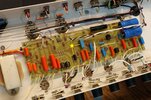
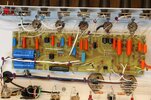
Tinkering With My SLO (Clone) 50: Background Hiss & FX Loop Concerns

If I can use one, anyone can!

Just watch your probe ratings and be careful.
O scope can be pretty helpful.
And it's not difficult to learn.

If you bridge out the first resistor with a wire jumper (then measure) you can kind of get an idea about how much noise comes from the 68K /33K input resistor.
It's the majority of the hiss.

But fundamentally the design is noisy...
What it really needs is a re-design, instead of using the same old traditional input circuit.

The resistor at the input has really outdated itself.
It worked OK for normal low gain amps but it's not so great for modern "high gain."
The same problem for filament noise too basically.

If you want an amp with a 40db noise floor, it's OK.
But the noise floor "should be" 90 db, as good as any hi fi amp.
 
Three days ago I posted that I was done chasing my tail in trying to reduce the background hiss of this high-gain amp. But I decided to try one more technique: Proper orientation of non polarized caps. First, I removed all the coupling caps and some signal caps from the board, and tested & marked them for their respective outer foil leads. Since I don't have an oscilloscope, I used the noisy hum method. Results: No noticeable benefits with this amp. Ok... I tried!

Anyone seeking more info on this, should look into the two following links...
Documentation from Aiken Amps:

And from our TTR's @NewReligion :
 
Looking at the schematic, we see a 470k resistor (labelled as a "grid stopper") at the control grid of V2a. While somewhat attenuating all frequencies, this resistor is being used to control high end (or upper high end). Resistors attenuate highs before other frequencies. But, as AMS has already said, resistors generate noise/hiss, especially noticeable when they're on the input of valves early in the signal chain. This 470k resistor on the control grid of V2a (OD channel) will be contributing noise. Resistor noise/hiss is just something we have to live with, though the choice of resistor type can be of help (though I imagine you've already used a metal film type here).
On my 2204/ Caswell #39 type amp, rather than use a 68k or 34k grid stopper resistor on the input, I've used an 18k, helps with lowering hiss a smidge & doesn't mess with the "feel" of the amp too much. Cheers
 
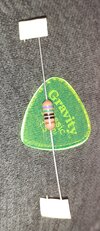
Rob Reeder/C3 Amps really tries to offer an authentic Soldano SLO experience. Most of the resistors in these kits are the same Vishay/Dale CCF series 1/watt metal films used by Mike Soldano.)

A 750 ohm-er:
View attachment 84715
Nice,,, non magnetic, non inductive & copper leaded. I also like the Vishay/Beyschlag metal film resistors. Cheers
 
So in the interest of any on this killer amp........... I'm think I'm finally done with this chapter of my SLO-50 build after deciding whether a mod to the stock designed SLO fx loop circuit is a keeper... or it's not worth it! IMO, the following mod is worth it... :celebrate:

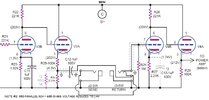
AFAIK, the 1980's SLO fx loop circuit was designed around the 80's guitar crunchers and their high signal-injecting rack effects. These SLO fx loops are too hot for our regular stompboxes (some of them at least...) when trying to use modulation style effects in the SLO amp's loop. There's a standard SLO alternative that require's a simple pigging backing of a resistor to a resistor, and a cap to another resistor. Works well, but this mod that comes by the name of "Ten Over" from TDPRI and the Amp Garage forums, designed a simple and well calculated mod, that is worth going the extra mile for consistent tone between the "no effects in the loop channel" or "loop circuit jumpered with effects pedals".

Original SLO schem with alternate fx loops mod in grayed areas:
STOCK SLO FX LOOP SCHEMATIC.JPG

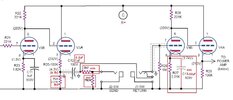
My massaged interpretation of Ten Over's design:
D.T. SLO FX LOOP MOD SCHEMATIC.JPG


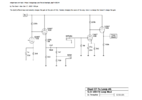
Ten Over's actual modded schem:
D.T. SLO 100 FX Loop Mod by D Tinnopher.png


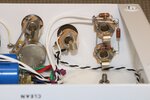
Two parts of the new mod: A couple of caps that allow the loop to retain the amp's preamp gain...
TenOver FX Loop Mod 9-5-22 (3).JPG


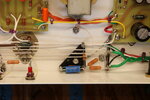
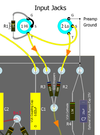
The two resistors added at the southeast of the loop jacks, form a voltage divider that cuts the high signal level, intended for rack gear, to levels more friendly to regular pedals:
TenOver FX Loop Mod 9-5-22 (4).JPG
 
Last edited:
So in the interest of any on this killer amp........... I'm think I'm finally done with this chapter of my SLO-50 build after deciding whether a mod to the stock designed SLO fx loop circuit is a keeper... or it's not worth it! IMO, the following mod is worth it... :celebrate:

AFAIK, the 1980's SLO fx loop circuit was designed around the 80's guitar crunchers and their high signal-injecting rack effects. These SLO fx loops are too hot for our regular stompboxes (some of them at least...) when trying to use modulation style effects in the SLO amp's loop. There's a standard SLO alternative that require's a simple pigging backing of a resistor to a resistor, and a cap to another resistor. Works well, but this mod that comes by the name of "Ten Over" from TDPRI and the Amp Garage forums, designed a simple and well calculated mod, that is worth going the extra mile for consistent tone between the "no effects in the loop channel" or "loop circuit jumpered with effects pedals".

Original SLO schem with alternate fx loops mod in grayed areas:
View attachment 85693

My massaged interpretation of Ten Over's design:
View attachment 85694


Ten Over's actual modded schem:
View attachment 85695


Two parts of the new mod: A couple of caps that allow the loop to retain the amp's preamp gain...
View attachment 85696


The two resistors added at the southwest of the loop jacks, form a voltage divider that cuts the high signal level, intended for rack gear, to levels more friendly to regular pedals:
View attachment 85697

Beautiful work as always!
 
I appreciate what you are posting, Greg-O. I'm learning a lot based on your posts and my self-study.

I'm also understanding why I absolutely hate how Fender, Vox and Mesa amps sound when overdriven, although they sound fantastic clean.
 
I recall reading how Jimmy Marshall modified the circuit of Pete Townsend's 5F6A Bassman.

From what i see, the 5F6A Bassman and the higher-power 5F8A Tweed Twin were Fenders' move toward cleaner and more powerful amps.

The way I understand this phenomenon is thst the first Fender amps were built at a time when distortion simply not desirable. If you look at Fender ads from the 1950's, youll see that they make specific mention of their amps as being distortion free. They continued to build amps like this because they got very good at it and it was what the artists at the time wanted, by to be totally honest, what real choices did you have in 1954???

Much like why the Stratocaster lacked a tone control on the bridge, which is a sonic abomination in itself in stock form. Like Hendrix and SRV, I admired their playing, but lovingly tolerated their tone, and it is much the same with YJM.

Further study of schematics show that at some point, the preamp topography of the 6G 'Brownface' circuitry seems to have changed and the tone controls were moved in between the first two gain stages, which again steals some gain, but apparently equaling cleaner sonics.

The Blackface amps continued this thinking...cleaner and brighter with more sparkle...and i believe this was driven more by the music of the era than anything else.

Thank God for Jim Marshall.

Jimmy appears to have stuck to the basic topography of the 5F6A - two gain stages before tone controls - even when they went to 100 models. Therefore, their amps were thicker, meaner, and went into tube saturation earlier.

Jimmy Marshall took over the rock guitar world amost completely.

Fast forward to the 1970's, when Marshall went to the master volume set-up (around 1976, IIRC???) with the 2203/2204 amps, this was a tremendous leap forward over the eaier "Plexi" designs in terms of giving higher levels of preamp saturation at more controllable volume levels.

It seems that Mr. Smith of Mesa Boogie fame capitalized on this this move as well. While Mesa did alter

With the exception of playing dead-clean, i can (and have) wasted countless hours (of rehearsal studio time) playing through Mesas, Fenders and Vox's and never hear anything that I like, despite taking in all the "education" on how their controls "should be adjusted."

Mesa's are still essentially a Fender circuit with extra gain stages and i think the reason they are such a close relative to the Fender in terms of tone is why i just cannot enjoy them...their EQ's don't really "EQ" the overall sound, because the tone stack is before the extra gain stages.

It would seem that all of them are, at least to some degree, copies of Western Electric amps, but the Marshall is easier to work with.
 
From another forum, here is an excellent looking elevated heater mod by FourT6and2 for his 100 watt SLO-Clone:
d7rl6uv-a9ef8162-e332-48b7-9e62-0f0717ccd9d1.jpg


And yet from another forum, here's dinkyguitar's elevated heater mod for his 50 watt SLO-Clone:
E4VG.jpg
 
From another forum, here is an excellent looking elevated heater mod by FourT6and2 for his 100 watt SLO-Clone:
d7rl6uv-a9ef8162-e332-48b7-9e62-0f0717ccd9d1.jpg


And yet from another forum, here's dinkyguitar's elevated heater mod for his 50 watt SLO-Clone:
E4VG.jpg
Well
I don't like elevating filaments because it eliminates the isolation between filament and other power supplies...
the insulation (center tap) of the filament winding was never intended to be used as such.
I would rather
re-position filament wiring
use DC filaments for preamp
or use cancellation method to eliminate filament buzzing. This has been called the "hum bucking" filament method.
Besides which elevating filaments does not actually eliminate all the buzzing noise....only some of it.
 
Nice build, good job!

I'm replying because my build was mentioned. But referencing the heaters to an elevated DC source was not done to reduce heater noise. There is very little heater noise in this kind of amp if your layout and lead dress are good. Elevating the heaters was done solely to reduce the heater-to-cathode voltage differential in the cathode follower position so modern (weaker) preamp tubes don't die prematurely. Also, the SLO power transformer has no heater center tap, which is why an artificial center tap is used.

slo_clone_2_by_haftelm_d7sk6zc-fullview.jpg


board_to_board_by_haftelm_d7sg26i-fullview.jpg
 
Nice build, good job!

I'm replying because my build was mentioned. But referencing the heaters to an elevated DC source was not done to reduce heater noise. There is very little heater noise in this kind of amp if your layout and lead dress are good. Elevating the heaters was done solely to reduce the heater-to-cathode voltage differential in the cathode follower position so modern (weaker) preamp tubes don't die prematurely. Also, the SLO power transformer has no heater center tap, which is why an artificial center tap is used.
Awesome!
Welcome to TTR… :cheers:
 
Back
Top