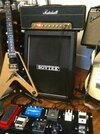
Tube socket replacement

Maybe a volume of 3ish
OK, thanks. I was just wondering how sensitive the amp will be in the type of impedance mismatch that you went through. It probably would have krapped-out at lesser volumes.
 
  • Like
Reactions: LRT
OK, thanks. I was just wondering how sensitive the amp will be in the type of impedance mismatch that you went through. It probably would have krapped-out at lesser volumes.
No problem just want to fix it right
 
Ams i will be doing the work and am ready to follow your instrutions.

First question is proper resistor to dischsrge capacitors?

Amp has set for several months and power switch is set to on and standby in operate but i fell thats not enough to make sure caps are discharged
Unplug the amp from power.
Turn on the standby switch...this will normally discharge the caps within a few minutes...
Now look at the schematics, are there any bleed resistors across the can caps?
These will discharge the power supply.

OK looking at the schematics:
on this amp there are no bleeder resistors across the can caps.
So, you will need to make sure it's discharged.

You can discharge the caps with any handy power resistor. I will use a 1K 5 watt...
but it doesn't need to be any certain value, just enough to load it. 100 ohm or 5K it will still work.

Now use your DC voltmeter to measure each can cap.
If it gets down to 9-10 volts, then don't worry it won't shock you.
It's only when the cap is charged way up to 100 volts and more that it actually shocks you.
 
  • Like
Reactions: LRT
Blink is correct about 4 or 5 years ago AMS helped me to properly convert 5881 to EL34
This consists of changing the grid resistors and screens to proper values. This is what the local teck of our areia didnt do it was jus put tubes in and bias.
Yes i failed to switch to 8ohms when adding the other cab , shame on me for not reading instructions.
Did you change the screen resistors to 2200 ohm, 5 watt? That's what the factory installed using EL34 output tubes.
It will work with 1K 5 watt, but it draws a lot of current. Better to use the 2200 ohm 5 watt.

The 5881 output tubes use 470 ohm screen resistors.
But don't run EL34s with the 470 ohm screen resistors. It will run too hot.

Now set the meter to ohms, and test each screen grid resistor, do they all read about 2200 ohms?
 
  • Like
Reactions: LRT
Ok im home
OK
Install the new socket and we can run through the voltage tests.
But don't put the tubes in yet.

Speakers:
Remove each speaker from the cabinet.
Move the speaker cone in/out by hand.
Does it scrape when it moves in / out? If it scrapes and rubs the speaker is blown.
The speaker must move in/out by hand freely without any interference.

NEVER play an amp into a speaker that scrapes when it moves in / out.

Now measure each speaker with the ohm meter.
Do the speakers read the correct ohms?

OK
if you can pass the above tests put the speakers together, and wire up the speaker jack.

Then we will make more tests on the cabinet and the speaker cable.
Don't use the cabinet until it passes all the tests and the ohms are verified.

16 ohm speaker will read 12.6 ohms that is normal.
8 ohm speaker reads about 6.8 ohms. That is normal.
4 ohm speaker reads about 3.2 ohms.
Now test that and don't assume it's right until you actually test it.
 
  • Like
Reactions: LRT
Im finally have time to sit and replace this socket
Think I'll check speakers first then move to the head. Ill post up the results on the speakers here shortly
Thanks again
 
Cab is 1960A with gt75 speakers
Speaker cable checked a 0.3 ohms for both conductors and 0 across.
Top right not scratchy and 13.30 ohms
Bottom right not scratchy and 13.80 ohms
Top left not scratchy and 13.80 ohms
Bottom left not scratchy and 13.80 ohms
At imput jack checked at 14.90 ohms
Polarity was proper and was double checke befor closing the cabinet up
 
I have discharged the cap and ar reading 0vdc and have also checked the screens
Screans are 2k2 5% 5w
1-2.204 kohm
2-2.209 khom
3-2.205 kohm
4-2.202 kohm
 
I will now proceed to replace the socket and will wait to here back
I am also going to have tubes tested
 
I will now proceed to replace the socket and will wait to here back
I am also going to have tubes tested
If you have a burned socket you probably have a blown tube.
Look inside the glass, did any of the tubes turn black inside?
Any burn spots inside the glass?
Any discoloration of the silver inside the glass?
Very often a blown tube will look burned/discolored inside the glass. You can see it pretty easily.

What happened is that the high voltage was bleeding into the filament...

The carbon track across the socket allows high voltage to enter the filament path.
This is bound to cook something inside the tube.
 
Last edited:
From what can be visibly inspected there is no discoloration to any tubes, no mirror like appearance or black spots. The tip of the pin on the tube from the bad socket looks as if it was sandblasted.
 
Back
Top