Origin 50 - Unable to bias help

Ghostman

Ambassador of the SuperNatural
Country flag
Hello Gents. A buddy of mine has an Origin 50 that he inadvertently left on for a few days. When he came back to it, he turned it off, let it cool down and then when he turned it back on, a power tube blew. Took out the tube and the fuse. He replaced both, but now he can't bias the amp. It's stuck on 91ma and the bias pot does nothing.

Anyone have any notions of where I should suggest he look? He's fairly electronic capable, handy with soldering etc.
 
Hello Gents. A buddy of mine has an Origin 50 that he inadvertently left on for a few days. When he came back to it, he turned it off, let it cool down and then when he turned it back on, a power tube blew. Took out the tube and the fuse. He replaced both, but now he can't bias the amp. It's stuck on 91ma and the bias pot does nothing.

Anyone have any notions of where I should suggest he look? He's fairly electronic capable, handy with soldering etc.
One disadvantage we have is that there is no schematic.

But the basic is:
Remove power tubes.
Turn power on, keep standby in "warm up" position.
Do not turn standby to "operate" position.
Set meter for DC volts.
Connect black probe to metal chassis.
Connect red probe to pin 5 of output tube socket.

Turn bias control up/down and note DC voltage on pin 5 of output tube socket.
Do this test for both output tube sockets.
What is the DC voltage reading on pin 5 of the output tube sockets??

Do not install tubes.
Do not operate amp. Do not turn standby switch to "operate" position.
Report voltage readings.

The ability to adjust DC voltage on pin 5 of the output tube socket (adjust up down) is the first thing you need to confirm.
 
Last edited:
Thank you AMS! I knew I could count on you chiming in. I'll get with my buddy and have him start there.
Have your bud join the forum.
He can take advantage of all the amenities resources experience and privileges that are included along with the deranged amp technicians....

However, there is also some technicians here in the forum who are sane responsible individuals (unlike the above). I'm certain you can call upon them if / when the need arises.

Well,
I kinda suspect that the bias pot wiper has failed.
And we're going to need to dig down into it, because there's no schematics.
 
Last edited:
One disadvantage we have is that there is no schematic.

But the basic is:
Remove power tubes.
Turn power on, keep standby in "warm up" position.
Do not turn standby to "operate" position.
Set meter for DC volts.
Connect black probe to metal chassis.
Connect red probe to pin 5 of output tube socket.

Turn bias control up/down and note DC voltage on pin 5 of output tube socket.
Do this test for both output tube sockets.
What is the DC voltage reading on pin 5 of the output tube sockets??

Do not install tubes.
Do not operate amp. Do not turn standby switch to "operate" position.
Report voltage readings.

The ability to adjust DC voltage on pin 5 of the output tube socket (adjust up down) is the first thing you need to confirm.
I didn't realize until he asked me about it, the Origin doesn't have a Standby switch.

Please advise.
 
One disadvantage we have is that there is no schematic.

But the basic is:
Remove power tubes.
Turn power on, keep standby in "warm up" position.
Do not turn standby to "operate" position.
Set meter for DC volts.
Connect black probe to metal chassis.
Connect red probe to pin 5 of output tube socket.

Turn bias control up/down and note DC voltage on pin 5 of output tube socket.
Do this test for both output tube sockets.
What is the DC voltage reading on pin 5 of the output tube sockets??

Do not install tubes.
Do not operate amp. Do not turn standby switch to "operate" position.
Report voltage readings.

The ability to adjust DC voltage on pin 5 of the output tube socket (adjust up down) is the first thing you need to confirm.
The Origin has no stand by switch
I should have read the entire thread first ,, lol
 
I didn't realize until he asked me about it, the Origin doesn't have a Standby switch.

Please advise.
OK you can do the same thing, be aware that there is high voltage on pins 3 and 4 of the output tube socket.

But you should still see minus DC voltage on pin 5.
Turn the bias pot, and the DC voltage on pin 5 should go up or down.

If there is no DC voltage on pin 5, that explains why the tubes would red plate or blow fuses.

But keep testing, don't put the tubes in yet.

Why doesn't your tech dude bud join the forum?
 
Trim pot was messed up on one of my Marshall's lucky it was in range from the factory
Had to pull the board to replace it.View attachment 81745
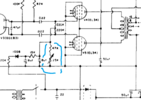
There are 2 basic types of bias adjust pot circuits.

In the super lead:
if the pot wiper fails, the tubes go cold.
This is a fail-safe design which protects the tubes.

In the DSL: (and others):
if the pot wiper fails, the tubes red plate.
It destroys the tubes.
This is a pretty poor design, which depends solely on the wiper of the bias pot.

See the difference?
One protects the output, the other does not.
One is wiper dependent, which is a bad way to go.

But fortunately, it is possible to update the bias adjust to the fail-safe circuit, on almost any board.
In other words:
if the bias pot wiper fails, the tubes go cold. It protects the tubes.
 
One disadvantage we have is that there is no schematic.

But the basic is:
Remove power tubes.
Turn power on, keep standby in "warm up" position.
Do not turn standby to "operate" position.
Set meter for DC volts.
Connect black probe to metal chassis.
Connect red probe to pin 5 of output tube socket.

Turn bias control up/down and note DC voltage on pin 5 of output tube socket.
Do this test for both output tube sockets.
What is the DC voltage reading on pin 5 of the output tube sockets??

Do not install tubes.
Do not operate amp. Do not turn standby switch to "operate" position.
Report voltage readings.

The ability to adjust DC voltage on pin 5 of the output tube socket (adjust up down) is the first thing you need to confirm.
Put one hand on your hip or back pocket.
 
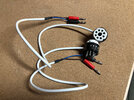
I bought a pair of these, makes it easier to work with biasing,

View attachment 81753
It's OK for adjusting the bias when the amp is working.
But for troubleshooting a broken amp it doesn't do a lot.

I usually test adjust the bias voltage on pin 5 when the high voltage is shut off.
I usually test it with the tubes out.
That way I won't accidentally fry the tubes when the bias is broken.

But basically verify everything first, and put the tubes in last.
Give max protection to the tubes.
 
My buddy ran through the checks and it was all working. He put the tubes back in and started to bias again, and it worked great. He was able to get it down to 38ma and it sounds great.

I'm not sure what he did different, but maybe he was checking the wrong test points.
 
Back
Top