
You are using an out of date browser. It may not display this or other websites correctly.
You should upgrade or use an alternative browser.
You should upgrade or use an alternative browser.
Paging SG John: What is a Good Aluminum Alloy For Threading?
- Thread starter smitty_p
- Start date


Strength of the finished threads will be the question. 6061-T6 or 2024-T4 do not cold form very well.
If there isn't going to me a lot of load on your workpiece, it would be likely be fine.
IMHO, you be better off (in terms of holding strength) to explore the options of a stronger aluminum alloy, such as 2024, 7075, 7050 etc.
If there isn't going to me a lot of load on your workpiece, it would be likely be fine.
IMHO, you be better off (in terms of holding strength) to explore the options of a stronger aluminum alloy, such as 2024, 7075, 7050 etc.
Last edited:

Amp Mad Scientist
Ambassador of Heresy
Very often a steel insert is crimped into a hole in the aluminum.SG John (or any other machinists!),
What is a good alloy for threading 8 x 32 or 10 x 24 threads? The stock will be 3/16” plate. I was thinking of 6061 aluminum. Is this a good candidate?
Or a steel insert is threaded into the aluminum.
These crimpers are often hand pump / hydraulic for small scale production.
This is because aluminum is not very strong for screw threads and strips easily. The threads need to be reinforced to withstand torque force of the screw.
You will not often see screws or nuts made from aluminum, because it's brittle.
Where more strength is needed the aluminum is combined with other metals such as magnesium / titanium etc.
This is what is used for engine parts like cylinder heads.
OP

Do you have a preference among those?IMHO, you be better off (in terms of holding strength) to explore the options of a stronger aluminum alloy, such as 2024, 7075, 7050 etc.
Do you have a preference among those?
What will your screws be holding in terms of load???
I'd use whichever of those was readily available. All are good, IMHO.
OP
Ummm…I’m not ready to reveal the purpose, yet!What will your screws be holding in terms of load???
I'd use whichever of those was readily available. All are good, IMHO.
I see the 7075 is available from onlinemetals.com in the thickness I need.
Amp Mad Scientist
Ambassador of Heresy
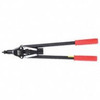 The crimpers for threaded inserts
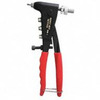 installer tool for rivet nuts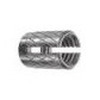
knurled press insert
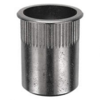 Steel rivet nut

67plexi
Ambassador of Amps
This is what I use on aluminum

SG John
Ambassador of Cool Guitars and Amps.
If you're going to do any welding, stick with 6061. It also bends the easiest of the three mentioned.
As for tapping, #8-32 will give good strength as the thickness of the stock exceeds the major diameter of the fastener. 32 TPI is .031" per thread, and 5 complete threads in the stock allowing for a countersink. Make sure to use a GH2 tap (ex. 8-32 UNF-GH2), and the correct pilot drill. That will give you the maximum strength of the fastener and female threads.
As for a #10, if a 32 TPI option is available, take that over the 24 TPI as I explained above. 24 TPI is .041" per thread, and only four complete threads. You are also squared with diameter versus thickness. Not a major deal breaker, but I like the insurance of the extra thread in something that thin. Also, if too heavy with the countersink, then you have less threads. For thin material, I prefer a 90 or 120 degree countersink over the standard 82 degree.
As for tapping, #8-32 will give good strength as the thickness of the stock exceeds the major diameter of the fastener. 32 TPI is .031" per thread, and 5 complete threads in the stock allowing for a countersink. Make sure to use a GH2 tap (ex. 8-32 UNF-GH2), and the correct pilot drill. That will give you the maximum strength of the fastener and female threads.
As for a #10, if a 32 TPI option is available, take that over the 24 TPI as I explained above. 24 TPI is .041" per thread, and only four complete threads. You are also squared with diameter versus thickness. Not a major deal breaker, but I like the insurance of the extra thread in something that thin. Also, if too heavy with the countersink, then you have less threads. For thin material, I prefer a 90 or 120 degree countersink over the standard 82 degree.
OP
If you're going to do any welding, stick with 6061. It also bends the easiest of the three mentioned.
As for tapping, #8-32 will give good strength as the thickness of the stock exceeds the major diameter of the fastener. 32 TPI is .031" per thread, and 5 complete threads in the stock allowing for a countersink. Make sure to use a GH2 tap (ex. 8-32 UNF-GH2), and the correct pilot drill. That will give you the maximum strength of the fastener and female threads.
As for a #10, if a 32 TPI option is available, take that over the 24 TPI as I explained above. 24 TPI is .041" per thread, and only four complete threads. You are also squared with diameter versus thickness. Not a major deal breaker, but I like the insurance of the extra thread in something that thin. Also, if too heavy with the countersink, then you have less threads. For thin material, I prefer a 90 or 120 degree countersink over the standard 82 degree.
Thanks, John!
For this piece, I will not be countersinking, as I will be attaching another item to it. Also, I’ve decided to go with 8-32, so that works out too. I will not be bending or welding this item, just cutting and forming to shape.
Do you think the 6061 is good? I don’t mind going to 7075, though it is a little more pricey. The load will be sideways, so shear is more the concern. I’m estimating probably about a 30 pound sideways load per screw.
SG John
Ambassador of Cool Guitars and Amps.
Is this something you could use a slightly longer fastener, then add a washer and jam nut? Also, ho many fasteners, and what is being held together?
Here is some good basic info regarding the properties of various fasteners.
https://www.trianglefastener.com/ck...nds - Full Line Catalogs/Technical_PagesB.pdf
Here is some good basic info regarding the properties of various fasteners.
https://www.trianglefastener.com/ck...nds - Full Line Catalogs/Technical_PagesB.pdf
Amp Mad Scientist
Ambassador of Heresy
Yup, you need a metal foundry.Thanks, John!
For this piece, I will not be countersinking, as I will be attaching another item to it. Also, I’ve decided to go with 8-32, so that works out too. I will not be bending or welding this item, just cutting and forming to shape.
Do you think the 6061 is good? I don’t mind going to 7075, though it is a little more pricey. The load will be sideways, so shear is more the concern. I’m estimating probably about a 30 pound sideways load per screw.