Info and Opinions Please?

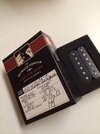
Not tons of information on these pickups out there it seems. They may or may not be part of the Burstbucker family from what I can tell, just referred to as '70s Tributes.
I'd interpret that to mean a low-wind pickup with a short A-5 magnet, a-la original '70s T-Tops, but obviously not certain. If they have any of that period-correct flavor though they should rip and definitely work for the Schenker tones: T-Tops are my favorite pickups of all time by a mile, so anything even in the ballpark is going to be a lot of fun.
 
I do like the angus young PU.
Higher output, better highs, less noise.
But you also pay $$$ for it, and the pole pieces match an SG whammy string spacing.
Which seems different than a LP (?) somehow it won't line up just right.
Or maybe it's just my imagination.

The Angus Young is 9.2k according to Andertons...

My 16.5k AlNico9 44awg Custom DiMarzio Neanderthal Humbucker is about as low as I can go and get enough punch to suit me.

My Mom's all stock 1979 Les Paul Custom sounds good, but it just doesn't produce much gain...

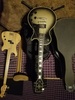
1979 Les Paul.jpg
 
All Burstbuckers feature 2-conductor wiring.
I have a BurstBuckers 1 & 2 set that came stock in my (2012) 60's tribute SG (fitted with the early "non DIP switch" type circuit board), so the pickups are of the 5 conductor variety. Interestingly, in the middle switch position the pickups are "out of phase". Whether designed this way or one of the magnets was unintentionally reversed during manufacture I don't know.
I "think" I remember reading something on the Gibson pickup store site back then, that the BurstBuckers that came factory installed in guitars were the 5 conductor type, while those purchased aftermarket were the 2 conductor type. Cheers
 
I have a BurstBuckers 1 & 2 set that came stock in my (2012) 60's tribute SG (fitted with the early "non DIP switch" type circuit board), so the pickups are of the 5 conductor variety. Interestingly, in the middle switch position the pickups are "out of phase". Whether designed this way or one of the magnets was unintentionally reversed during manufacture I don't know.
I "think" I remember reading something on the Gibson pickup store site back then, that the BurstBuckers that came factory installed in guitars were the 5 conductor type, while those purchased aftermarket were the 2 conductor type. Cheers

Very possible. My quote came direct from Gibson website.
 
Very possible. My quote came direct from Gibson website.
But then, my 2019 SG Standard 61 came stock with the BurstBuckers 61 set & these are 2 conductor types. From memory, the BurstBuckers 61's sound quite different to the BurstBucker 1 & 2 pickups too.
I would like to see Gibson offer the T Top pickup again. I know it was common for people to rip at least the bridge T Top out in order to fit a Dimarzio Super Distortion, but quite a few big names didn't & a lot of great rock was played & recorded with T Top equipped guitars. They (T Tops) are right up there among my favourite pickups, I have repro's in both my SG's & my LP Traditional. Cheers
 
If you're having Schenkeritis, my opinion is to leave it alone. His classic UFO and Scorpions tones were with a '72 Flying V Medallion with T-tops, and then a range of amps going from early JMPs to JCMs. You're amp has all the gain to let the clarity of the low gain pickups shine.
 
When I got my 2000 Gibson Explorer it had Seymour Duncan SH-1 and SH-5 pickups sounded like SH :poo:T
had a early set of Gibson T Tops fixed 7.4 neck 7.3 bridge gold screws was saving them for my 1972 LE Les Paul Custom
glad I didn't the 1972 LPC was Gibson's first re issue guitar.

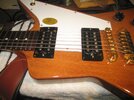
Explorer 002.JPG

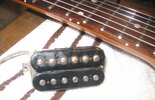
T Top 001.JPG

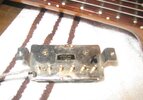
T Top 002.JPG
 
If you're having Schenkeritis, my opinion is to leave it alone. His classic UFO and Scorpions tones were with a '72 Flying V Medallion with T-tops, and then a range of amps going from early JMPs to JCMs. You're amp has all the gain to let the clarity of the low gain pickups shine.

Exactly this. High output pickups just compress the hell out of everything and generally muddy it up. The secret sauce for the last 45 years or so is articulate low-output pickups (like, say, a T-Top) and getting all the gain you need from your rig, but also being able to roll back the volume to clean things up. Especially now, since we live in the era of cheap,cheap gain.
 
Exactly this. High output pickups just compress the hell out of everything and generally muddy it up. The secret sauce for the last 45 years or so is articulate low-output pickups (like, say, a T-Top) and getting all the gain you need from your rig, but also being able to roll back the volume to clean things up. Especially now, since we live in the era of cheap,cheap gain.

I can respect the old ways....but for me, "Tone" is George Lynch's rhythm from a 16.6k Duncan JB SH-4, or Robbin Crosby's rhythm tone from an 18.2k Duncan Holdsworth AH-10, or Matthias Jabs work on Love At First Sting with a 20k Dommenget Musclebucker.

Seymour-Duncan-CS-AH-1-Metal-Fatigue-10-2013.jpg

I've got access to T-Tops and I've honestly tried to love them, but they just don't grab me...
 
I can respect the old ways....but for me, "Tone" is George Lynch's rhythm from a 16.6k Duncan JB SH-4, or Robbin Crosby's rhythm tone from an 18.2k Duncan Holdsworth AH-10, or Matthias Jabs work on Love At First Sting with a 20k Dommenget Musclebucker.

View attachment 75188

I've got access to T-Tops and I've honestly tried to love them, but they just don't grab me...

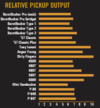
I get that. But lest we all forget DC resistance only tells a tiny slice of the output story. I'm really not even sure why the winders fall for the obvious marketing hyperbole of using it as any kind of measure when we've needed a more universal metric for years. A while back Gibson used to put out charts that showed the relative output of their pickups, separated from the idea of DC resistance, and I thought that was a good start but evidently people became confused when they realized that some pickups with a higher resistance actually had a lower relative output than some with lower resistance and so so on. At the end of the day its whatever drives your amp the way you want it to so I could not agree with you more - we all hear things differently.

Back to the original question though, the Schenkerific and other early Metal tones were that combination of T-Tops (mostly) and more often than not a Plexi-style circuit, and if the OP is looking for that kind of more open but still very saturated sound I think he'd likely do best with the stock PuPs.

To me, there is nothing on Planet Earth that screams Metal more than a late-'70s Les Paul Custom with the original T-Tops, but for you its something else and that's all good.
 
^^^^THIS!!!

True in one regard, but this is not singular point either. For example, I have a huge box of take-out pickups here and many of them are Gibsons. They span from 490's, to ones that have no stickers, to the newer Gibson "slug" variants with 5 conductor wiring.

I can tell you this factually, based on what I have here in my box.

There is not a single low DCR pickup (including Duncan Designed, a Carvin and a few genuine Seymour Duncans) that is louder on the VU meter than a higher DCR pickup.

Maybe such a thing is possible, and I do not discount that as a possibility, but I am yet to see it. I spoke to the guitar shop owner about this question last night and he agreed that he has yet to see a lower DCR pickup be louder than a higher DCR counterpart.

My Mom has two vintage Les Pauly's from the 1972-1979 era and both have the T-Top pickups in them. Both have the most beautiful clean tones you could ever hope to find in any guitar I have ever heard. But when overdriven, the output is noticeably lower and the gain structure is cleaner than most other guitars I am used to playing - and the volume output is lower than other guitars.

An example. We've tested the pickups for DCR on Mom's Les Pauls for the purposes of putting them up for sale. The bridge pickups are around 7.75k and the neck about 7.52k respectively. As I said, both sound BEAUTIFUL clean, but if I plug into my Origin and crank it up (which we did a few weeks ago after I picked it up from Greg) I would say that both Les Paul's have about 3 to 4 dial positions lower volume (on my Origin) than my Stratocaster with a 16.5k/44awg/A9 DiMarzio Neanderthal - which is exactly what I would expect.

I am constantly playing through vintage guitars on recordings and this theme is consistent among those instruments in terms of volume output.

But, TBTH, I think this lower volume output is exactly what draws people to these vintage guitars. and I believe the "cleaner" gain structure is another aspect of the siren's song - and that's totally cool.

I recently had a 1958 Les Paul here for repair. I actually had to notify my homeowner's insurance and send them a copy of the guitar's appraisal sheet because of it's value. The owner asked me to put a set of original PAF's into it as he received it with some very, very old Duncans. he came up with a set of Gibson PAF's from the era, complete with all provenance and I installed them.

He was very surprised (and pleased) that the guitar basically became "clean" after the PAF's were installed and when he played through his own personal amp (a Van Weelden) has was stunned at how his previous settings no longer produced any real gain to speak of.

But, again, this was expected when I installed pickups with far less DCR.

When DiMarzio cooked up my signature pickup, we ended up with a 16.5k DCR / 44awg / AlNico 9 magnet with a MV rating of around 450, for comparison purposes. I wasn't given resonant peaks, etc.

But I can tell you this about YelloStrat. If you set up an amp with your choice of guitar and dial up the gain where you want it, and then you plug in YellowStrat, you will have to turn the amp down 3-4 dial positions to get the volume level back to where it was with the other humbuckers. But, it never squeals, or exhibits other form of bad sonic behavior.
 
Last edited:
I get that. But lest we all forget DC resistance only tells a tiny slice of the output story. I'm really not even sure why the winders fall for the obvious marketing hyperbole of using it as any kind of measure when we've needed a more universal metric for years. A while back Gibson used to put out charts that showed the relative output of their pickups, separated from the idea of DC resistance, and I thought that was a good start but evidently people became confused when they realized that some pickups with a higher resistance actually had a lower relative output than some with lower resistance and so so on. At the end of the day its whatever drives your amp the way you want it to so I could not agree with you more - we all hear things differently.

Back to the original question though, the Schenkerific and other early Metal tones were that combination of T-Tops (mostly) and more often than not a Plexi-style circuit, and if the OP is looking for that kind of more open but still very saturated sound I think he'd likely do best with the stock PuPs.

To me, there is nothing on Planet Earth that screams Metal more than a late-'70s Les Paul Custom with the original T-Tops, but for you its something else and that's all good.

1635947897860.png

I totally agree with you.

AC/DC was forged on a low output PAF and the early Marshall circuitry and it is still a genre-defining tone, even to this day.
 
I was looking for something different for my fake Les Paul when I was installing the 21 tone Jimmy Page harness.

On the one hand, I needed 4 conductor wiring for that harness, but I also wanted a bit more clarity.

I tried a lot of pickups that I had here, and I was given several by colleagues to demo and nothing really grabbed me.

Then, a local Luthier suggested I try a couple of Planet Tone pickups he had on his bench. One was the 'Pasadena' neck and the 'Full Throttle' bridge.

I was really impressed with how much quieter they were at higher gain settings, because "idle noise" has always been something I dislike.

I ended up buying an "Afterburner" bridge and a "Special 59" neck from Jose at Planet Tone.

Now, keep in mind that I walk into a studio with a guitar, sometimes on a daily basis and I work with the same group of engineers and musicians on a regular basis and everyone commented on how good the Les Paul sounded.

Now I play with several guys who have "real" Les Paul's and its funny to me that when we play out, I am the one always fielding the guitar and rig questions and I'm playing the Faux Paul against real Gibson's.

I find it interesting that guys will come up to me after a show and tell me they have a vintage 70-80's Les Paul that they want "to sound like mine..."

I am always quick to tell them that my guitar is just a fake stage prop, but I am continually turning down offers on it.
 
Back
Top