Marshall Tubes:

I'm always changing tubes and I'm frequently given the old ones. I've got quite a varied collection of Marshall tubes, some with white, red and gold lettering.

I'm assuming the color denotes a date range and no tube is better than the other???

View attachment 73801
It's just a matter of testing them in the amp one at a time.
Preamp tubes can become noisy (crackle pop) with long usage.
They can become microphonic.

Checking the silver inside the glass, see if it has discolored. The longer the tube is used, the more discolored it becomes.
If it's all turned brown / black inside, it's trash.

A normal consumer type tube tester isn't very accurate.
It misses the majority of the potential problems.
Noises, microphonics, frequency response, it doesn't detect any of those problems.
Lab tube testing is a whole different thing.

The best way to test a tube is in the actual circuit.
 
With tubes in general - aside from the fact that the 12AU7 produces the lowest amount of gain and the Genelex B758 Gold Lion produces the highest - I hear extremely INSIGNIFICANT tone differences between tubes, only changes in gain production...
It's not gain, it's sensitivity.
The gain is determined by the power supply available voltage.
Unless the voltage is increased, the gain remains the same.

12AX7 has the highest sensitivity.
12AU7 is the lowest sensitivity.
But the gain of both tubes is only the power supply voltage. The gain produced is always limited by that fact.

Why do sales people constantly mix up "gain" with sensitivity?
Hell if I know.
But most of the information you read is completely wrong, because "gain" is mixed up with "sensitivity."

This is what a guitar player really wants: high sensitivity.
Not high gain.

It's not my fault that the terminology is all screwed up by sales people.
But just because everybody else ignores the error, doesn't mean that I need to use the wrong words.

Gain and sensitivity are 2 completely different things.
And until we recognize the difference, we don't make any progress.

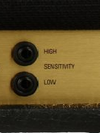
inputs.png

Your fist lesson is now complete.
 
With tubes in general - aside from the fact that the 12AU7 produces the lowest amount of gain and the Genelex B758 Gold Lion produces the highest - I hear extremely INSIGNIFICANT tone differences between tubes, only changes in gain production...
In the same circuit (compare the 2 tubes)
12AX7 and 12AU7 have the same amount of maximum gain.
Limited by the power supply only.

The difference between the 2 is sensitivity.
12AX7 high sensitivity
12AU7 low sensitivity
 
Every site that talks about 12A** tubes mentions this as gain factor.
Not just salespeople.
From Vintage Valves

Now here’s how the gain factors compare if bench-marked against the tube with the highest gain, the 12AX7.

12AX7 100%
12AT7 60%
12AY7 45%
12AV7 41%
12AU7 19%

So in terms of gain factor it’s important to recognise what the effect of swapping between 12A*7 tubes will do within your application"....

Tubestore, premiere guitar, wki, etc etc.

EDIT WRONG THIS IS ALL WRONG. % is correct but it is not gain.
 
Last edited:
Amplification factor read the tube data 12AX7 is 100 Amplification factor
So using this term high gain a EF86 has a Amplification factor of 185 that's 85 more than a 12AX7
If I rewire the 9 pin tube socket for a EF86 I will have a high gain amp No way more to the equation


https://www.telefunken-elektroakustik.com/wp-content/uploads/2017/06/ECC83-TK-Tube-Data-Sheet.pdf

But if you want to learn study this

 
Amplification factor read the tube data 12AX7 is 100 Amplification factor
So using this term high gain a EF86 has a Amplification factor of 185 that's 85 more than a 12AX7
If I rewire the 9 pin tube socket for a EF86 I will have a high gain amp No way more to the equation


https://www.telefunken-elektroakustik.com/wp-content/uploads/2017/06/ECC83-TK-Tube-Data-Sheet.pdf

But if you want to learn study this

The one is 700 pages long!
So you are saying with this that amplification factor should NOT be called gain factor? I am unsure of the result of this post and what an EF86 has to do with it?
Sorry. Kinda dense here!
 
Amplification factor is not gain :pound-hand:
This is correct.
It is a very common misconception that the tubes "amplification factor" is the tubes "gain". We even see it stated as such in explanations posted by tube suppliers & the like, but really, in posting stuff like this they are simply showing that they don't know as much as what they'd have the general public believe that they do.
From the tubes datsheet we get the "plate resistance" & the "amplification factor".
With these, & circuit values from into which the tube is to be placed, we can then "calculate" the gain. See here https://www.angelfire.com/electronic/funwithtubes/Basics_04_Triodes_Ex-S.html
Hope this makes it clear that the tubes "amplification factor" is NOT the same thing as the "gain" that a tube will produce in a given circuit. Cheers
 
Last edited:
This makes sense, because in reading all of this I was thinking I didn't understand how to cleanly amplify a signal if everything is adding gain. I don't want a lot of gain, just clean power for the most part. I already started reading the 700 page RCA recieving tube manual that 67Plexi posted.
A very good publication if you are going to get into designing (or even modifying) amps without resorting to a "suck it & see" (aka experiment & hope for a good result) type approach. RCA tube applications manuals were where Leo got all his circuit design blocks from to build all those classic old Fender amps.
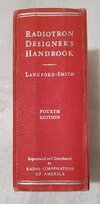
Another very good publication is The Radiotron Designers Handbook by F Langford Smith, also available as a (PDF) download. 1498 print pages. Heres my old bookIMG_20211018_223143.jpg
Considered by many to be the tube "Bible".
A bit of history, Radiotron was the first valve (tube) manufacturing plant here in Australia, set up by RCA. Fritz Langford Smith was an engineer at Radiotron, where as well as working on (television) tube designs that went into production here & in the USA, he penned this excellent book.
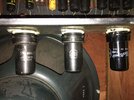
& a bit of trivia, a pic of one of the main amps Keith Richards used in the recording of the Stones 2020 Blue & Lonesome16342467269013703555016503084363.jpg
where we see, the tube on the left is a Radiotron valve. Cheers
 
This is correct.
It is a very common misconception that the tubes "amplification factor" is the tubes "gain". We even see it stated as such in explanations posted by tube suppliers & the like, but really, in posting stuff like this they are simply showing that they don't know as much as what they'd have the general public believe that they do.
From the tubes datsheet we get the "plate resistance" & the "amplification factor".
With these, & circuit values from into which the tube is to be placed, we can then "calculate" the gain. See here https://www.angelfire.com/electronic/funwithtubes/Basics_04_Triodes_Ex-S.html
Hope this makes it clear that the tubes "amplification factor" is NOT the same thing as the "gain" that a tube will produce in a given circuit. Cheers
Ah. Cheers for that.
Yes, I fell for the Gain Factor as listed essentially everywhere.
:(:rolleyes::hide:
 
Back
Top