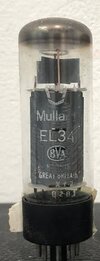
What's Up With the Price of Tubes?

Damn, there's some miss-information creeping into this thread,,, and I do not like my TTR buddy's to be
miss-informed.

Ok, firstly folks, the type of valves we use in our guitar amp use Barium for gettering purposes. That deposit on the glass, known as "getter flash" is this barium metal that has been induction heated to vaporise it & deposit it on the glass.
While it most usually has a shiny silver appearance, the colour can actually vary from a grey colour through to black. The colour of the getter flashing is totally dependant on how quickly it is heated during the gettering process.
The Tube Store has an article on there site, entitled "blue glow in tubes, tube getters & other info" which also explains this, & also links a quite in depth article on valve gettering, that I will attempt to link for you all Blue Glow in Tubes, Tube Getters, and other Info - www.thetubestore.com If the link does work (I'm a digital dummy) the article should be easily found.

Barium is a "reactive" metal, hence its use for gettering in valves.
During manufacture of our valves, after the outgassing process & sealing of the glass envelope, there is still some residual air left inside the valve bottle. Also, during use, when the valve is heated, impurities & gasses continue to evolve from the metals of the elements etc.
The barium metal reacts with all of these & thus gets them out of the vaccum. So, the barium getter flashing is slowly used up. This can be seen by the barium getter flashing taking on an opaque, see-through appearance, starting at the very edge of the getter flashing where the barium deposit is thinnest, progressively making its way to the centre of the getter flashing where the barium deposit is thickest.
Easily seen hereView attachment 71925
And hereView attachment 71926
Note how in both these pics we can see the ring shaped "halo" getter clearly visible at the top inside the glass bottle.
When new, viewed from the side like this, the getter flashing would have had it's edge just very slightly above these "halo" getters. If you look carefully, you can make out that the opaque colouring extends down to just above the getters. So we can see that the barium getter flashing has been used up in this area.
To get an idea how slowly this getter flashing is used up, just take a look at some power tubes you've installed/had installed & know roughly how many (hundreds or thousands of) hours you have put on them. Cheers
Edit:
You may have heard about tubes that "go gassy." This is like where the bottle develops a leak or elements within the tube emit a heap of gass. This can be seen as the getter flash taking on a white appearance, seen hereView attachment 71929
Cheers
First of all, the TubeStore link works. I still need to read it though.

Barium Getter Flashing: So, the amount of flashing diminishes as the tube is used up?
 
I have quite a few NOS amd in some cases OS preamp tubes. I got them from a very reputable dealer. Some are from the early 60s. Sounds and work great. Totally different construction from current tubes.
If you know what you have and what you like, get tubes from a reputable source. Old RCA, GE, RFT, Mullards etc are super good tubes. The odd one might die or go micro, I use those as PI tubes.

By contrast, i have had 3 new Tung Sols go very quickly on me, in a couple cases in the PI slots. They seem to not handle that well.
Anyone who feels the NOS thbes are crap, send em my way, please.
 
Barium Getter Flashing: So, the amount of flashing diminishes as the tube is used up?
Yes, but it does not happen quickly. Look to those Mullard EL34's in the pics I posted (1st pic, xf3's, 1974 tubes, 2nd pic, single halo xf2's, 1972 tubes).
This level of diminished getter flashing comes from thousands of hours use. Tubes like these can still have reasonably good working life left in them though. It's possible to find pics of Mullard type EL34's showing much greater diminished getter flashing than these do. Same with other "old production" types.
I have quite a few NOS amd in some cases OS preamp tubes. I got them from a very reputable dealer. Some are from the early 60s. Sounds and work great. Totally different construction from current tubes.
If you know what you have and what you like, get tubes from a reputable source. Old RCA, GE, RFT, Mullards etc are super good tubes. The odd one might die or go micro, I use those as PI tubes.

By contrast, i have had 3 new Tung Sols go very quickly on me, in a couple cases in the PI slots. They seem to not handle that well.
Anyone who feels the NOS thbes are crap, send em my way, please.
This mirrors my experiences too.
Any valve, being man-made, can fail prematurely, go microphonic/noisey etc, however the incidence of this was/is quite noticeably less with old production valves.The old production valves were simply made to a much higher standard & quality control was much tighter.
Well played with the "anyone who feels the NOS tubes are crap, send em my way, please" @Jethro Rocker, why didn't I think of that. Cheers
 
Yes, but it does not happen quickly. Look to those Mullard EL34's in the pics I posted (1st pic, xf3's, 1974 tubes, 2nd pic, single halo xf2's, 1972 tubes).
This level of diminished getter flashing comes from thousands of hours use. Tubes like these can still have reasonably good working life left in them though. It's possible to find pics of Mullard type EL34's showing much greater diminished getter flashing than these do. Same with other "old production" types.

This mirrors my experiences too.
Any valve, being man-made, can fail prematurely, go microphonic/noisey etc, however the incidence of this was/is quite noticeably less with old production valves.The old production valves were simply made to a much higher standard & quality control was much tighter.
Well played with the "anyone who feels the NOS tubes are crap, send em my way, please" @Jethro Rocker, why didn't I think of that. Cheers
I still have one GE EL34 from my old 1983 2203 head. It matches well enough to one of my Svetlanas amd are still using it in my TSL. Pre amps I have tons that are good and about 3 that are micro. But they still work.
 
I still have one GE EL34 from my old 1983 2203 head. It matches well enough to one of my Svetlanas amd are still using it in my TSL. Pre amps I have tons that are good and about 3 that are micro. But they still work.
Yes, power tubes do not need to be perfectly matched for our guitar amps. Up to about 5mA difference in plate current & about 500umhos difference in transconductance is ok. In fact, there is those from the school of thought that some miss-matching is beneficial as it adds to the harmonic content.
It would be interesting to know who made your GE branded EL34. Companies like GE, RCA, Sylvania etc imported & rebranded EL34's (often from Mullard), up until Sylvania designed the fat bottle 6CA7 & they all then started manufacturing that type tube. I have GE branded single halo getter xf2 Mullard EL34's. If yours is a Mullard made tube it will have the tube type designation & date code markings toward the bottom of the glass bottle, seen here16284712292187612777691497523234.jpg
Tube type designation xf2, & below it the date code B2B1, which translates to: Blackburn plant, 1972, February, 1st week of.
The second position of the date code is the last digit of the year of manufacture. This can be confusing, so accurately deciphering comes down to knowing your tubes. A double halo getter EL34 with a 2 in the second position of the date code would indicate 1962 year of manufacture. This being a single halo xf2 means 1972, but considering there's also the 50's era metal base & xf1 variants, then the later xf3, xf4 & xf5 variants, it can be confusing. Cheers
 
Yes, power tubes do not need to be perfectly matched for our guitar amps. Up to about 5mA difference in plate current & about 500umhos difference in transconductance is ok. In fact, there is those from the school of thought that some miss-matching is beneficial as it adds to the harmonic content.
It would be interesting to know who made your GE branded EL34. Companies like GE, RCA, Sylvania etc imported & rebranded EL34's (often from Mullard), up until Sylvania designed the fat bottle 6CA7 & they all then started manufacturing that type tube. I have GE branded single halo getter xf2 Mullard EL34's. If yours is a Mullard made tube it will have the tube type designation & date code markings toward the bottom of the glass bottle, seen hereView attachment 72005
Tube type designation xf2, & below it the date code B2B1, which translates to: Blackburn plant, 1972, February, 1st week of.
The second position of the date code is the last digit of the year of manufacture. This can be confusing, so accurately deciphering comes down to knowing your tubes. A double halo getter EL34 with a 2 in the second position of the date code would indicate 1962 year of manufacture. This being a single halo xf2 means 1972, but considering there's also the 50's era metal base & xf1 variants, then the later xf3, xf4 & xf5 variants, it can be confusing. Cheers
So GE never made EL34s like they did 12AX7s? Mine is from 1983, when I got that amp brand new. I assumed they were GE tubes.
 
So GE never made EL34s like they did 12AX7s? Mine is from 1983, when I got that amp brand new. I assumed they were GE tubes.
Not that I'm aware, but of course, that doesn't mean that GE didn't manufacture them.
Philips was the parent company of a good many valve manufacturers, including Mullard, Amperex, Miniwatt Holland, Miniwatt Australia, Valvo, MOV (Marconi Osram Valve corporation), IEC, GEC & GE, among a good many others.
Philips also supplied Mullard production tooling to many different plants worldwide, however "rebranding" was also a very common practice worldwide.
I have Mullard EL34 duets branded as Amperex, GE, Miniwatt, Valvo, & a quad branded as Philips. In fact, out of all my Mullard tubes, only 2 or 3 are actually branded Mullard.
A few close-up pics might help some of us in identifying the origins of your GE EL34. I would be pleasantly surprised to learn it was a GE made tube. Cheers
 
Yes, power tubes do not need to be perfectly matched for our guitar amps. Up to about 5mA difference in plate current & about 500umhos difference in transconductance is ok. In fact, there is those from the school of thought that some miss-matching is beneficial as it adds to the harmonic content.
It would be interesting to know who made your GE branded EL34. Companies like GE, RCA, Sylvania etc imported & rebranded EL34's (often from Mullard), up until Sylvania designed the fat bottle 6CA7 & they all then started manufacturing that type tube. I have GE branded single halo getter xf2 Mullard EL34's. If yours is a Mullard made tube it will have the tube type designation & date code markings toward the bottom of the glass bottle, seen hereView attachment 72005
Tube type designation xf2, & below it the date code B2B1, which translates to: Blackburn plant, 1972, February, 1st week of.
The second position of the date code is the last digit of the year of manufacture. This can be confusing, so accurately deciphering comes down to knowing your tubes. A double halo getter EL34 with a 2 in the second position of the date code would indicate 1962 year of manufacture. This being a single halo xf2 means 1972, but considering there's also the 50's era metal base & xf1 variants, then the later xf3, xf4 & xf5 variants, it can be confusing. Cheers
Not that I'm aware, but of course, that doesn't mean that GE didn't manufacture them.
Philips was the parent company of a good many valve manufacturers, including Mullard, Amperex, Miniwatt Holland, Miniwatt Australia, Valvo, MOV (Marconi Osram Valve corporation), IEC, GEC & GE, among a good many others.
Philips also supplied Mullard production tooling to many different plants worldwide, however "rebranding" was also a very common practice worldwide.
I have Mullard EL34 duets branded as Amperex, GE, Miniwatt, Valvo, & a quad branded as Philips. In fact, out of all my Mullard tubes, only 2 or 3 are actually branded Mullard.
A few close-up pics might help some of us in identifying the origins of your GE EL34. I would be pleasantly surprised to learn it was a GE made tube. Cheers
Cool info... (y)
Didn't know about how the real Mullards were so widely rebranded!
 
Mine is from 1983, when I got that amp brand new.
IIRC, Marshall started using Brimar EL34's some time in the 70's. Brimar made an excellent EL34, right up there with the xf2 Mullard for both quality & sound. However by the 80's, as British valve manufacturers had shut down (or was shutting down), Marshall had begun to use Tesla EL34's. These were made on Mullard tooling, so appearance-wise, they look very much like a single halo getter xf2 Mullard, so spot welded plates. They have a brown base with, IIRC, no hole in the guide pin. A single halo Mullard xf2 will have a black base with the hole in the guide pin.
Also in the early 80's Marshall started using RFT EL34's, easily identified by the dimple on top of the glass bottle. Cheers
 
Last edited:
IIRC, Marshall started using Brimar EL34's some time in the 70's. Brimar made an excellent EL34, right up there with the xf2 Mullard for both quality & sound. However by the 80's, as British valve manufacturers had shut down (or was shutting down), Marshall had begun to use Tesla EL34's. These were made on Mullard tooling, so appearance-wise, they look very much like a single halo getter xf2 Mullard, so spot welded plates. They have a brown base with, IIRC, no hole in the guide pin. A single halo Mullard xf2 will have a black base with the hole in the guide pin.
Also in the early 80's Marshall started using RFT EL34's, easily identified by the dimple on top of the glass bottle. Cheers
Excellent. Either way sounds like a winner tube!
 
Back
Top