6CA7 in a Marshall DSL100HR. Worth Doing?

What causes the voltage change on the plates with differing current flow is:
Current flows within the tube in the form of electrons. Electrons carry a negative charge.
So, increased current flowing to the plates means more "negatively charged electrons" landing on the positively charged plates. It stands to reason that this causes the positive potential on the plate to fall. Example, +400V plus -50V = +350V.
Conversely, less current flowing to the plates means less negatively charged electrons landing on the positively charged plates. The plates positive potential thus rises.
This is how changes in current flow brought about by applied signal cause voltage swings across the output transformer primary. Cheers

That's a great explanation!
 
I always remember the simple formula from 10 grade electronics class.

P=I*E. (PIE)

power in watts
current in amps
voltage in volts
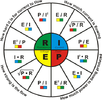
Yep! Thats one of the cores in the wheel of PIRE( P= Watts, I= Current, R=Resistance, E= Voltage).

Pretty reliable quick reference to figure out each other as long as you have at least 2 values.

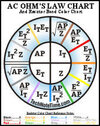
There's another wheel chart thats a lil more advanced but honestly, you wouldnt use it unless you figuring lots of AC power figures . Its name isnt as handy as PIRE: its ZApItEt lol ( z= Impedence, Ap= Apparent Power, It= Current Total, Et= Voltage Totalohmchart.png
images (1).jpeg
 

Attachments

Yep! Thats one of the cores in the wheel of PIRE( P= Watts, I= Current, R=Resistance, E= Voltage).

Pretty reliable quick reference to figure out each other as long as you have at least 2 values.

There's another wheel chart thats a lil more advanced but honestly, you wouldnt use it unless you figuring lots of AC power figures . Its name isnt as handy as PIRE: its ZApItEt lol ( z= Impedence, Ap= Apparent Power, It= Current Total, Et= Voltage TotalView attachment 70520
View attachment 70522

Law and order O.H.M.
That's one law nobody can break.
 
Yep! Thats one of the cores in the wheel of PIRE( P= Watts, I= Current, R=Resistance, E= Voltage).

Pretty reliable quick reference to figure out each other as long as you have at least 2 values.

There's another wheel chart thats a lil more advanced but honestly, you wouldnt use it unless you figuring lots of AC power figures . Its name isnt as handy as PIRE: its ZApItEt lol ( z= Impedence, Ap= Apparent Power, It= Current Total, Et= Voltage TotalView attachment 70520
View attachment 70522
Yes, Clockworkmike is onto it, also Don O.
The variations in plate (positive) potential have nothing at all to do with loading down the power supply & is all about the above.
It is why tubes must work into a "load",,,, so that the manipulated current flow is manifested as voltage swings (across the load).
This "load" includes the plate resistor in what we call pre-amp "gain stages" (actually "voltage amplifiers"), the cathode resistor in a cathode follower, the output transformer primary's "reflected" impedance in output transformers. Cheers
Edit:
Actually, I should expand on this (now that I've had my first coffee & onto my second).
During power tube "biasing" (which was the topic that brought this discussion about), the tubes are operating at what we call "quiescent" condition, aka "no signal" condition. At this "idle" condition the tubes are not working across the (reflected) "load impedance" of the OT primary, rather, the DC resistance of that tube's half of the OT primary.
The rising or falling plate potential with bias adjustment is still due to ohms law/current flow through this resistance though.
When an AC signal is applied to the tubes the OT primary's reflected load impedance comes into play. Cheers
 
Last edited:
Back
Top