NWGBD

Now, on studio projects, I almost always use my 2019 Schecter Hellraiser C1 with Floyd Rose 1000 (plus coil tapping) for all studio projects.

Coil tapping or splitting?

If you mean that one coil of a humbucker is grounded out, creating a single coil operation, that is splitting.

Tapping actually grounds out part of one coil, essentially bypassing part of the coil to get a lower output from the coil.

I ask because I wasn’t aware you were involved in any projects requiring a tapped application. I would be curious how well tapping works. I’ve already done coil splitting, so I’m quite familiar with that; but I haven’t tried tapping.

It gets confusing because these terms are often misused, kinda like Leo Fender started (erroneously) calling his vibrato bridge a “tremolo” bridge!
 
Coil tapping or splitting?

Well, according to EMG, "The 81TW humbucker doubles down on tone, taking the EMG 81 and adding a separate single coil pickup in the same housing. This is not your traditional coil-tap humbucker. EMG has designed the dual-mode to allow for maximum flexibility, featuring two pickups in one humbucker. The original 81 provides all the crunch and attack it's famous for and the additional single-coil now gives players two classic tonal options to choose from. Either mode is accessed through a push/pull pot for ease and versatility...."

The neck pickup is an 89. "Featuring two pickups in one, the 89 houses separate preamps and coils for a custom humbucker and single coil sound at your fingertips. Loaded with Alnico V magnets, the humbucker sound is rich, warm and powerful, but still clear and articulate, similar to the 85. The single coil mode, accessed via the included push pull pot, delivers the traditional Strat single coil sound: bright, airy, and chimey, and is very similar to the EMG SA. In either mode, the clean sound is gorgeously pristine and has a lot of presence. Used equally in bridge and neck positions. Whether you are playing hard rock or jazz, you can get it all with this beautifully balanced and versatile pickup..."

The amazing thing is even in single coil mode, it's quiet, yet it has the capability of the really clear and sparkly Stratocaster tones.

I've now owned two Hellraisers, a 2005 pre-release production sample and this 2019. Both were flawlessly setup. No additional work had to be done. They were stage ready right out of the box.

So, when I am hired to play on a recording and I am traveling, I always take the Hellraiser because of its versatility.
 
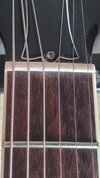
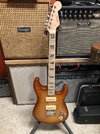
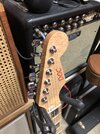
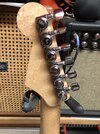
Well did the nut work, installed the bridge and strung it up. The tuners are a bust! While a pain to string, there’s no way to tighten them without a pair of pliers. You have no mechanical advantage (e.g. gear ratio) with these. I couldn’t even get it to tune. I must be missing something. Gonna put a set of Schallers on it now.View attachment 70390View attachment 70391View attachment 70392View attachment 70393View attachment 70394View attachment 70395View attachment 70396

Note how your strings sweep up towards the tuner side of the headstock???

I think this will improve with a post tuner. String alignment across the neck looks good...
 
A wider slot still won't fix misalignment.

Excellent observations.

I’ve done a LOT of fussing with vibrato s over the years and I’m becoming increasingly of the opinion that typical 3x3 headstocks simply cannot provide the type of alignment you’ve been able to achieve in a 6-inline headstock.
 
Excellent observations.

I’ve done a LOT of fussing with vibrato s over the years and I’m becoming increasingly of the opinion that typical 3x3 headstocks simply cannot provide the type of alignment you’ve been able to achieve in a 6-inline headstock.

I agree!!!!

Not long ago, I made a nut from a Corian blank for one of my Les Paul's. While it never 'plinked' while tuning, it had this annoying habit of going sharp.

I employed a slot configuration that is only .004" wider than the string and the string enters the nut straight. I've seen videos where guys suggest you start "making the turn" right at the front of the nut, but I kept the string straight.

The string makes contact with the first 2/3rds of the ot, at which time the slot floor begins to fall away. The exit is also widened to give the string some room.

This was a huge improvement and tuning is now stable under all conditions.

20210520_064019.jpg

20210520_074550.jpg
 
Well, according to EMG, "The 81TW humbucker doubles down on tone, taking the EMG 81 and adding a separate single coil pickup in the same housing. This is not your traditional coil-tap humbucker. EMG has designed the dual-mode to allow for maximum flexibility, featuring two pickups in one humbucker. The original 81 provides all the crunch and attack it's famous for and the additional single-coil now gives players two classic tonal options to choose from. Either mode is accessed through a push/pull pot for ease and versatility...."

The neck pickup is an 89. "Featuring two pickups in one, the 89 houses separate preamps and coils for a custom humbucker and single coil sound at your fingertips. Loaded with Alnico V magnets, the humbucker sound is rich, warm and powerful, but still clear and articulate, similar to the 85. The single coil mode, accessed via the included push pull pot, delivers the traditional Strat single coil sound: bright, airy, and chimey, and is very similar to the EMG SA. In either mode, the clean sound is gorgeously pristine and has a lot of presence. Used equally in bridge and neck positions. Whether you are playing hard rock or jazz, you can get it all with this beautifully balanced and versatile pickup..."

The amazing thing is even in single coil mode, it's quiet, yet it has the capability of the really clear and sparkly Stratocaster tones.

I've now owned two Hellraisers, a 2005 pre-release production sample and this 2019. Both were flawlessly setup. No additional work had to be done. They were stage ready right out of the box.

So, when I am hired to play on a recording and I am traveling, I always take the Hellraiser because of its versatility.

I see what they’re doing. It’s a cool idea that I actually pondered awhile back.

But, alas, EMG is misusing the term “coil-tap”.

Ahh, well…I suppose if misusing terms is good enough for Fender, it’s good enough for EMG!

Another example of Fender’s terminology confusion is when they refer to their amps as having a “vibro” function. What they call “vibrato” with their amps is actually tremolo!
 
Note how your strings sweep up towards the tuner side of the headstock???

I think this will improve with a post tuner. String alignment across the neck looks good...
Yep, knew that was going to be an issue with no tuner post. Well these were an experiment and failed terribly. I still can’t figure how they expect someone to tune these with just fingers.
 
I agree!!!!

Not long ago, I made a nut from a Corian blank for one of my Les Paul's. While it never 'plinked' while tuning, it had this annoying habit of going sharp.

I employed a slot configuration that is only .004" wider than the string and the string enters the nut straight. I've seen videos where guys suggest you start "making the turn" right at the front of the nut, but I kept the string straight.

The string makes contact with the first 2/3rds of the ot, at which time the slot floor begins to fall away. The exit is also widened to give the string some room.

This was a huge improvement and tuning is now stable under all conditions.

I definitely like your approach! It makes sense.

I would love to see how that would work with a vibrato unit, like a Bigsby or a Maestro.

I’ve done similar (though probably not as precise) on my Gibsons with vibratos. It helps, though does not completely eliminate return to pitch issues.

I mean, audibly, it sounds acceptable. But, on a tuner it isn’t perfect or as close as I’d like.
 
I definitely like your approach! It makes sense.

I would love to see how that would work with a vibrato unit, like a Bigsby or a Maestro.

I’ve done similar (though probably not as precise) on my Gibsons with vibratos. It helps, though does not completely eliminate return to pitch issues.

I mean, audibly, it sounds acceptable. But, on a tuner it isn’t perfect or as close as I’d like.

When I set up a Gibson with a Bigsby-style vibrato, I also use a food grade teflon lube (called Super Lube) in the nut and I've had good results.
 
I see what they’re doing. It’s a cool idea that I actually pondered awhile back.

But, alas, EMG is misusing the term “coil-tap”.

Ahh, well…I suppose if misusing terms is good enough for Fender, it’s good enough for EMG!

Another example of Fender’s terminology confusion is when they refer to their amps as having a “vibro” function. What they call “vibrato” with their amps is actually tremolo!

Exactly why i posted their description because it's confusing to me.
 
Last edited:
Back
Top