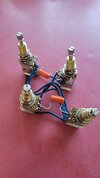
Jersey Shore Guitar Garage 21 Tone Jimmy Page Dual Humbucker Wiring Harness:

Inspector #20

Ambassador of Tone
Fallen Star
Country flag
I want to do this on my #1 Les Paul...

Description:

Full Boat" Wiring Mod, Coil-Cut Version (far right) - Essentially the same as the preceding mod, but substituting stud coil-cut switching on both humbuckers for the series/parallel mode. The coil-cut gives a slightly sharper, more trebly tone than parallel, but at the expense of loss of hum cancelling. Still, many people prefer this set-up. This particular wiring mod is also known as the "Jimmy Page" mod, since the legendary Led Zeppelin guitarist used a very similar set-up in some of his Les Paul's.

One aside here--I really don't see much point in combining coil-cutting and parallel switching for the same humbucker in a combination wiring mod. I learned this from experience, since I initially wired my Dot with a 3-way toggle for series, coil-cut and parallel modes. The bottom line is that the coil-cut and parallel modes don't sound different enough, in my opinion, to want to have both on the same guitar. If you want maximum twang, the coil-cut has a bit more of that. If it's more important to you to maintain your 'bucker's hum-cancelling capability, stick with parallel wiring.
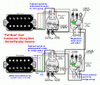
full_boat_sp.gif
 
I want to do this on my #1 Les Paul...

Description:

Full Boat" Wiring Mod, Coil-Cut Version (far right) - Essentially the same as the preceding mod, but substituting stud coil-cut switching on both humbuckers for the series/parallel mode. The coil-cut gives a slightly sharper, more trebly tone than parallel, but at the expense of loss of hum cancelling. Still, many people prefer this set-up. This particular wiring mod is also known as the "Jimmy Page" mod, since the legendary Led Zeppelin guitarist used a very similar set-up in some of his Les Paul's.

One aside here--I really don't see much point in combining coil-cutting and parallel switching for the same humbucker in a combination wiring mod. I learned this from experience, since I initially wired my Dot with a 3-way toggle for series, coil-cut and parallel modes. The bottom line is that the coil-cut and parallel modes don't sound different enough, in my opinion, to want to have both on the same guitar. If you want maximum twang, the coil-cut has a bit more of that. If it's more important to you to maintain your 'bucker's hum-cancelling capability, stick with parallel wiring.

View attachment 68324
The noise from non humbucker pickups is the reason why I don't do this...
But shielding the guitar inside will help reduce the buzzing.
Pretty much all guitar wiring I do will keep the PUs in humbucking mode at all times....I never switch to single coil mode if I can help it.

With high gain amps:
The noise is a problem.
But with low gain (like a normal fender type amp) The noise is almost tolerable.

Most of my customers are high gain maniacs, and the noise is a factor.

One more thing is the push-pull pot. (the pot is not so great quality)
Once the knob is installed on the shaft, pulling the knob off can break the shaft of the pot.
(the shaft breaks off the inside of the pot switch) and the shaft comes out of the pot.
It's happened many times on guitars and some Fender amps too.
I'm afraid that these push pull pots have a long way to go as far as durability.

So, your alternative is to use set-screw knobs, instead of push-on knobs.

But I don't drill holes in a guitar to install little switches....I hate that, I avoid that.
 
Last edited:
The noise from non humbucker pickups is the reason why I don't do this...
But shielding the guitar inside will help reduce the buzzing.
Pretty much all guitar wiring I do will keep the PUs in humbucking mode at all times....I never switch to single coil mode if I can help it.

With high gain amps:
The noise is a problem.
But with low gain (like a normal fender type amp) The noise is almost tolerable.

Most of my customers are high gain maniacs, and the noise is a factor.

One more thing is the push-pull pot. (the pot is not so great quality)
Once the knob is installed on the shaft, pulling the knob off can break the shaft of the pot.
(the shaft breaks off the inside of the pot switch) and the shaft comes out of the pot.
It's happened many times on guitars and some Fender amps too.
I'm afraid that these push pull pots have a long way to go as far as durability.

So, your alternative is to use set-screw knobs, instead of push-on knobs.

But I don't drill holes in a guitar to install little switches....I hate that, I avoid that.

Live, you'll never hear the noise and my noise gate will cover most of the noise anomalies. I seldom use the single coil feature on my Schecter, but its super quiet...
 
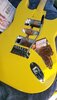
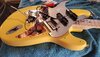
Way ahead of me, I see... beautiful work!! Question: for connecting the jack ground cable to the EMI shielding, would you solder it or just fix it in place with more connective tape? I'm asking because I'm about to take the dive into upgrading my guitars by myself and shielding cavities is high on my list. Any words of guidance will be greatly appreciated!
 
Way ahead of me, I see... beautiful work!! Question: for connecting the jack ground cable to the EMI shielding, would you solder it or just fix it in place with more connective tape? I'm asking because I'm about to take the dive into upgrading my guitars by myself and shielding cavities is high on my list. Any words of guidance will be greatly appreciated!

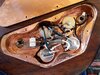
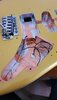
I always solder to one point on the copper tape...it's quick and easy. I make the wires long enough to allow easy servicing in the future...I also connect all the cavities together so I have complete continuity.

20210109_124717.jpg

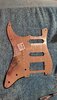
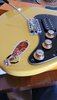
I also cover the back of all covers with either copper or aluminum tape. I tend to mix copper and aluminum sometimes depending on what I have on hand. You can buy the aluminum tape at the local Dollar Tree, so I use it for covering large areas.

20210213_064038.jpg

I typically use aluminum tape on the backs of the pickguard and covers just because it's much cheaper. Either one is fine and I get full continuity with both types of tape.

20210213_085959.jpg

Insulate ALL hot connections, that are near the shielding tape, with black tape or shrink tubing. A good example is where a "Hot" is near the wall of the cavity and if it's close enough, it will create a hum. Pay attention to this in the input jack cavity as shown.

20210109_131916.jpg

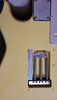
On Stratocasters, I put a piece of shielding tape to the spring claw and use that to make contact with the shielding on the spring cover.

20210311_160521.jpg

In my area, radio station interference is really bad, so I take shielding to an extreme...
 
Back
Top