Amp Gain staging question

According to some research it's very common for amps to have attenuation after every stage of high gain amps. It keeps the integrity of the signal and according to one book I have if there's no attenuation then, "...it produces a distortion that is unfocused and fizzy."
Basically an amplified signal cannot be fed into one stage and another without attenuation.
It would overload the next stage...
so it goes for conventional amplifier design.
(these designs were all copied from hi fi amplifiers phono preamplifiers) which were built in the late 1930s - and 1940s.
The master volume control was also invented in the 1940s.
The "cascade" gain stage was in wide spread use in the 1940s. (actually it's a "plate follower")
The "cascode" stage was in wide spread use in the 1940s. (It's a cathode follower)

Randall Smith did not invent any of the above....but continues to falsely claim that he invented all of it.
(A complete deception / an outright lie).
He simply copied it from other old designs.

However there is a different method which does not require the usual attenuation.
But this method is not known to many, only a few understand it.

The basis of all modern designs is the Fender Bassman (which was copied by Mesa Boogie and Marshall)
And continues to be the most copied design, and the basis for all modern guitar amplifiers.
 
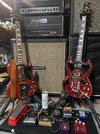
My DST Solera is a two channel amp that is basically a 50 watt Hiwatt on one side and a 50 watt Soldano on the other side. The Hiwatt side has such massive headroom, and is really loud. When you switch to the Soldano side, it loses volume and is super compressed. I wrote it off as "Nature of the Beast" regarding the High Gain Soldano sound. If using either channel as a stand alone amp sound, they are both great, and fun to use. But for me, it is best when keeping it on the Hiwatt side. Since my two Hiwatts are both 100 watts, this amp feeds my slightly less loud Hiwatt fix.

Huh?!!!!!!!!!!!!
 
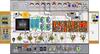
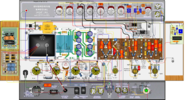
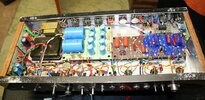
Now, if someone who has all the components, skill to use his tools and is good with a soldering iron and multi meter could not build an amp from this picture, there is something wrong.

ALL schematics and diagrams should look like this.

1616352191878.png
 
Hehe John, Hey after seeing your Fawn color Marshall I have my own 4 hole Year 1978 Marshall JMP 100 watt MkII that has mismatched Input socket nuts on it. 1 Black, and 3 Chrome ones. I suspect the previous owner lost the proper ones, so I am asking, does you amp have the Black ones or chrome?
 
Hehe John, Hey after seeing your Fawn color Marshall I have my own 4 hole Year 1978 Marshall JMP 100 watt MkII that has mismatched Input socket nuts on it. 1 Black, and 3 Chrome ones. I suspect the previous owner lost the proper ones, so I am asking, does you amp have the Black ones or chrome?


On the '78 and '79 heads, they are black. On my '73, they are chrome. My JTM is also chrome even though it was made in '89.
 
Thanks John. That is what I was thinking. I have a spare set of the black ones I acquired that I will swap in place of the 3 chrome ones.
 
Thanks John. That is what I was thinking. I have a spare set of the black ones I acquired that I will swap in place of the 3 chrome ones.

I think that if it has the plastic rocker switches, they should be black plastic. And if it has toggle switches, then they should be chrome.
 
I was sitting around thinking the other day about how I wanted to approach the design of this beast and then a thought occurred to me. Why not just find a kit that has the main components and layout I want, and tweak that to match the circuit I wanted.

I think I'll do that. All the heavy lifting done already.
 
I was sitting around thinking the other day about how I wanted to approach the design of this beast and then a thought occurred to me. Why not just find a kit that has the main components and layout I want, and tweak that to match the circuit I wanted.

I think I'll do that. All the heavy lifting done already.
It's even better to buy a new finished amp and modify it.
I was researching...
A new fender or marshall costs the same as the kit does. There is no advantage to buying a kit really.
The price of the kit is really too high compared to just buying the real thing.

I can buy a new fender for the same price as the inferior kit costs.
The kits are cheap parts and flimsy aluminum chassis etc...why bother?

I buy a new fender, the cabinet is really well made, the chassis is steel..why buy a kit? It's becoming a no brainer.
I'm just going to build onto a new complete chassis.
 
It's even better to buy a new finished amp and modify it.
I was researching...
A new fender or marshall costs the same as the kit does. There is no advantage to buying a kit really.
The price of the kit is really too high compared to just buying the real thing.

I can buy a new fender for the same price as the inferior kit costs.
The kits are cheap parts and flimsy aluminum chassis etc...why bother?

I buy a new fender, the cabinet is really well made, the chassis is steel..why buy a kit? It's becoming a no brainer.
I'm just going to build onto a new complete chassis.
Couple of reasons:
1. I get to build it. Sniff that Solder!!
2. Amps are made cheap these days. Wafer thin circuit boards, SMT components, and not very "mod" friendly.

I'd like a good Turret style amp, but my way.
 
Back
Top