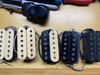
They came out of my '85 Les Paul. Someone had wired them with stacked pots so they could get single coil sounds out of them by splitting the coils. They are the worst things I have ever heard. I put some original spec PAF copies in the guitar years ago, wired them correctly, and have been happy ever since. It would be fun to hear how they sound wired properly to see if they the hype is all that real. But, for what they are selling for these days, I may not refuse a good offer.
Those are probably T-tops, I'm afraid.
Shaws didn't have 4-conductor leads; they can't be wired to split (unless somebody replaced the leads on yours).
T-tops have low output and a characteristic bright-but-not-harsh tone. That may account for why you didn't like 'em.
Personally I like T-tops in neck position. At the bridge, not so much: not meaty enough to suit me.
Still, tons of great music was made using 'em over the years.
If yours are uncovered you can check for the molded T on the top of the bobbins - Shaws didn't have that.
Also check the DCR: T-tops are pretty consistent at 7.4-7.5K.
Shaws are wound lighter, around 7k. I have one that's 6.97K and the highest I've seen was 7.2k.
Gibson only put Shaws in certain selected models, reissues mostly. Anything with the vintage 17 degree headstock angle, and long tenon one-piece mahogany neck would have them. This includes the KM and Heritage-80 Les Pauls, also Heritage series slab guitars like the korina Explorer and Moderne, plus a few special-edition "sorta reissues" like the first runs of the ES-335 Dot.
I had them as the stock pickups in a Standard-80, my '83 Guitar Trader burst reissue and the '82 Moderne.
But AFAIK no Shaws ever were used in regular production LPs and LPCs.
Then again, Gibson's been known sometimes to use what's at hand rather than what's specified.
A few of the distinguishing traits of Shaws were also shared by certain batches of T-tops.
Shaws were 2-wire with braided vintage style leads; most T-tops were too, though some had 4-way leads with a plastic sleeve.
Shaws used the Pat # baseplate; nearly all T-tops had that too.
Most Shaws had an ink stamp with a batch # or date. But some T-tops had that too, and some Shaws made near the end did not.
The surest identifier I know of for a Shaw is that the spacers are white plastic. AFAIK that's true for all of them.
But you can't see without removing the cover.