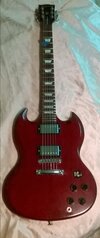
Gibson SG Neck Pickup Placement

Inspector #20

Ambassador of Tone
Fallen Star
Country flag
Curious....I get an annoying Wolftone on the 15th/17th fret of my Gibson SG, and only on the 'G' string. The anomaly doesnt seem to be affected by pickup height and it only happens when overdriven.

My Les Paul doesnt do this.

Is it just an oddity based where the neck pick sits???

Thank you...
 
The pole pieces on a Les Paul neck pickup are under the harmonic point where the 24th fret would be.
The pickup is right against the end of the 22 fret fingerboard. Same thing with an ES 335.
The neck pickup on an SG is closer to the bridge. It is actually in the "wrong" place.
There is a space between the neck pickup and the end of the fingerboard on SGs.
That's why Les Pauls and SGs sound so very different in the middle position.
 
Here you can see what Tomy M. is talking aboutWP_20160731_004.jpg
This is a 24 fret neck. On an LP etc the poles would be where that last fret is. Not a huge difference but because of the pickup is seeing a different harmonic content. Cheers
 
Last edited:
The pole pieces on a Les Paul neck pickup are under the harmonic point where the 24th fret would be.
The pickup is right against the end of the 22 fret fingerboard. Same thing with an ES 335.
The neck pickup on an SG is closer to the bridge. It is actually in the "wrong" place.
There is a space between the neck pickup and the end of the fingerboard on SGs.
That's why Les Pauls and SGs sound so very different in the middle position.

That's the answer I wanted. It might also explain my persistent SG Wolftones on the neck...
 
Cheers Robert, I mainly use just the bridge on the SG . How are you going with the LP pickups? I'm with you on the hotter A5's. Cheers
 
Cheers Robert, I mainly use just the bridge on the SG . How are you going with the LP pickups? I'm with you on the hotter A5's. Cheers

Ivan,

I first discovered the 'G' string Wolftones when playing Gary Moore's Still Got The Blues live on the neck pickup. I just couldn't get a clean note. I double checked intonation, even dropped the pickup...no change.

Now the pickups in the SG now are GFS Classic II's Alinco II with only 7.93k bridge and 7. 88k neck - not a hot pickup really, so I guess its just the nature of the beast???
 
Cheers Robert, I mainly use just the bridge on the SG . How are you going with the LP pickups? I'm with you on the hotter A5's. Cheers

Good Morning again!

On the LPC I went again with GFS. They have really been good to me and their pickups have been really quiet too.

I did go with the Alinco V because the LPC is a lot darker sounding than my SG and I felt it was a step in the right direction.

The VEH is fairly "warm," I guess you could say with 11.5k bridge and 9.5k neck. The quality of the gold plating is really nice on these too.

I don't have them in yet...maybe Sunday??? Got a couple of students today and we are hosting a birthday party later this afternoon, so I'll be busy.

I got most of my parts already. The gold Dunlop straplocks, gold speed knobs, pointers, pickups, wire harness, Grover gold keystone tuning keys, Gotoh aluminum tailpiece...just waiting on the roller bridge, the gold plated brass switch washer and aged white switch tip.

I'm rethinking the bumblebees at present. I really like the .033uf/.015uf cap combination. I have a pair of Russian K40Y's in that configuration and I may use them as opposed to the .022uf/.022uf bumbles....just a preference I suppose.

I feel like the K40Y's give me more gradual adjustment over my tonal range. I used these in the SG too. Very impressed with them.


IMG_20170426_13867.jpg
 
Last edited:
That's the answer I wanted. It might also explain my persistent SG Wolftones on the neck...
No, it won't. At least not fully, and not directly.

A dead spot is always caused by a resonance in the body resp. neck, which is strong enough to take too much of energy from the string. A Wolftone is just the opposite of a dead spot, i.e. caused by a structural detail which is extremely stiff (dynamically, not due to static load). Making things worse - the Q of these resonances of course will also affect the attack of those notes.

Back to the "directly". Of course the pickup positions cause structurally weak spots, especially in an SG, and the deep cutaways, too. Also a different neck profile (stiffnes) and even different headstock sizes and tuners (=dynamic masses) as well.

A neck pickup immediately at the end of the fingerboard of the SG would lead to an even larger weakness of the neck body joint and make it even more prone to dead spots and wolftones.

And indeed, of course, the noticeability of these resonances are affected by the pickups and their positions. But in general the effects of the PU positions on sound are independent of those of the body and neck resonances.
 
No, it won't. At least not fully, and not directly.

A dead spot is always caused by a resonance in the body resp. neck, which is strong enough to take too much of energy from the string. A Wolftone is just the opposite of a dead spot, i.e. caused by a structural detail which is extremely stiff (dynamically, not due to static load). Making things worse - the Q of these resonances of course will also affect the attack of those notes.

Back to the "directly". Of course the pickup positions cause structurally weak spots, especially in an SG, and the deep cutaways, too. Also a different neck profile (stiffnes) and even different headstock sizes and tuners (=dynamic masses) as well.

A neck pickup immediately at the end of the fingerboard of the SG would lead to an even larger weakness of the neck body joint and make it even more prone to dead spots and wolftones.

And indeed, of course, the noticeability of these resonances are affected by the pickups and their positions. But in general the effects of the PU positions on sound are independent of those of the body and neck resonances.

There's no "dead" spot per se. The volume is equal across all strings and frets. The wolftone sounds exactly like magnetic pull on a Stratocaster, but it only happens between the 15th and 17th frets.

I have no such overtone anomalies anywhere on my Les Paul.
 
Back
Top