Les Paul Studio Project

I am very fond of Seymour Duncan '59s. If I go with that, I'll probably install a bridge pickup in both the bridge and neck positions. Their DC resistance and marketing would lead you to believe they are really just good for classic rock and lesser gain use. I've found them to retain a lot of clarity under pretty high gain. They're an all around great pickup.
So many other brands fill this niche. But the SD's are as good as any... :yesway:

I may do push-pull pots for a coil-split set up. Regardless, I'll use 500K pots and .015 mfd capacitors.
Have you researched Parallel to Series on a push-pull, instead of coil-split (or coil tap). Less volume drop with less of the single coil induced hum. Personally, I'll never go back to tapping a single coil on a humbucker, instead of switching from Parallel to Series... YMMV... :celebrate:
 
I'm still kicking around ideas for tuners. Honestly, I am somewhat leaning toward the classic look, with Klusons, but the newer model with screw-in ferrules, vs. the press-in ferrules.

Yes, I'll do the poker chip. To me, there is something that just says, "Les Paul," about the poker chip.

Wow, Man...cool corpse.... :-)

I'm tuner shopping as well for my LPC replica project. I'm leaning towards the gold metal tulip Grovers....gold witch hats maybe...
 
Really nice husk there Smitty.I think the white Les Pauls and great looking guitars. I say the Duncan 59s all the way .
 
Houston, we've got a problem.

Yup, I just ran across a discovery that forces a significant change to the direction I wanted to take with this project. To recap from my original post, I wanted to put my Kahler on this guitar. The Kahler in question is the hybrid type that hooks onto the stop-tail studs.

Here's the little honey, right here:

full


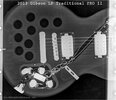
Well, yesterday evening I just happened to be watching a youtube video on a Gibson Guitar factory tour, and there was a shot of chambered body blanks, which suddenly caught my attention. I knew this thing had to be weight-relieved when I got it. It is very light...almost as light as my SGs. But, I saw some heavily chambered body blanks in the video. This set me to Googling and I found this link, with X-Rays, over at My Les Paul, which discusses different chambering styles for different years.

Gibson Les Paul 101

Well, it turns out the year of my Studio husk (2007) is supposed to have chambering that looks like this:

full


Yikes! As you may imagine, this created a bit of concern for me. I began wondering where I could get my guitar X-rayed to confirm it's chambering topology. Then, I hit upon the idea of using my stud finder to take "soundings" of the interior of the guitar, to see if I could map out the chambers.

Here's a pic of me using the stud finder on the guitar:

full


The good news is, this worked very well. The bad news is that the stud finder triggered exactly where the X-ray above suggests it should, including that long, hollow channel that runs up between the stop-tail and bridge studs. The only real difference being that the guitar in the X-ray is routed for a P-90 in the neck. Mine is routed for two humbuckers. But, everywhere else that mattered, for my purposes, was just like that X-ray.

So, this means the Kahler is out of the question, for two main reasons. First, installing a Kahler still requires routing. It uses a two-tiered hole. The lowest tier goes about 1" deep into the top. That would penetrate directly into that hollow channel between the studs. It also is a wide route that would go almost to the stop-tail studs, taking out even more of the anchoring wood. Second, when I got the guitar, I taped off the top and began laying things out. To use the Kahler, I would have had to plug and redrill the stop-tail studs about 5/16" to 3/8" further back. Well, that would mean I'd drill right into a void.

The bottom line is that I have no choice but to proceed with this build as a traditional, stop-tail setup.

This is disappointing. But, not devastating. Without exaggeration, this Studio is really a semi-hollow guitar, sans f-holes! Honestly, that does make me feel a little better about it. After I discovered this, I actually considered routing an f-hole in the top half of the rear bout! But, I don't feel like finishing the edges and adding to my risk of feedback, so I'll leave it alone.

Ah, well...fun in the fast lane!
 
Last edited:
Great piece of thinking to use a stud finder - one of those is going straight in my tool box. :cheers:
Shame about the trem though - just have to keep it for another project. But I never knew they had taken weight relief that far - it is essentially a hollow body without f-holes. I think my ES339 has more solid mass inside it.
 
Great piece of thinking to use a stud finder - one of those is going straight in my tool box. :cheers:
Shame about the trem though - just have to keep it for another project. But I never knew they had taken weight relief that far - it is essentially a hollow body without f-holes. I think my ES339 has more solid mass inside it.

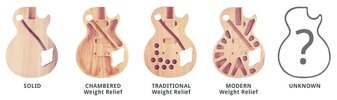
It seems they don't take out as much as this X-ray shows, anymore. It seems they've done different schemes over the years. And, they don't use the same scheme for every guitar.

Here's the video I watched that first raised my concern. They don't show the exact chambering pattern as in the above X-ray, but mine definitely matches it!

Yeah, the stud finder works great. It doesn't work too well to detect smaller holes, but it works well in those larger, chambered areas where there's a more defined, straight boundary.

 
^^^Yeah. I ran across that pic as I was racing hither and yon over the internet looking for answers!

I did find an interesting tid-bit on one forum. That pattern in your Traditional is called "Cloud 9" weight relief - named for the nine holes in the body.

It's interesting that the chambered image in your picture doesn't show that channel between the studs. Mine definitely has it, like that X-ray in my post. I ran my stud finder through that area several times to be sure. But, even if mine was like your picture, I'd still not have enough wood to relocate the stop-tail bushings.
 
^^^Yeah. I ran across that pic as I was racing hither and yon over the internet looking for answers!

I did find an interesting tid-bit on one forum. That pattern in your Traditional is called "Cloud 9" weight relief - named for the nine holes in the body.

It's interesting that the chambered image in your picture doesn't show that channel between the studs. Mine definitely has it, like that X-ray in my post. I ran my stud finder through that area several times to be sure. But, even if mine was like your picture, I'd still not have enough wood to relocate the stop-tail bushings.

No you pretty much need the full solid. I'm betting that as all this stuff lies hidden, they are experimenting quite a lot with different weight relief patterns. Weight is cash off the bottom line when it comes to shipping.
 
NICE! its going to be great, Smitty.

My LPC replica has a bunch of holes in it, both large and small. But it is so perfectly balanced. I can rest it on my leg and it doesn't tip. Whatever methodology the Luthier used works.
 
uhm.........why the Second one is basically a "Florentine" without the "F" hole.......WOW......
5x-poziom-jpg.4314
 
This from Wiki: A Florentine cutaway has a sharp bout. The terms probably originate with the Gibson Guitar Corporation and probably do not reflect historic instrument-making practices of Florence and Venice. A less common third type is the squared-off cutaway, used on the Selmer-Maccaferri guitar and some nylon-string guitars.

1ea162230fc9d4efab71d0df9094a5b2.jpg
 
Back
Top