Got a brand new Toy!

We could measure the attenuator just like everything else.
But when you measure you're probably going to find something that's causing it.

It can be a bad speaker cable or anything in the chain.

If all the parts are working right, the attenuator would normally not hurt anything.
Thank you

I needed the reassurance of an expert, I was so freaked out.

If it is the attenuator, for some reason, I will pick up all the costs Mike, and refund your money.

I swear it was great the evening before shipping, I've used it enough, if there was a problem I think it would have happened at my place.
 
Thank you

I needed the reassurance of an expert, I was so freaked out.

If it is the attenuator, for some reason, I will pick up all the costs Mike, and refund your money.

I swear it was great the evening before shipping, I've used it enough, if there was a problem I think it would have happened at my place.
Well it's something, not necessarily the attenuator.
 
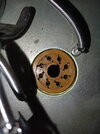
The left tube socket has some slight burn marks
Pic please!

The harder you run a tube amp, the more it's going to expose any weakness it might have. You mentioned that you've had the same power tubes in there for a year...
How many hours do you think you got on those power tubes?
How hard have you been operating the amp during this time?
What brand and type of power tubes are these?

If any of the power tubes have become on the worn side and your driving the piss out of the amp, then that alone could have lead to this failure. The power tube also could have failed because of another component was failing. And of course, when a power tube fails it could also cause collateral damage and take out other components.
 
Oh man

I swear the attenuator ran o.k. on my JTM45, tested it before shipping.

If you think it's the attenuator, be happy to take it back. Just bums me out you had problems the first day.

Bummer, I'll look through my parts, if I have one of those fuses I will post it to you today, should get it Mon or Tues.

Get back to you in a couple, be right back.
No man we're good, this is on me totally! The power brake is fine man. There has been some issues with this amp anyways and i think its time to get sent off for a full redux
 
Pic please!

The harder you run a tube amp, the more it's going to expose any weakness it might have. You mentioned that you've had the same power tubes in there for a year...
How many hours do you think you got on those power tubes?
How hard have you been operating the amp during this time?
What brand and type of power tubes are these?

If any of the power tubes have become on the worn side and your driving the piss out of the amp, then that alone could have lead to this failure. The power tube also could have failed because of another component was failing. And of course, when a power tube fails it could also cause collateral damage and take out other components.
I probably put at least 15hrs on the tubes since changing. This thing had some issues going on before, like a bridge rectifier burned out and then a larger capacitor beside it. They were swapped out and the filter caps changed as well. But these tubes were supposed to be matched pair, yet i noticed on the boxes, they wrote the mA and its two different numbers?

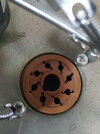
Heres the socket, slight discoloration20210206_145445.jpg

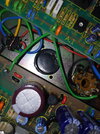
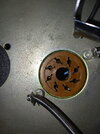
Otherside, nothing abnormal from appearance
20210206_145635.jpg

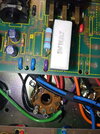
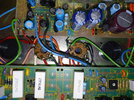
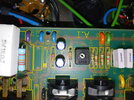
C8 and rectifier changed before
20210206_145554.jpg

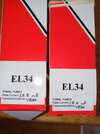
The tubes
20210206_145852.jpg
 
Sorry I'm late to this. There is a couple thing I'd like to ask, firstly do you live in an area with high humidity? Was there any dust inside the amp? An excessive impedance mismatch can definitely cause a valve socket to arc, but it is by no means the only thing that can cause this. Dust alone can as it's conductive, same with moisture. AMS is right in that the socket MUST be replaced. Arcing leaves carbon tracking on the socket, & again, carbon is conductive. Can you tell us the socket pins that it has arced between? This may help narrow down a possible cause. As Sysco said, pics please, detailed pics. We should all keep at least a couple of spare main & HT fuses for each of out amps, & take spares to gigs, rehearsals, jams etc. Hope we can get your amp all sorted. Cheers
 
Sorry I'm late to this. There is a couple thing I'd like to ask, firstly do you live in an area with high humidity? Was there any dust inside the amp? An excessive impedance mismatch can definitely cause a valve socket to arc, but it is by no means the only thing that can cause this. Dust alone can as it's conductive, same with moisture. AMS is right in that the socket MUST be replaced. Arcing leaves carbon tracking on the socket, & again, carbon is conductive. Can you tell us the socket pins that it has arced between? This may help narrow down a possible cause. As Sysco said, pics please, detailed pics. We should all keep at least a couple of spare main & HT fuses for each of out amps, & take spares to gigs, rehearsals, jams etc. Hope we can get your amp all sorted. Cheers
I posted up above where i saw it. Just some slight discoloration, dont know if that helps?
 
I probably put at least 15hrs on the tubes since changing. This thing had some issues going on before, like a bridge rectifier burned out and then a larger capacitor beside it. They were swapped out and the filter caps changed as well. But these tubes were supposed to be matched pair, yet i noticed on the boxes, they wrote the mA and its two different numbers?

Heres the socket, slight discolorationView attachment 58202

Otherside, nothing abnormal from appearance
View attachment 58203

C8 and rectifier changed before
View attachment 58204

The tubes
View attachment 58205
That's not too far apart, both the mA & transconductance, although the transconductance figure of 4,800 & 4,830 (umhos, or micromhos, mho being ohm spelt backwards) is very low for an EL34. Typically, the NOS xf2 Blackburn Mullard EL34's I have all have transconductance in the 11,000~12,000 range & the earliest Philips Mullard EL34 datasheet's show this as 11,000 . Transconductance is the relationship between the change in plate current (output) in regard to voltage change (input) on the control grid. So much for modern EL34's being made "more efficient" than the very first "original" EL34's (sorry, I couldn't resist that).
Plate current should be within 5mA, transconductance a couple hundred umhos. Cheers
 
That's not too far apart, both the mA & transconductance, although the transconductance figure of 4,800 & 4,830 (umhos, or micromhos, mho being ohm spelt backwards) is very low for an EL34. Typically, the NOS xf2 Blackburn Mullard EL34's I have all have transconductance in the 11,000~12,000 range & the earliest Philips Mullard EL34 datasheet's show this as 11,000 . Transconductance is the relationship between the change in plate current (output) in regard to voltage change (input) on the control grid. So much for modern EL34's being made "more efficient" than the very first "original" EL34's (sorry, I couldn't resist that).
Plate current should be within 5mA, transconductance a couple hundred umhos. Cheers
On the question of moisture and dust, nah i keep them very clean and the humidity inside is an average of 35-45% typically and monitored. But hey, that's a good question!
 
On the question of moisture and dust, nah i keep them very clean and the humidity inside is an average of 35-45% typically and monitored. But hey, that's a good question!
Apologies, I was doing Sunday breakfast & got told to put the 'phone away.
Ok, that takes that possibility (dust, moisture) out of the list of possibilities.
We more often see arcing on the underside of the socket (pins are larger there), though sometimes on the top, & there is visible discolouration showing. As we are looking at the top of the socket, we count the pins anti-clockwise from the guide pin slot. Can we have a more clearly lit pic of that socket please, so as to properly ascertain which pins the discolouration is between (I can be sure of some but not sure about others). Can you check the base of the valve to see if it shows signs of arcing also?
May I ask how much you attenuate?
A couple of things with attenuating, the more we attenuate, the greater the impedance mismatch (no attenuator loads the output exactly as the speakers do). Also, quite often, the more we attenuate the harder we drive the output valves. All valves can fail without there being a fault in the amplifier, even with little use on them, & yes, a valve that fails internally can also arc externally. Cheers
 
Apologies, I was doing Sunday breakfast & got told to put the 'phone away.
Ok, that takes that possibility (dust, moisture) out of the list of possibilities.
We more often see arcing on the underside of the socket (pins are larger there), though sometimes on the top, & there is visible discolouration showing. As we are looking at the top of the socket, we count the pins anti-clockwise from the guide pin slot. Can we have a more clearly lit pic of that socket please, so as to properly ascertain which pins the discolouration is between (I can be sure of some but not sure about others). Can you check the base of the valve to see if it shows signs of arcing also?
May I ask how much you attenuate?
A couple of things with attenuating, the more we attenuate, the greater the impedance mismatch (no attenuator loads the output exactly as the speakers do). Also, quite often, the more we attenuate the harder we drive the output valves. All valves can fail without there being a fault in the amplifier, even with little use on them, & yes, a valve that fails internally can also arc externally. Cheers
Thank you for your time here my friend and sorry to keep you from your daily grind! Yeah the base of the tube itself had no signs of arcing anywhere , i will take some more photos of the socket base as well. As far as attenuation? I had it at about 50% attenuated when the amp blew, but had it choked a lot before that in the 20% range, so pretty suppressed honestly but these are typically monsters that can go across the spectrum with no issue. Johan segeborn uses one from wide open to choked to death lol

I was exploring something strange on this amp: i bought it new in 1996 as a 2500 SLX EL34 model. But last year after fixing the C8 capacitor and BR3 bridge rectifier, i noticed certain values in some resistors didnt match up. It turns out that this amp is actually a 1993 2500 SLX 5881 Model that someone attempted to make an EL34 ( so i was burned when i bought it "new"). I need to open the amp up again in a little bit and run down the lists, but namely there is 5 resistors of different values between the two amps and im wondering if this was ever properly addressed

R30
R31
R34
R28
R23
 
Last edited:
Apologies, I was doing Sunday breakfast & got told to put the 'phone away.
Ok, that takes that possibility (dust, moisture) out of the list of possibilities.
We more often see arcing on the underside of the socket (pins are larger there), though sometimes on the top, & there is visible discolouration showing. As we are looking at the top of the socket, we count the pins anti-clockwise from the guide pin slot. Can we have a more clearly lit pic of that socket please, so as to properly ascertain which pins the discolouration is between (I can be sure of some but not sure about others). Can you check the base of the valve to see if it shows signs of arcing also?
May I ask how much you attenuate?
A couple of things with attenuating, the more we attenuate, the greater the impedance mismatch (no attenuator loads the output exactly as the speakers do). Also, quite often, the more we attenuate the harder we drive the output valves. All valves can fail without there being a fault in the amplifier, even with little use on them, & yes, a valve that fails internally can also arc externally. Cheers
Heres some update photos. The only discoloration i can slightly see would be counterclockwise from the guide pin at 3 and 7somewhat ( i assume cathode and anode?) One socket is clean, the other shown was the tube that blew. The other shot is from within
20210206_205456.jpg20210206_205503.jpg
20210206_205339.jpg
I checked all the resistors from a 5881 and EL34. This amp is seemingly a real EL34 even though its stamped 5881 on the chassis. R28 which appears to be the bias adjustment resistor however is incorrect. It should be a 22k per schematic and is 68k, quite off.

Unfortunately until i get the fuses in, i cant explorer much more at this point in time, as in pulling all tubes and powering up to checking the transformers or reading across parts of the amp

20210206_205618.jpg
 
Last edited:
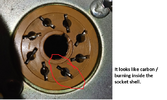
Yeah, looking at it I would probably change at least the 1 socket.
When carbon builds up like that, you can't clean it off.
It's an indication that the insulation will fail, or is failing.

socket.png

But what you want to do is start by measuring your speaker cabinet with an ohm meter, and confirm that it reads like 12.6 ohms for a 16 ohm speaker.
 
what the..........................carbon? --- who the..................................

NORM BRIONGON THE SOLID STATE ORANGES................................................................oh wait I have Mosfet Marshals .....nevermind ;)
 
Yeah, looking at it I would probably change at least the 1 socket.
When carbon builds up like that, you can't clean it off.
It's an indication that the insulation will fail, or is failing.

View attachment 58261

But what you want to do is start by measuring your speaker cabinet with an ohm meter, and confirm that it reads like 12.6 ohms for a 16 ohm speaker.
I really appreciate you taking the time to look at this and give some great advice my friend. I will certainly pop the cabinet open tomorrow and take some readings at each speaker and then together at the speaker cable input and get back with you.

It is very possible there could be some break down internally at the cabinet, i certainly wouldnt rule that out considering its at least 25 years old
 
Back
Top