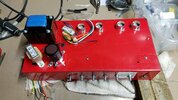
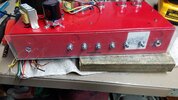
JCM 800 Micro 1W build

jtcnj

Ambassador of the Crossroad
Country flag
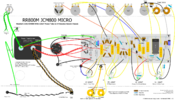
IT is from robrobinette.com - the 1W version.
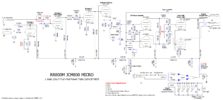

1586883731363.png

1586883787074.png

Mine will be a head, chassis on bottom of cab tubes facing up.
Edit: single input and output jacks.
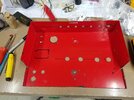
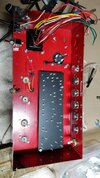
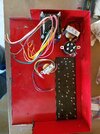
Finally getting this started, a little at a time. End of March I roughed out chassis, then last weekend got most of the placements set up and holes drilled.
I was going to drill the plastic faceplate with the control face holes but didnt have time and grew impatient.
I dont recall if it is acrylic or polycarbonate, off the shelf at Lowe's.

Mainly remaining are the screw holes for sockets and have to make a card template for the PT cut out and mounting holes.
Also, final placement and holes for OT, and wire hole for choke.

I will clean up the edges, fold the back up and weld the corners when the other prep is done.
First time building on a board instead of terminal strips, and a store bought one at that. I must be getting old and lazy.
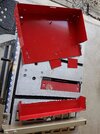
20200327_151808.jpg

20200327_160239.jpg

20200410_154813.jpg
 
Awesome. I'll be watching this thread with great interest, Mr JTCNJ. I've had the iron for exactly this same build for a while, as well as a board I can turret up & most other hardware & components. Still need a suitable chassis & cab (probably combo for versatility). Looking forward to seeing more as your build progresses. Cheers
 
Last edited:
Subscribed... :cheers:
I've been contemplating the same micro JCM project too. But if I go forth with it, I'll probably cheat and use a chassis designed for a Princeton Reverb.

Edit: single input and output jacks.
The JCM800's Low Input has a beautiful clean tone that hardly anybody ever talks about. Not sure how this circuit with only one watt of power would sound like at the Low Input.
 
I looked it up on Rob's page, and enjoyed the sound clip. The version that was shown in the photo looks great. I also like the 6V6 JCM800 he has on that page.

Every time I look at that page, I spend at least an hour reading. Tonight was no different.
 
I was thinking the same; I wonder how easy (or not) it'd be to add an attenuator?
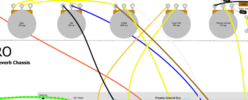
Well, the amp already has a master volume. In fact, Rob Robinette has modded the stock JCM800's pre-phase inverter master volume with a Trainwreck Type 3 post phase inverter MV. This might work better than the stock design... I need to try this Type 3 MV on my own JCM's. But... @jtcnj : I would positioned the MV control last, and move the treble, mid, bass, and presence control one hole closer to the preamp volume control. There will be less cross-traffic wiring, and by moving the EQ controls towards the pre-volume control, the EQ pots will line up more efficiently with their corresponding components.
 
Well, the amp already has a master volume.

What is your view of attenuator vs pre/post vol/gain controls? Are all needed or if the amp has good master volume, preamp/gain knob and post/volume knob that's all you need.

I ask because, I'm not sure. I always like the idea of an attenuator, but almost always find an amp sounds best on it's highest wattage setting (I'm talking low wattage amps here).
 
Well, the amp already has a master volume. In fact, Rob Robinette has modded the stock JCM800's pre-phase inverter master volume with a Trainwreck Type 3 post phase inverter MV. This might work better than the stock design... I need to try this Type 3 MV on my own JCM's. But... @jtcnj : I would positioned the MV control last, and move the treble, mid, bass, and presence control one hole closer to the preamp volume control. There will be less cross-traffic wiring, and by moving the EQ controls towards the pre-volume control, the EQ pots will line up more efficiently with their corresponding components.
i had that in mind as I consider component placement as well - as we are looking at the same thing:

1586961334417.png

I chose all Hammond iron with similar specs which worked out better dollars from Hawk Electronics.
as with the single jacks, I am not rigid to the design.
 
What is your view of attenuator vs pre/post vol/gain controls? Are all needed or if the amp has good master volume, preamp/gain knob and post/volume knob that's all you need.

I ask because, I'm not sure. I always like the idea of an attenuator, but almost always find an amp sounds best on it's highest wattage setting (I'm talking low wattage amps here).
Maybe you should rephrase the question to: "Do you want to open up a Pandora Box?"

A well designed attenuator is very practical and essential if the tube amp has no master volume. But of course, an attenuator is very useful for any tube amp regardless whether it has a master volume or not. Attenuators are all about getting into the amp's sweet spot, therefore running the amp hard and sacrificing some tube life because of it.

A pre phase inverter MV might work better than a post PIMV on some amp circuits, while a post PIMV might work better on others. Or in the example with my two JCM800's, they have both: the stock pre PIMV and the post PIMV. But if I really need to "feel" my 50 watt monsters in my 120 square foot mancave, then my attenuator comes back into play.

Most owners of Mesa Boogie amps rave about how effective and musical their amps master volume circuits perform. I don't recall any of these owners stating a need for an attenuator. Don't know how Mesa does it. Even if I had their schematics, it would probably be way over my head to implement it. I also heard, on paper, great comments about Naylor amps and their master volume circuits. I think the Naylors are still very handwired, but I've yet to find any decent schematics of their products.

And then there are amps that use voltage reducing circuitry to reduce volumes but keep the whole amp in its sweet spot. I have no experience with this technology, but those that do seem to be very satisfied with this approach.
 
Back
Top