Failure on a speaker Celestion Marshall vintage

marshalltsl

Well-Known Member
Country flag
Hi.
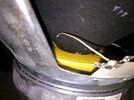
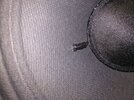
Yesterday the band's rehearsal didn't last a single song. The fellow guitarist stopped his amp sudently. After inquiring we discovered that the problem came from the vintage Marshall 1936 cabinet. We check with a meter and the fault comes in a speaker. Very rare. We barely played 2 minutes. We disassembled the speaker and you can't see anything. Checking with a meter the Celestion speaker, it has no resistance but if you press with your fingers the cone right where the braided cable comes out towards the connection faston it works. We have resistance. Is it worth repairing? Can it be repaired?
The speaker looks great and does not smell anything burnt.
Thanks.
IMG_20201013_001120_799.jpg
 
Hi.
Yesterday the band's rehearsal didn't last a single song. The fellow guitarist stopped his amp sudently. After inquiring we discovered that the problem came from the vintage Marshall 1936 cabinet. We check with a meter and the fault comes in a speaker. Very rare. We barely played 2 minutes. We disassembled the speaker and you can't see anything. Checking with a meter the Celestion speaker, it has no resistance but if you press with your fingers the cone right where the braided cable comes out towards the connection faston it works. We have resistance. Is it worth repairing? Can it be repaired?
The speaker looks great and does not smell anything burnt.
Thanks.
View attachment 50172
This is called
" a pigtail repair."
To change the pig tails is a common repair job for speakers.
Most knowledgeable speaker re-coner techs can do it.
 
What type of Celestion speakers are in there?

Are you sure that the bad connection is at point A?

If the bad connection is at point B, then this would be a very easy fix!
View attachment 50181
If you push with a finger under point A the speaker have resistance. I think you need unglue the coil wire of point A. Then glue It correctly. But I don't know, I'm not a speaker tech.
 
What type of Celestion speakers are in there?

Are you sure that the bad connection is at point A?

If the bad connection is at point B, then this would be a very easy fix!
View attachment 50181
It's usually that the pigtail wire itself fails. The actual metal in the wire breaks, but the fiber part remains attached.
Then there is no continuity to the voice coil.
Usually the pigtail is removed and replaced.

But sometimes, there is a failed solder connection this is less common.

Pig tail wire is a special type, which can be purchased from speaker supply.

The glue is removed with MEK solvent. This is nasty solvent with fumes that causes brain damage.
The pig tail wire is un-soldered.
A new piggy wire is installed and soldered.
New glue is then applied over the solder point.

I have seen people do this and I have done it occasionally. But it's a very delicate soldering job / easy to break the thin voice coil wire.

Skip to 35:00 for the pigtail soldering
 
Last edited:
Is this better than using acetone?

Acetone is what I used to soften and remove the black glue. It discolored the cone where the glue was removed, into a whitish color. But all the discoloration was covered up by the reapplication of the black glue to finish up the repair.
MEK has acetone in it but is far nastier than acetone alone.
Wear gloves, eye protection and lots of ventilation; God help you.

Butanone, also known as methyl ethyl ketone (MEK),[a] is an organic compound with the formula CH3C(O)CH2CH3. This colourless liquid ketone has a sharp, sweet odor reminiscent of acetone. It is produced industrially on a large scale, but occurs in nature only in trace amounts.[7] It is partially soluble in water, and is commonly used as an industrial solvent.[8] It is an isomer of another solvent, tetrahydrofuran.
 
MEK has acetone in it but is far nastier than acetone alone.
MEK doesn't have acetone "in" it.
A ketone is an oxidised form of an alcohol, MEK being a derivative of methyl & ethyl alcohols.
Acetone is the simplest of a ketone, being a derivative of acetic acid (vinegar). Ketones are also known as propanones. Cheers
 
Last edited:
MEK doesn't have acetone "in" it.
A ketone is an oxidised form of an alcohol, MEK being a derivative of methyl & ethyl alcohols.
Acetone is the simplest of a ketone, being a derivative of acetic acid (vinegar). Ketones are also known as propones. Cheers
Since you just demonstrated some knowledge on some groovy chemicals, I have a question about naphtha:
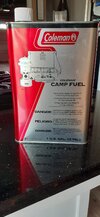
Naphtha cannot be sold in Crazyfornia. For the last few years, I've been using Coleman's Camp Fuel. Same thing?

20201016_115131.jpg
 
They are both long chain hydrocarbons, but not "exactly" the same. Naptha is a kinda broadly applied name as it can be a mixture of different hydrocarbons & derived from a few different sources, including natural gas, coal, peat & crude oil. I think the US ban on naptha has something to do with crude oil from Venezuela. Cheers
 
MEK doesn't have acetone "in" it.
A ketone is an oxidised form of an alcohol, MEK being a derivative of methyl & ethyl alcohols.
Acetone is the simplest of a ketone, being a derivative of acetic acid (vinegar). Ketones are also known as propones. Cheers


That stuff still exists? I haven't heard of it being used in over thirty years.
 
Best product I used all the time that no longer exists was Trichloroethylene or Tric for short.

Best thing ever for cleaning electronic parts. We had it in aerosol cans and also gallon jugs.
Worked wonders cleaning RC car parts as well. I miss Tric and also Stoddard Solvent.
 
I think the US ban on naptha has something to do with crude oil from Venezuela.
I don't think naphtha is banned in all of the USA... yet! Cookyfornia banned it about 10 years ago for "environmental" reasons. But your right, that in the last 2 years, the USA is using the disruption of limiting naphtha ingredients from coming from Venezuela as a sanctioning tool.
 
Best product I used all the time that no longer exists was Trichloroethylene or Tric for short.

Best thing ever for cleaning electronic parts. We had it in aerosol cans and also gallon jugs.
Worked wonders cleaning RC car parts as well. I miss Tric and also Stoddard Solvent.


It was best used in a hot tank. Could remove every drop of oil or any other liquid from cast aluminum, so that you could weld without oil eruptions.

Most evil chemical known to skin. Friends of mine and I who were all machinists or welders blame that stuff for the various cancers we’ve had.
 
Last edited:
Hi guys!
Bad news. The speaker tech service say It needs replace the speaker coil to fix It properly.
In fact the real issue was a speaker Jack output from the 1936 cab. The 1936 just ran with one speaker. A 120W tube amp with just one 70W speaker is bad. Afortunetly the amp is fine.
Fix It costs 145 euros. Let's see how many cost a new one.
 
Back
Top