OP


For a speaker cable that makes sense.
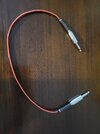
Did you inspect the connections of the cable to each plug of the disappointing speaker cable?

AFAIK... This does not make any sense. And, I don't think it's a proper method to test a speaker cable by trying to measure resistance between the ground sleeves and between the positive tips. If you set the meter to "Continuity", then you test the cable at those same points for... uhm, continuity. You should also notice a very small ohm reading. The positive tip reading will probably and consistently be smaller and more stable than testing the ground shield. Positive should be under 1 ohm. Ground may be a hair above 1 ohm, but the display will fluctuate wildly.Yes. Everything looked good...

^^^^^^^^This^^^^^^^^Make sure your hands and fingers are not touching the probes metal contacts and the plug.

Flesh for Fantasy... :dood:Flesh in the circuit.
Indeed! Results may vary. I wouldn’t want to be caught checking voltages with that method...Flesh for Fantasy... :dood:


AFAIK... This does not make any sense. And, I don't think it's a proper method to test a speaker cable by trying to measure resistance between the ground sleeves and between the positive tips. If you set the meter to "Continuity", then you test the cable at those same points for... uhm, continuity. You should also notice a very small ohm reading. The positive tip reading will probably and consistently be smaller and more stable than testing the ground shield. Positive should be under 1 ohm. Ground may be a hair above 1 ohm, but the display will fluctuate wildly.
Another test is to keep the meter set to Continuity and probe the ground of one plug and probe the positive tip of the other plug. You should have an "Open". If you hear an audible tone from the meter then there is something wrong with the cable.
I don't know how capacitance affects a speaker cable, but with an instrument cable it definitely reduces the very high frequencies. So, the third test is to check for capacitance. With only one plug to test, secure it where it wont move around. With meter set to test capacitance, and with the probes in your hands, zero-out the meter's reading. Now probe the cable's plug at the ground sleeve and its positive tip. Make sure your hands and fingers are not touching the probes metal contacts and the plug.
^^^^^^^^This^^^^^^^^
vvvvvvv-Not like this-vvvvvvvv

Flesh in the circuit.
Wow...Problem solved...
I cut the ends off the Neutrik speaker cable, so they could be recycled. When I checked the cable, it had 16 ohms of resistance. The connectors had zero.
And the csble is clearly marked "Speaker Cable...:

Wow...
Not sure... Once again, to me it makes no sense for the conducting material to have that much resistance. Is there another type of cabling that is designed with that type of resistance? I certainly don't know!Is it defective, or made that way???


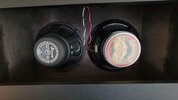

Counterfeit maybe?Pretty sad that a Mogami cable with Nuetrik connectors turns out to be a 16 ohm piece of trash...
Custom Cables 1/4" TRS to 1/4" TRS Cable Made from Mogami W2552 & Neutrik Connectors
Custom Built to Order Balanced TRS-TRS Cable Made from Mogami W2552 Superflexible Microphone Cable & Neutrik Connectorswww.performanceaudio.com